Quote now
EN

Automotive floor mats protect vehicle interiors from dirt, moisture, mud, road salt, and everyday wear. For manufacturers producing custom car mats and molded interior accessories, automotive floor mat forming provides a practical way to create products that follow the contours of a vehicle's floor while maintaining consistent shape, surface quality, and fit.
Junsai Group provides thermoforming machinery and automation solutions for plastic forming applications, helping manufacturers develop production processes suited to different materials, product dimensions, and output requirements. With appropriate vacuum forming equipment, mold design, heating control, and trimming operations, manufacturers can produce a wide range of automotive floor mats and related interior components.
From standard car floor mats to custom-shaped protective liners, the forming process can accommodate different product designs, textures, thicknesses, and edge profiles. Selecting the right machine configuration depends on the material being processed, the depth and geometry of the mat, production capacity, and the finishing requirements of the final product.
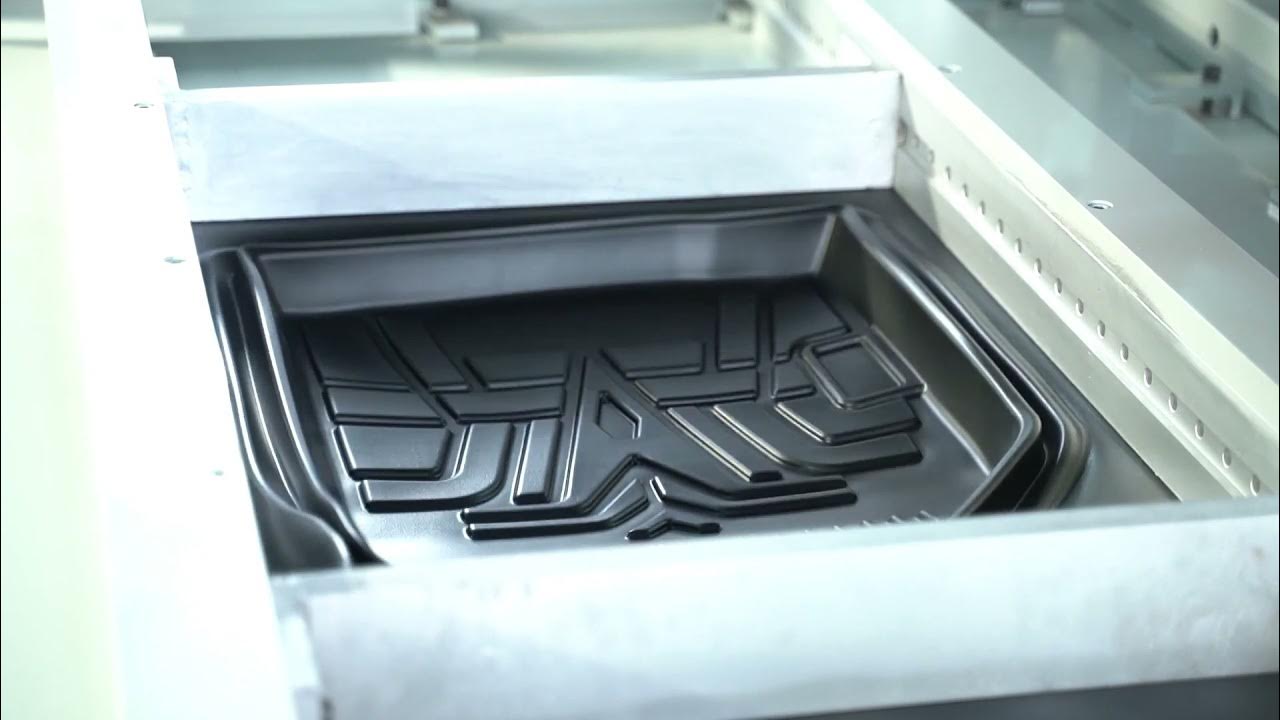
Automotive floor mat forming is a manufacturing process used to shape suitable plastic sheets or other formable materials into floor mats that match the contours of a vehicle's footwell or cargo area. The process commonly uses vacuum forming, pressure forming, or other suitable thermoforming techniques to create the required three-dimensional shape.
During vacuum forming, a thermoplastic sheet is heated until it becomes pliable and then positioned over a mold. A vacuum draws the sheet against the mold surface, allowing it to reproduce the required contours. After cooling, the formed part is removed from the mold, trimmed to its final dimensions, and inspected.
The finished products may include molded car floor mats, trunk liners, protective floor coverings, and other interior accessories. Depending on the product design, the manufacturing process can incorporate raised edges, channels, recessed areas, and surface textures that help manage dirt and moisture.
Automotive floor mat forming is particularly suitable for products that require a shaped surface rather than a simple flat sheet. The choice of forming method depends on the material, desired detail, dimensional tolerances, and expected production volume.
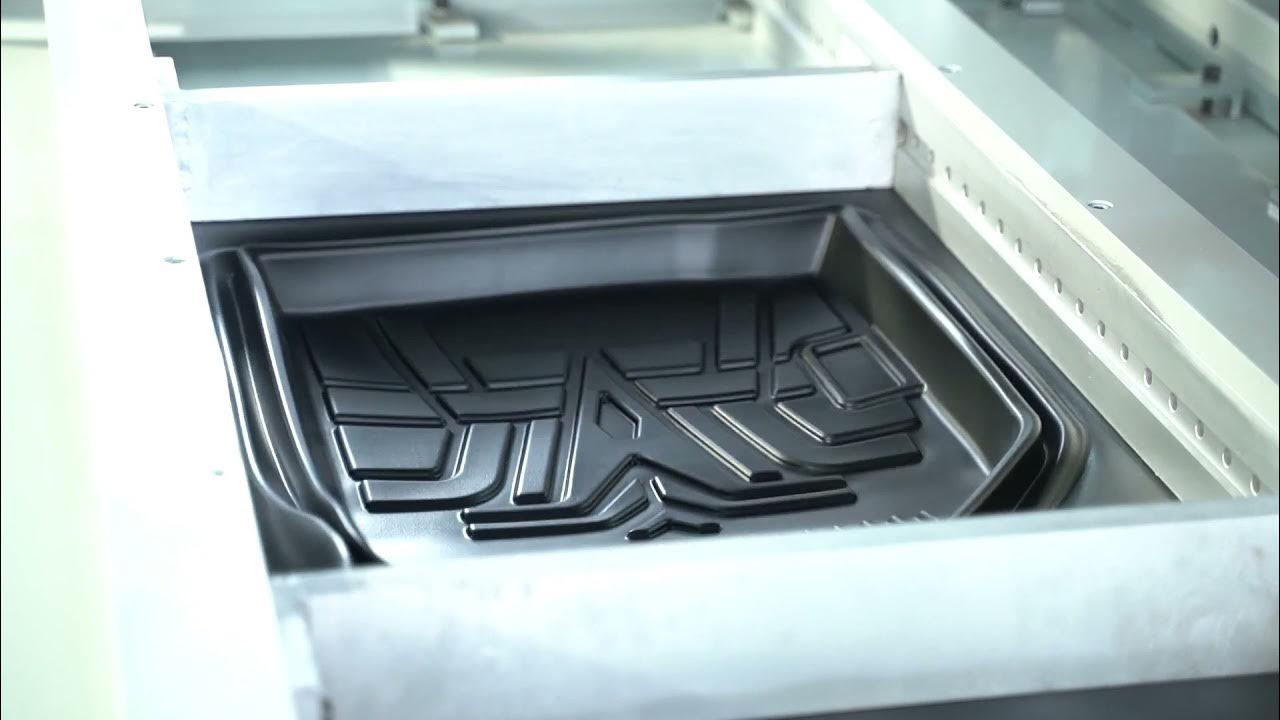
Vacuum forming is widely used for shaping thermoplastic sheets into large or contoured components. For automotive floor mats, the process must account for material behavior, mold geometry, heating uniformity, and the required finished thickness.
The process begins with selecting a material that meets the intended requirements for flexibility, wear resistance, moisture resistance, temperature performance, and surface appearance.
Depending on the product construction, suitable thermoplastics may include TPO, TPU, ABS, or other grades developed for the intended application. Some floor mats also use rubber, textile, foam, or multilayer constructions that may require different manufacturing methods or additional bonding operations.
The sheet dimensions and thickness must be suitable for the forming machine and mold. Material selection should also consider odor, cleanability, recyclability, and compatibility with automotive interior requirements.
The sheet enters the heating station, where controlled heat softens the material and prepares it for forming. Temperature distribution affects how evenly the sheet stretches across the mold.
Insufficient heating can result in incomplete forming, while excessive heating may cause sagging, surface defects, or undesirable thinning. A suitable heating system and repeatable process settings help maintain consistency across production batches.
Once the sheet reaches the required forming temperature, it is transferred to the forming station. The mold defines the shape of the car floor mat, including the footwell contours, raised edges, channels, and other design features.
Vacuum removes air between the sheet and mold surface, drawing the softened material into the required geometry. Mold design, vacuum performance, material temperature, and forming depth influence the level of detail that can be achieved.
For products with deeper contours or more demanding surface details, manufacturers may need to evaluate alternative tooling designs, pressure assistance, or other forming techniques.
The formed material must cool sufficiently to retain its shape after removal from the mold. Cooling conditions affect dimensional stability, shrinkage, and the risk of warping.
After cooling, the part is released from the mold and transferred to the trimming or finishing station. Appropriate mold design and process control can help simplify demolding and reduce damage to the formed edges.
The formed sheet normally includes excess material around the product perimeter. Trimming establishes the final outline and creates the edge profile required by the product design.
Manufacturers may use dedicated trimming tools, CNC routing, or other suitable cutting methods. Each finished mat should be checked for dimensional accuracy, surface defects, edge quality, and conformity to the intended vehicle-floor geometry.
For products designed for a specific vehicle model, fit testing is necessary to confirm that the mat sits correctly and does not interfere with pedals, seat movement, or other vehicle functions.
Automotive floor mat forming can support several product categories, depending on the material, mold design, and manufacturing process.
Molded car floor mats are shaped to fit the footwell and floor contours of a vehicle. They may include raised borders, textured surfaces, and channels designed to help contain dirt and liquids.
Vacuum forming can be suitable for certain rigid or semi-flexible plastic mat designs. For softer elastomeric products, compression molding, injection molding, or other material-specific processes may be more appropriate.
All-weather floor mats are designed to withstand exposure to moisture, mud, dust, and everyday outdoor debris. They commonly feature raised edges and molded channels to help contain contaminants.
The forming process must be matched to the selected material's flexibility, wear resistance, temperature performance, and cleaning requirements. A formed shape alone does not establish that a product is suitable for every weather condition.
Custom-fit car mats are designed for specific vehicle models or interior configurations. Their outlines and contours must accommodate the available floor space, seating arrangement, and factory retention points where applicable.
Manufacturers can use vehicle measurements, digital design data, prototype molds, and fit testing to develop a suitable product. Accurate trimming and dimensional control are particularly important when the mat is intended for a defined vehicle model.
The same forming principles can be applied to trunk liners and cargo-area protection mats. These products may require larger forming areas, deeper contours, reinforced sections, or surface features that help secure cargo and contain spills.
Machine selection should consider the maximum product dimensions, forming depth, material thickness, and required production output.
Vacuum forming offers several advantages for floor mat designs that are compatible with sheet-based thermoforming.
Manufacturers can develop different mat outlines, surface textures, raised borders, and molded channels through changes to the mold and product design. This flexibility can be useful for custom-fit car mats and product families designed for different vehicle interiors.
The achievable detail depends on the material, mold construction, sheet thickness, and forming conditions.
For certain large, relatively shallow components, vacuum forming tooling may be less expensive and simpler to manufacture than complex injection molding tooling.
Actual tooling cost depends on mold size, material, surface finish, dimensional requirements, and expected production volume. Tooling should be evaluated alongside cycle time, material use, trimming, and labor costs.
Controlled heating, vacuum performance, mold temperature, cooling, and trimming can improve repeatability between production cycles.
For automotive floor mats, consistent dimensions help maintain a predictable fit and appearance. Manufacturers should still validate each product design through dimensional inspection and vehicle-specific fit testing.
Vacuum forming can be configured for prototype development, small-batch manufacturing, and larger production programs, provided the equipment and process are appropriate for the product.
Automation can support sheet loading, forming, demolding, and transfer to downstream operations. The practical output rate depends on heating time, forming time, cooling time, trimming, and product changeovers.
Material utilization can be improved through careful sheet sizing, mold layout, part nesting, and trimming optimization. The amount of scrap depends on the product outline, forming depth, sheet dimensions, and production setup.
Manufacturers should assess scrap recovery and recycling options based on the material grade and applicable processing requirements.
Selecting equipment for automotive floor mat forming requires a clear understanding of the finished product and the intended manufacturing process.
The machine's forming area must accommodate the full product dimensions and the required mold arrangement. Large car floor mats and trunk liners may require a larger working area than small interior accessories.
The available forming depth and mold clearance should also match the product geometry.
Different materials require different heating ranges, forming conditions, and cooling strategies. Flexible materials may behave differently from rigid thermoplastic sheets, and some multilayer products require additional processing steps.
Before selecting a machine, manufacturers should confirm material compatibility, sheet thickness, heating requirements, and expected dimensional stability.
Uniform heating helps the material stretch consistently across the mold. Heating configuration should be suitable for the sheet size, material properties, and production cycle.
Repeatable temperature control can reduce variation caused by uneven forming and excessive material thinning.
The vacuum system must provide sufficient performance for the intended mold and material. Mold venting, surface details, forming depth, and part geometry affect the vacuum requirements.
Manufacturers should also consider mold installation, changeover time, maintenance access, and the availability of suitable tooling.
For larger production programs, automated material handling and downstream trimming can reduce manual work and improve workflow consistency.
When comparing machines, evaluate the complete production cycle rather than relying solely on a machine's stated forming speed. Actual capacity depends on the full sequence of heating, forming, cooling, demolding, trimming, and inspection.
Material selection influences the forming method, durability, comfort, surface appearance, and long-term performance of a car floor mat.
| Material category | Potential characteristics | Manufacturing considerations |
|---|---|---|
| TPO | Thermoplastic processing, flexibility, and suitability for selected automotive interior applications | Confirm grade-specific forming behavior, temperature resistance, and surface performance |
| TPU | Flexibility, abrasion resistance, and elastic behavior in suitable grades | Evaluate forming temperature, material cost, and dimensional stability |
| ABS | Rigidity, surface quality, and established thermoforming applications | May be suitable for rigid substrates or related interior components rather than every flexible mat design |
| Rubber and elastomers | Flexibility, grip, and wear resistance, depending on formulation | Often require material-specific molding or forming processes rather than conventional sheet vacuum forming |
| Multilayer plastic or textile constructions | Potential combinations of surface appearance, cushioning, and protective functions | May require lamination, bonding, or separate finishing operations |
Not every material listed is suitable for every floor mat design. The final choice should reflect the product's mechanical requirements, expected temperature range, exposure to moisture and cleaning agents, odor requirements, and manufacturing method.
For vehicle-specific products, manufacturers should also consider applicable customer specifications and interior material requirements.
A well-designed forming process must produce mats that fit correctly and perform consistently under normal use.
Dimensional accuracy: Check the outer profile, key reference points, raised edges, and retention features against the approved design.
Thickness distribution: Inspect areas that experience greater stretching during forming, especially deep contours and corners. Excessive thinning can reduce durability and cause premature wear.
Surface appearance: Examine the formed surface for wrinkles, bubbles, discoloration, scratches, and other defects that may affect appearance or usability.
Shape retention: Evaluate whether the mat maintains its intended geometry after cooling, storage, and exposure to the expected operating environment.
Fit and retention: Confirm that vehicle-specific mats fit the intended footwell and use the correct retention system. The mat must not interfere with accelerator, brake, or clutch pedal movement.
Material performance: Assess wear resistance, flexibility, temperature behavior, cleanability, and other properties relevant to the product specification.
Documented inspections, repeatable machine settings, and periodic production checks help manufacturers maintain consistent quality across batches.
Junsai Group provides thermoforming machinery and automation solutions for manufacturers developing formed plastic products. For automotive floor mat applications, equipment selection should begin with the material, finished product dimensions, mold design, and target output.
A suitable production configuration may include sheet heating, vacuum forming, cooling, demolding, and integration with downstream trimming equipment. The level of automation can be adapted to the production workflow and the manufacturer's operational requirements.
When evaluating a forming solution, manufacturers should provide the following information:
These details help establish whether vacuum forming or another manufacturing process is more appropriate and identify the equipment configuration needed for the application.
Whether you are developing custom car floor mats, molded protective liners, or large cargo-area coverings, Junsai Group can help assess the thermoforming equipment requirements for your project.
The best process depends on the mat material, design, flexibility, thickness, and production volume. Vacuum forming is suitable for many sheet-based plastic mats with molded contours. Rubber mats and certain soft elastomer products may require compression molding, injection molding, or other material-specific processes.
Yes. Vacuum forming can produce custom-shaped plastic floor mats when the material, mold, and forming conditions are suitable. Vehicle-specific dimensions and contours should be verified through prototype production and fit testing before mass production.
Suitable materials depend on the intended product. Certain TPO, TPU, ABS, and other thermoplastic grades may be used in relevant applications. Rubber and other elastomers often require different processing methods. Material compatibility should be confirmed with the equipment supplier and material manufacturer.
They can be suitable when the selected material and product design meet the required temperature, moisture, wear, and cleaning performance specifications. Raised edges and molded channels can help contain dirt and liquids, but all-weather performance must be verified through appropriate product testing.
Vacuum forming shapes a heated plastic sheet over a mold using vacuum pressure. Injection molding fills a mold with molten plastic. Vacuum forming may offer tooling advantages for certain large sheet-based products, while injection molding can be better suited to complex shapes, integrated features, and specific high-volume applications. The appropriate process depends on the mat design and material.
Manufacturers can improve quality through uniform sheet heating, suitable mold design, consistent vacuum performance, controlled cooling, accurate trimming, and regular dimensional inspection. Fit testing is also necessary for vehicle-specific mats to confirm that the finished product matches the intended floor contours.
A machine may support multiple product designs when the forming area, heating system, mold arrangement, material compatibility, and changeover requirements permit. Different mats may require separate molds and adjustments to process settings. The equipment's actual flexibility should be confirmed against the intended product range.
Production capacity depends on sheet heating time, forming time, cooling requirements, demolding, trimming, material handling, and mold changeovers. Product dimensions, material thickness, forming depth, and automation level also affect output. A production trial provides a more reliable estimate than the forming cycle alone.
The price depends on the forming area, heating system, vacuum capacity, automation level, tooling, trimming integration, and required production output. Manufacturers should compare the complete equipment configuration and expected operating costs rather than evaluating the purchase price alone.
Provide the product drawing or sample, material specification, sheet thickness, maximum dimensions, forming depth, target output, quality requirements, and automation expectations. This information helps determine the suitable forming method, machine size, tooling configuration, and downstream equipment.
Producing consistent automotive floor mats starts with the right combination of material, mold design, forming technology, and finishing operations. Vacuum forming offers a practical manufacturing option for suitable plastic mats that require custom contours, molded edges, and repeatable dimensions.
Junsai Group supports manufacturers evaluating thermoforming machinery and automation for automotive interior products and other plastic components.
Contact Junsai Group to discuss your automotive floor mat forming requirements, share your product specifications, and identify an equipment configuration suited to your production needs.