Quote now
EN

Heavy gauge thermoforming and thin gauge thermoforming differ mainly in thermoplastic sheet thickness, part size, structural requirements, production methods, and equipment configuration. Thin gauge thermoforming is commonly used for lightweight packaging, disposable trays, food containers, and high-volume consumer products. Heavy gauge thermoforming, also called thick gauge thermoforming, is suited to larger, more rigid, durable components such as medical equipment housings, industrial covers, machine enclosures, vehicle interior panels, and protective equipment shells.
The best process depends on the required part geometry, material selection, impact resistance, dimensional tolerances, production volume, tooling budget, and delivery schedule. Thin gauge production often uses roll-fed systems for continuous, high-speed manufacturing, while heavy gauge production typically processes individual thermoplastic sheets using sheet-loading, heating, forming, cooling, and CNC trimming operations.
Thermoforming is a plastic manufacturing process in which a thermoplastic sheet is heated until it becomes pliable, formed over or into a mold using vacuum, pressure, or mechanical assistance, and cooled to retain the desired shape. The formed component is then trimmed and finished as required.
The main distinction between heavy gauge and thin gauge thermoforming is the starting sheet thickness and the intended application. Industry terminology is not completely standardized, so thickness ranges may vary between manufacturers and sectors.
Both processes can produce complex three-dimensional parts, but their tooling, heating requirements, material handling, forming cycles, and finishing operations differ.
| Comparison factor | Heavy gauge thermoforming | Thin gauge thermoforming |
|---|---|---|
| Starting material | Thick thermoplastic sheet | Thin thermoplastic sheet or film |
| Typical thickness | Often around 3–12 mm or more, depending on the application | Often around 0.15–1.5 mm, depending on the product |
| Material supply | Individual sheets or cut blanks | Frequently roll-fed material |
| Typical products | Machine covers, equipment housings, vehicle panels, durable enclosures | Packaging trays, food containers, lids, disposable products |
| Production volume | Low to medium volumes are common; larger runs are also possible | Medium to very high volumes are common |
| Equipment | Heavy-duty sheet handling, heating, forming, and trimming systems | High-speed roll-fed or sheet-fed forming and cutting lines |
| Trimming | CNC trimming, routing, sawing, or other secondary operations | Inline cutting, punching, die cutting, or automated trimming |
| Tooling approach | Often suitable for lower-volume projects and large parts with relatively economical tooling | Often optimized for repeatable, high-speed production |
| Part characteristics | Larger structures, thicker walls, and greater material mass | Lightweight parts with relatively thin walls |
| Cost considerations | Tooling and setup can be economical for lower volumes, but material and machining costs may be higher per part | Low material usage per part and high throughput can reduce unit costs at scale |
The thickness ranges above are illustrative rather than universal specifications. Actual classifications depend on the machine, material, product dimensions, and manufacturing requirements.
Heavy gauge thermoforming is used to manufacture durable plastic components that need to maintain their shape under normal operating loads, resist handling damage, or cover large equipment assemblies. It is particularly useful when a product requires a large, contoured surface without the expense of a complex injection molding tool.
Material selection affects forming behavior, part weight, surface finish, chemical resistance, operating temperature, and long-term durability. The most appropriate thermoplastic depends on the environment in which the finished part will be used.
| Material | Main characteristics | Typical applications |
|---|---|---|
| ABS | Good impact resistance, rigidity, and surface finish | Equipment housings, machine covers, vehicle interior components |
| HIPS | Easy to form, economical, and suitable for many general-purpose applications | Enclosures, panels, protective covers |
| HDPE | Chemical resistance, toughness, and moisture resistance | Industrial liners, tanks, protective components |
| PP | Low density, chemical resistance, and good fatigue performance in suitable designs | Industrial covers, storage components, selected automotive parts |
| PETG | Good clarity, formability, and impact performance for appropriate grades | Transparent guards, display housings, equipment covers |
| PC | High impact resistance and, in suitable grades, optical clarity | Protective guards, transparent equipment covers |
| PMMA | High optical clarity and weatherability, with lower impact resistance than PC | Display panels, transparent covers, exterior-facing components |
These materials are not interchangeable in every application. For example, a transparent machine guard may require a different material specification from an opaque industrial enclosure exposed to chemicals or outdoor weather.
Designers should also check the selected grade's forming temperature, allowable operating temperature, UV resistance, flammability rating, chemical compatibility, and relevant industry requirements.
Heavy gauge thermoforming is frequently selected for products with relatively large dimensions, complex contours, or lower-to-medium production requirements.
Medical equipment
Medical equipment manufacturers use thermoformed plastics for equipment housings, instrument enclosures, diagnostic equipment covers, carts, and selected protective panels. The process can accommodate curved surfaces, integrated mounting features, and custom exterior designs.
Material selection must reflect the intended medical application. Requirements may include cleaning-agent resistance, durability, biocompatibility, or compliance with applicable medical device standards. A thermoformed housing should not automatically be considered suitable for direct patient contact or sterilization without grade-specific validation.
Industrial equipment and machinery
Heavy gauge plastic can be formed into machine guards, control panel housings, equipment covers, protective shells, and industrial enclosures. Compared with fabricated assemblies made from multiple smaller pieces, a thermoformed component may reduce the number of joints and simplify exterior design.
Automotive and transportation
Applications include interior panels, luggage compartment liners, seat backs, wheel-arch liners, and other large trim components. The choice between ABS, PP, PC blends, and other thermoplastics depends on impact requirements, weight targets, appearance, temperature exposure, and applicable vehicle specifications.
Agricultural and construction equipment
Large protective covers, dashboard housings, access panels, fenders, and formed interior components can be manufactured using heavy gauge thermoforming. The process is especially useful when product designs require large surfaces and frequent customization.
Retail, recreational, and consumer products
Large display housings, equipment shells, recreational vehicle components, protective enclosures, and custom product covers are additional applications. Thermoforming can support relatively rapid design changes without requiring the same tooling investment as some alternative processes.
The main advantages include:
There are also limitations. Heating thicker sheets requires careful temperature control, and large parts may need longer heating and cooling cycles. Material distribution can vary across deep draws and corners, while trimming, drilling, and finishing may add labor and machining costs.
A thicker starting sheet does not guarantee uniform wall thickness throughout the finished component. Designers must account for material stretching during forming, especially around corners, recesses, and deep-draw areas.
Thin gauge thermoforming is designed for lightweight products made from relatively thin thermoplastic sheets or films. Many applications involve continuous production, where high throughput and consistent dimensions help manufacturers control cost per part.
| Material | Main characteristics | Typical applications |
|---|---|---|
| PET and APET | Clarity, stiffness, and suitability for many packaging applications | Clear trays, lids, display packaging |
| rPET | Recycled-content PET, subject to grade and application requirements | Trays, clamshell packaging, selected food packaging |
| HIPS | Good formability and economical processing | Food trays, consumer product packaging |
| PP | Heat resistance for suitable grades, low density, and chemical resistance | Food containers, lids, reusable or disposable packaging |
| PVC | Formability and clarity in selected applications, subject to regulatory restrictions | Blister packaging and selected protective packaging |
| PLA | Bio-based polymer with application-dependent heat resistance and processing requirements | Selected disposable packaging and trays |
The suitability of each material depends on the required stiffness, transparency, forming depth, sealing method, temperature exposure, and end-use regulations. Food-contact applications, for example, require confirmation that the exact material grade and manufacturing process meet the applicable regulatory requirements.
Food packaging
Thin gauge thermoforming produces food trays, bakery containers, produce packaging, lids, and other packaging formats. Material thickness, sealing performance, clarity, stacking behavior, and resistance to handling damage all influence product design.
Medical and pharmaceutical packaging
Applications include selected diagnostic trays, device packaging inserts, instrument trays, and protective packaging. Depending on the product, requirements may include clean manufacturing conditions, dimensional consistency, barrier performance, and compatibility with the chosen sterilization method.
Packaging intended for sterile medical devices requires a validated packaging system. Thermoforming alone does not establish sterility or guarantee that a package maintains a sterile barrier.
Consumer electronics and retail packaging
Blister packs, clamshells, internal packaging inserts, and protective trays can hold products securely while making them visible to customers. Thin gauge forming can be integrated with automated loading, sealing, cutting, and packaging operations.
Industrial and logistics packaging
Manufacturers use thermoformed trays to organize components, protect delicate products, and support automated assembly or material handling. Custom cavities can keep parts separated and positioned consistently during transport.
Thin gauge production offers several advantages:
Its limitations include reduced structural rigidity in many designs, sensitivity to local thinning during deep draws, and potential deformation under loads or elevated temperatures. Thin gauge components may require ribs, formed edges, reinforced geometry, or carefully designed packaging to achieve the required stiffness.
The lowest possible sheet thickness is not always the most economical choice. If a part deforms easily, fails during handling, or requires additional reinforcement, the resulting scrap and quality costs can outweigh the initial material savings.
Material selection should begin with the finished part's requirements rather than with the forming process alone. A suitable material must satisfy the functional, environmental, regulatory, and commercial needs of the product.
Impact resistance matters for machine covers, medical equipment housings, transport packaging, and parts exposed to repeated handling. ABS and PC may be appropriate for certain impact-resistant applications, while HDPE and PP may be better suited to applications involving chemical exposure or moisture.
However, performance depends on the exact resin grade, additives, sheet manufacturing process, temperature, part geometry, and formed wall thickness. Designers should evaluate the finished component rather than relying solely on the properties listed for an unformed sheet.
The thickness of the plastic affects stiffness, material consumption, heating time, forming behavior, and finished-part weight.
Heavy gauge parts generally begin with thicker sheets, but the final wall thickness can vary substantially across the component. Deep cavities, sharp corners, and complex shapes may cause localized thinning. Thin gauge products face similar challenges, although their smaller starting thickness can make material distribution especially important for packaging strength and dimensional stability.
When specifying sheet thicknesses, manufacturers should define:
These details help prevent disagreements between the part designer, material supplier, and thermoforming manufacturer.
Parts exposed to cleaning agents, oils, solvents, disinfectants, outdoor weather, or elevated temperatures need appropriate material grades. Chemical compatibility should be checked under actual exposure conditions, including concentration, contact time, temperature, and mechanical stress.
For medical equipment, cleaning and disinfection requirements should be defined early in development. For outdoor applications, UV stabilization and weathering performance may also affect the selection.
PETG, PC, and PMMA can be considered for transparent or visually demanding components, but each offers different optical, impact, scratch, and weathering properties. Opaque materials such as ABS, HIPS, and PP may be more suitable for colored housings or concealed structural components.
Surface texture, gloss, color consistency, and cosmetic defects should be evaluated using samples produced with the intended material and forming conditions.
Recycled thermoplastic sheets can help reduce reliance on virgin material when the selected grade meets product performance and regulatory requirements. Manufacturers should consider recycled content, material traceability, contamination risks, color variation, and the availability of a consistent supply.
Product designers can also reduce material consumption by optimizing geometry, limiting unnecessary thickness, improving nesting, and designing parts for easier separation or recycling at the end of their service life.
Although both processes rely on heating and forming thermoplastic sheets, their equipment is configured around different material handling requirements, production speeds, and part sizes.
Heavy gauge thermoforming machines are designed to handle thicker sheets and often larger formed components. Depending on the machine configuration, a production line may include:
Heating thicker plastic evenly can take longer than heating thin sheet material. The machine therefore needs sufficient heating capacity, appropriate temperature control, and a forming arrangement suited to the sheet dimensions and part geometry.
Large parts may also require more elaborate handling systems to prevent sheet sagging, uneven heating, or distortion during transfer.
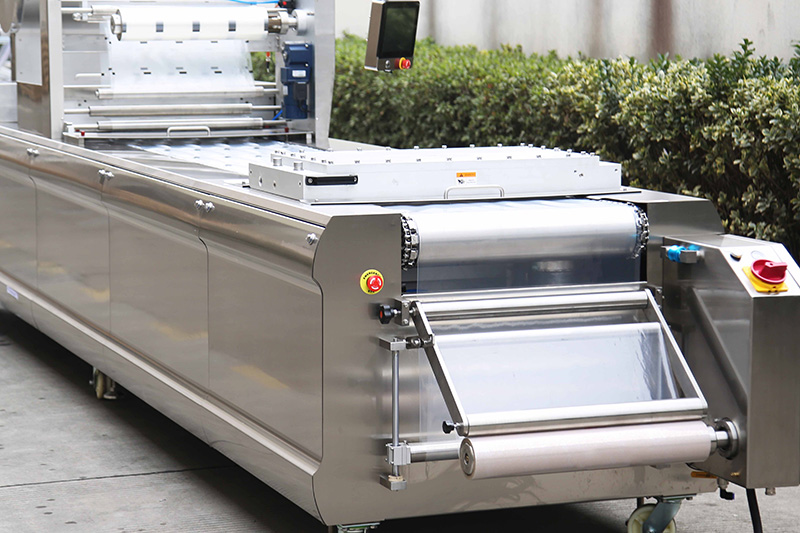
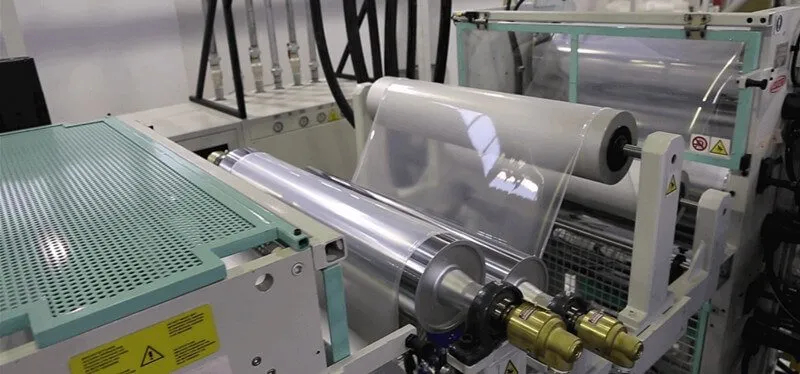
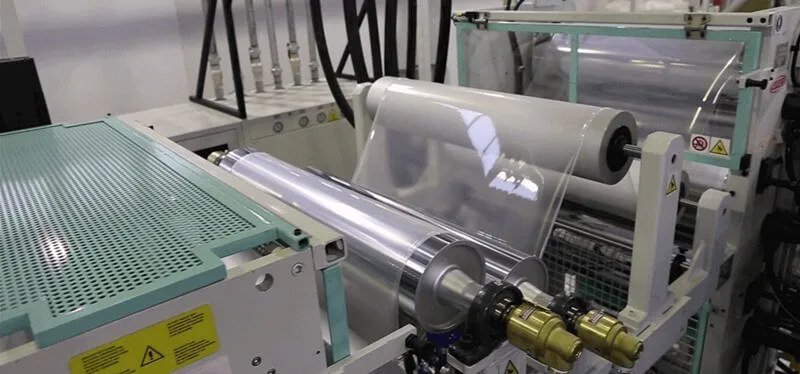
Thin gauge thermoforming equipment commonly supports continuous or semi-continuous production. A typical roll-fed system may contain:
Roll-fed equipment can reduce manual material handling and support high production rates. However, output depends on the part footprint, mold layout, forming depth, heating and cooling requirements, cutting cycle, and downstream packaging speed.
Some thin gauge products are manufactured from pre-cut sheets rather than rolls. Therefore, roll-fed production is common but not mandatory for every thin gauge application.
CNC trimming is frequently used for heavy gauge thermoformed parts because large components may require precise openings, mounting holes, edges, and complex perimeter profiles. A CNC router can follow a programmed toolpath to produce consistent features across repeated production runs.
Thin gauge parts are often cut inline with dies, punches, or integrated cutting systems. CNC trimming can still be useful for prototypes, specialty products, and applications requiring complex contours or lower production volumes.
The best trimming method depends on material thickness, dimensional tolerances, edge quality, part geometry, production quantity, and tooling costs. Designers should account for trimming allowances in the original mold and part design.
Thermoforming tooling can be made from materials such as aluminum, composite materials, or other suitable tooling substrates. The appropriate choice depends on expected production volume, thermal behavior, surface finish, cooling requirements, and the forming method.
For heavy gauge parts, mold design must accommodate larger surfaces, deeper features, sheet draw behavior, and the need for consistent wall distribution. For thin gauge products, tooling often focuses on cycle efficiency, cavity layout, material utilization, and integration with cutting and stacking systems.
Pressure forming may be appropriate when a product requires greater detail or a more defined surface finish than a basic vacuum-formed part can deliver. The added equipment and tooling requirements should be weighed against the required appearance and functionality.
The production process affects part quality, cycle time, scrap rate, and manufacturing cost. While the specific sequence varies by machine and product, both heavy gauge and thin gauge thermoforming follow the same basic principle: heat the sheet, form it, cool it, and finish the component.
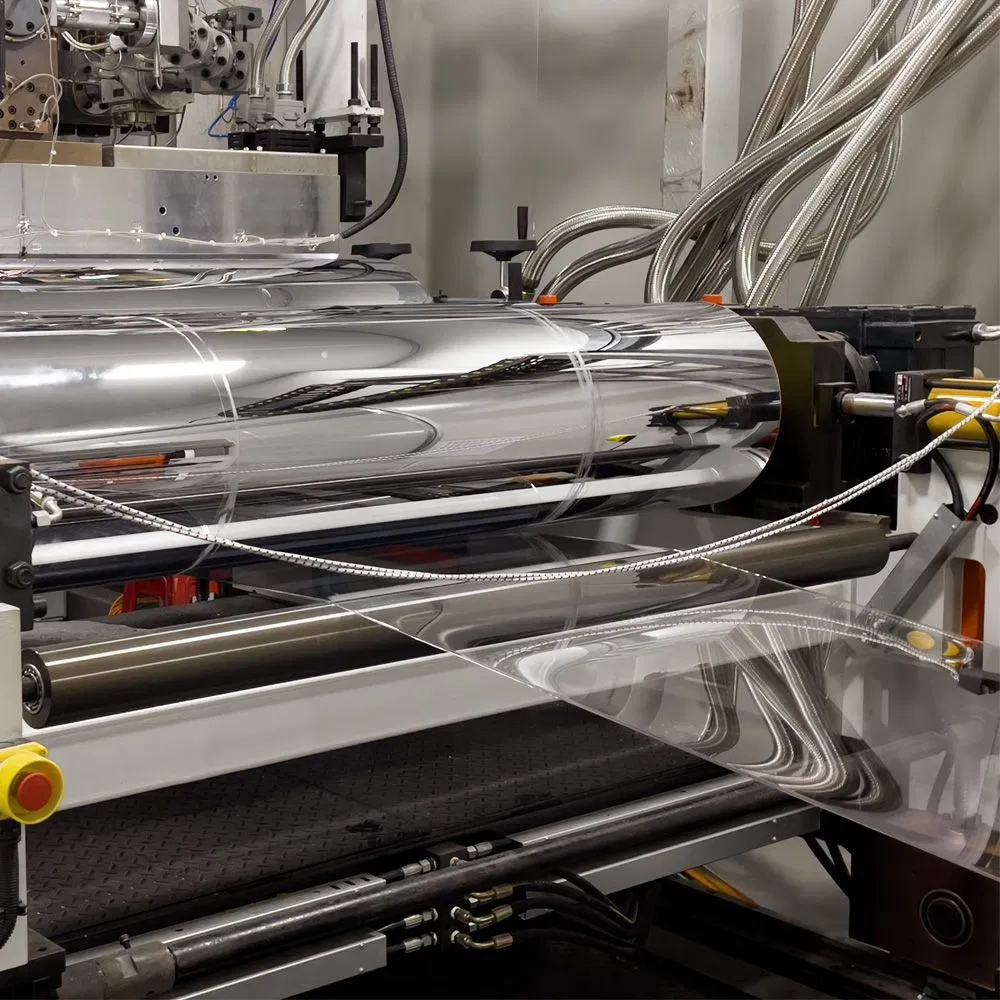
The manufacturer selects a thermoplastic sheet that meets the specified material grade, thickness, color, and surface requirements. Material may arrive as individual sheets, cut blanks, or rolls.
For heavy gauge thermoforming, sheets must be positioned accurately and handled safely because their weight and dimensions can make loading more demanding. For thin gauge production, roll alignment and web tension are important for maintaining consistent feeding and minimizing material waste.
The sheet is heated until it reaches a suitable forming temperature. The correct temperature range depends on the polymer, sheet thickness, heating method, and required part geometry.
Uneven heating can lead to inconsistent material distribution, surface defects, excessive sagging, or incomplete forming. Heavy gauge materials generally need more time and energy to heat through their thickness, while thin gauge sheets can heat more quickly but may be more sensitive to overheating or temperature variation.
Manufacturers should establish material-specific heating parameters rather than applying the same settings to different thermoplastics.
Once the sheet reaches the appropriate forming condition, the machine shapes it over or into the mold.
Vacuum forming uses a pressure difference to draw the heated sheet against the mold. Pressure forming applies additional air pressure to improve contact with the mold surface. Some applications use mechanical assistance or matched tooling to control material movement and improve dimensional consistency.
The selected method depends on part geometry, required detail, material behavior, and production objectives.
The formed component must cool sufficiently to retain its shape after removal from the mold. Cooling conditions influence dimensional accuracy, residual stress, warpage, and cycle time.
Thick sections generally require more cooling time because heat must dissipate from a greater mass of material. Cooling channels, mold temperature control, and appropriate part-release timing can improve consistency.
After forming, excess material is removed. Heavy gauge components may undergo CNC trimming, drilling, routing, edge finishing, or additional machining. Thin gauge products are often cut or punched inline, followed by stacking and counting.
Depending on the product, further operations may include inserts, fastening features, bonding, printing, surface finishing, or assembly.
Finished parts should be inspected against the agreed specifications. Inspection may cover dimensions, wall thickness, surface appearance, color, warpage, fit, and functional performance.
Where relevant, manufacturers can use dimensional fixtures, coordinate measurement systems, thickness measurement methods, and application-specific mechanical tests. A documented inspection plan helps maintain consistency between production batches.
Neither heavy gauge nor thin gauge thermoforming is automatically cheaper. Cost effectiveness depends on the relationship between tooling investment, material consumption, machine utilization, finishing requirements, scrap, and production volume.
Heavy gauge thermoforming is often attractive for large parts produced in low-to-medium quantities because the tooling investment can be lower than that required for injection molding. This can be especially beneficial during product development, customization, and early production.
Thin gauge thermoforming can deliver competitive unit costs in high-volume applications because automated roll feeding, multi-cavity molds, inline cutting, and stacking can reduce labor and processing time per part.
However, the distinction is not absolute. Heavy gauge thermoforming can support high-volume production when equipment and tooling are designed for it, while thin gauge thermoforming can be practical for smaller runs when the setup and tooling are appropriate.
Material is often a major cost component. Heavy gauge parts use more material per component, although their larger size and structural requirements may justify that consumption.
Thin gauge parts generally use less material per unit, but the actual material cost depends on the sheet grade, thickness, part dimensions, nesting efficiency, and scrap recovery. For roll-fed production, efficient layout and control of web width can improve material utilization.
Manufacturers should evaluate material cost per acceptable finished part rather than comparing raw sheet prices alone.
Heavy gauge components may require more manual handling, longer heating and cooling cycles, and additional CNC machining. Thin gauge lines can reduce labor through automation but may require substantial investment in integrated production and packaging equipment.
Energy costs depend on heating technology, cycle time, material thickness, machine efficiency, and production scheduling. Finishing costs depend on the number and complexity of cutouts, holes, edges, and assembly operations.
Injection molding is widely used for high-volume plastic parts that require repeatable dimensions, complex molded features, and efficient cycle times after tooling has been developed. It may be less economical for large, relatively simple components when the initial mold investment is high and production volume is limited.
Thermoforming can reduce initial tooling costs and accommodate large surface areas, but it may require additional trimming and finishing. Injection molding can also produce more complex integrated features, such as molded ribs, bosses, and snap-fits, without the same secondary machining requirements.
| Cost factor | Thermoforming | Injection molding |
|---|---|---|
| Initial tooling | Often lower for suitable parts | Often higher, especially for complex molds |
| Large components | Frequently attractive | Can require substantial tooling and machine capacity |
| High-volume production | Competitive with appropriate automation | Often highly competitive |
| Complex integrated features | May require design compromises or secondary operations | Often well suited to intricate molded details |
| Material distribution | Sheet stretches during forming | Melt fills the mold cavity |
| Secondary finishing | Trimming is commonly required | Often limited, depending on gate and part design |
| Product design changes | May be less expensive for suitable tooling revisions | Mold modifications can be costly |
| Best-fit applications | Large housings, panels, trays, and formed shells | High-volume components with detailed molded features |
A reliable comparison should use the same part specifications, annual demand, quality standards, and expected product life. Comparing tooling cost alone can produce a misleading result.
Consider a large equipment cover required in several thousand units per year. Heavy gauge thermoforming may offer a favorable balance of tooling investment, part size, and production flexibility. If the design later becomes a standardized component required in very large quantities, the manufacturer can reassess whether injection molding or another process offers a better long-term cost structure.
For a small packaging tray required in hundreds of thousands of units, thin gauge thermoforming may be more appropriate because roll-fed processing and automated cutting can support high output with relatively low material consumption per tray.
The final decision should be based on total cost of ownership, including tooling, material, machine time, labor, scrap, finishing, quality control, packaging, and logistics.
Lead times depend on material availability, tooling complexity, machine availability, part dimensions, validation requirements, and the number of production operations.
Heavy gauge thermoforming may offer relatively short development lead times for large, straightforward components because suitable tooling can sometimes be produced faster and at lower cost than an injection mold. However, complex geometry, large molds, CNC programming, and dimensional validation can extend the schedule.
Thin gauge production may require time for roll-fed line setup, multi-cavity tooling, cutting systems, material trials, and automated packaging integration. Once the process is stable, high-speed production can support substantial output.
A typical project schedule includes:
These stages are not fixed-duration milestones. Their timing varies by project, and some activities can run in parallel.
To reduce lead times, customers should provide accurate drawings, three-dimensional CAD files, material requirements, annual demand estimates, critical dimensions, appearance standards, and expected delivery quantities at the beginning of the project.
Selecting a process starts with the finished product and works backward to the material, tooling, and equipment.
Heavy gauge thermoforming is often a suitable option when the product requires a large exterior surface, a relatively thick starting sheet, impact resistance appropriate to the application, or a custom shape that would be expensive to produce using another method.
It is worth evaluating for medical equipment housings, industrial machinery covers, automotive interior components, protective enclosures, and large custom plastic parts.
Thin gauge thermoforming is often a better fit when the product is lightweight, requires relatively thin walls, and will be manufactured at medium or high volumes. Packaging products that benefit from rapid forming, inline cutting, and automated stacking are common examples.
Typical applications include food trays, pharmaceutical packaging inserts, consumer product packaging, and industrial component trays.
Thermoforming is not the best solution for every plastic component. Injection molding may be preferable for small, intricate parts with integrated ribs, bosses, or snap-fit features, particularly when annual volumes justify the mold investment.
Plastic fabrication, machining, rotational molding, or blow molding may be appropriate for other geometries or functional requirements. A manufacturing review should compare the complete part design, tooling requirements, material properties, and expected production volume before committing to a process.
A well-designed part is easier to form, trim, inspect, and assemble. Early collaboration between the product designer and thermoforming manufacturer can prevent problems that would otherwise appear during production.
Draft angles help the formed part release from the mold. The required angle depends on mold depth, surface texture, material behavior, and the selected forming method. Deep vertical walls and textured surfaces may need additional draft.
Rounded corners and gradual transitions generally allow material to distribute more evenly than sharp corners. Deep-draw features should be evaluated carefully because the sheet stretches as it conforms to the mold.
The manufacturer should assess likely thinning areas and determine whether the design needs larger radii, adjusted draw depth, material pre-stretching, plug assistance, or a thicker starting sheet.
Heavy gauge parts may need flanges, formed returns, ribs, or separate reinforcement to improve stiffness. The most suitable approach depends on loading conditions and assembly requirements.
Because thermoforming does not create all the integrated structural features available in injection molding, designers may need to add brackets, inserts, or separate components where concentrated loads occur.
Thermoformed parts can shrink or change shape as they cool. Material type, wall thickness, mold temperature, part geometry, and trimming conditions all affect final dimensions.
Critical dimensions should be identified early, and tolerances should reflect both functional requirements and realistic manufacturing capability. Unnecessarily tight tolerances can increase inspection, machining, and rejection costs.
Prototype parts help verify appearance, fit, assembly, and basic functionality before production tooling is finalized. Where the final part will experience impact, repeated handling, chemical exposure, temperature changes, or regulatory scrutiny, additional validation may be necessary.
Testing should use representative materials and manufacturing conditions whenever possible. A prototype made from a different polymer or a substantially different process may not accurately predict the final product's performance.
Quality control should address both the raw material and the finished thermoformed parts. A stable production process depends on consistent sheet properties, controlled heating conditions, appropriate mold temperatures, and repeatable trimming operations.
Common quality checks include:
Acceptance criteria should be established before mass production. For safety-related components, medical products, or regulated packaging, the inspection and validation plan must also address applicable industry standards and customer requirements.
The primary difference is the starting thermoplastic sheet thickness and the type of product being manufactured. Heavy gauge thermoforming typically produces larger, more substantial components such as equipment housings and machine covers. Thin gauge thermoforming is commonly used for lightweight packaging, trays, and disposable products manufactured at higher production rates.
Heavy gauge thermoforming often begins around 3 mm, although some manufacturers use different thresholds. Sheets of 3–12 mm or more are common in many heavy gauge applications. The classification depends on the industry, equipment capability, material, and product requirements rather than a universal thickness standard.
Thin gauge thermoforming frequently uses sheets around 0.15–1.5 mm thick. The actual range varies according to the polymer, product design, forming equipment, and required performance. Packaging applications may use thinner or thicker sheets depending on their intended function.
ABS, HIPS, HDPE, PP, PETG, PC, and PMMA are among the materials used in heavy gauge thermoforming. ABS is often selected for rigid housings, HDPE for chemical-resistant applications, PC for suitable impact-resistant transparent components, and PMMA for applications requiring high optical clarity. The final selection should be based on the specific material grade and operating environment.
Yes. Heavy gauge thermoforming can produce medical equipment housings, diagnostic equipment covers, instrument enclosures, and other selected components. Material selection must account for cleaning, disinfection, chemical exposure, mechanical performance, and any applicable regulatory requirements. The manufacturing process alone does not establish medical-grade suitability.
Thermoforming can be more economical for large parts, customized products, and lower-volume projects because initial tooling costs are often lower. Injection molding may offer a lower unit cost for high-volume production of complex parts with integrated features. The better option depends on tooling, material usage, production volume, finishing requirements, and product design.
Yes. Heavy gauge thermoforming can support high production volumes when machine capacity, mold design, automation, cooling, and trimming operations are configured appropriately. Its production rate is generally influenced by heating and cooling requirements, part dimensions, and the complexity of secondary operations.
Roll-fed thermoforming feeds continuous thermoplastic material from a roll into the production line. It is commonly used for thin gauge packaging because it supports automated feeding, forming, cutting, and stacking.
Sheet-fed thermoforming processes individual sheets or blanks. It is common in heavy gauge applications because thicker sheets are generally supplied and handled individually. The most suitable feeding method depends on material thickness, product dimensions, equipment design, and production volume.
CNC trimming removes excess plastic and creates precise edges, openings, holes, and mounting features. It is particularly useful for large components with complex contours or tight dimensional requirements. Although CNC trimming adds a secondary manufacturing step, it can improve repeatability and reduce the need for manual finishing.
Greater sheet thickness generally increases material consumption, part weight, heating energy, and cooling time. It can also improve stiffness or durability when the material and geometry are suitable. However, excessive thickness may increase costs without providing a meaningful performance benefit. The optimal thickness balances mechanical requirements, formability, manufacturing efficiency, and material cost.
Heavy gauge thermoforming can offer shorter tooling lead times for certain large, relatively simple parts, particularly when compared with complex injection molding projects. Thin gauge thermoforming can also achieve rapid production once roll-fed tooling and automated equipment are ready. Actual lead times depend on design complexity, tooling availability, material supply, testing, and production scheduling.
Yes. Recycled-content PET and other suitable recycled thermoplastics can be used in selected thermoforming applications. The material must meet the required forming, mechanical, appearance, and regulatory specifications. Recycled content may affect color consistency, processing behavior, and material properties, so grade selection and quality verification are necessary.
Manufacturers can improve quality through appropriate material selection, uniform sheet heating, optimized mold design, controlled cooling, suitable forming parameters, and accurate trimming. Monitoring formed wall thickness, inspecting critical dimensions, and validating the process under representative production conditions also help reduce defects and scrap.
A useful quotation package includes the part drawing or 3D CAD file, required material, starting sheet thickness, overall dimensions, expected annual volume, target order quantity, surface finish, color, dimensional tolerances, and any relevant performance or regulatory requirements. The manufacturer can then evaluate tooling, equipment, production methods, finishing operations, and estimated lead times.
Heavy gauge and thin gauge thermoforming serve different manufacturing needs, and the best choice depends on the finished product rather than sheet thickness alone.
Heavy gauge thermoforming is well suited to large plastic housings, industrial covers, medical equipment enclosures, and durable components that benefit from thicker starting sheets and flexible tooling options. Thin gauge thermoforming is commonly used for lightweight packaging, trays, and other products that require efficient material usage and high production throughput.
For manufacturers comparing thermoforming processes, the decision should consider material selection, impact resistance, part geometry, equipment configuration, CNC trimming, tooling costs, production volume, and lead times. Injection molding should also be evaluated when complex integrated features or very high production volumes justify the tooling investment.
A detailed review of the part design, material specifications, production forecast, and quality requirements can help establish the most cost-effective manufacturing route. Working with an experienced thermoforming manufacturer early in product development can also identify potential forming challenges, improve material utilization, and reduce unnecessary tooling or finishing costs.