Quote now
EN

Positive and negative pressure forming are two methods used to shape heated thermoplastic sheets in thermoforming. The main difference is how pressure is applied to bring the plastic into contact with a mold. Negative pressure forming, commonly known as vacuum forming, removes air from between the sheet and the mold so atmospheric pressure pushes the material against the mold surface. Positive pressure forming uses compressed air to push the heated sheet against the mold, often with vacuum assistance to remove trapped air.
Understanding the difference between these forming processes helps manufacturers choose suitable equipment, control tooling costs, achieve the required level of detail, and manage production lead times. The right process depends on product geometry, material properties, surface requirements, production volume, and the cost of producing acceptable parts.
Negative pressure forming uses vacuum to draw a heated plastic sheet against a mold. It is often suitable for large covers, trays, liners, packaging, and products with relatively simple geometry.
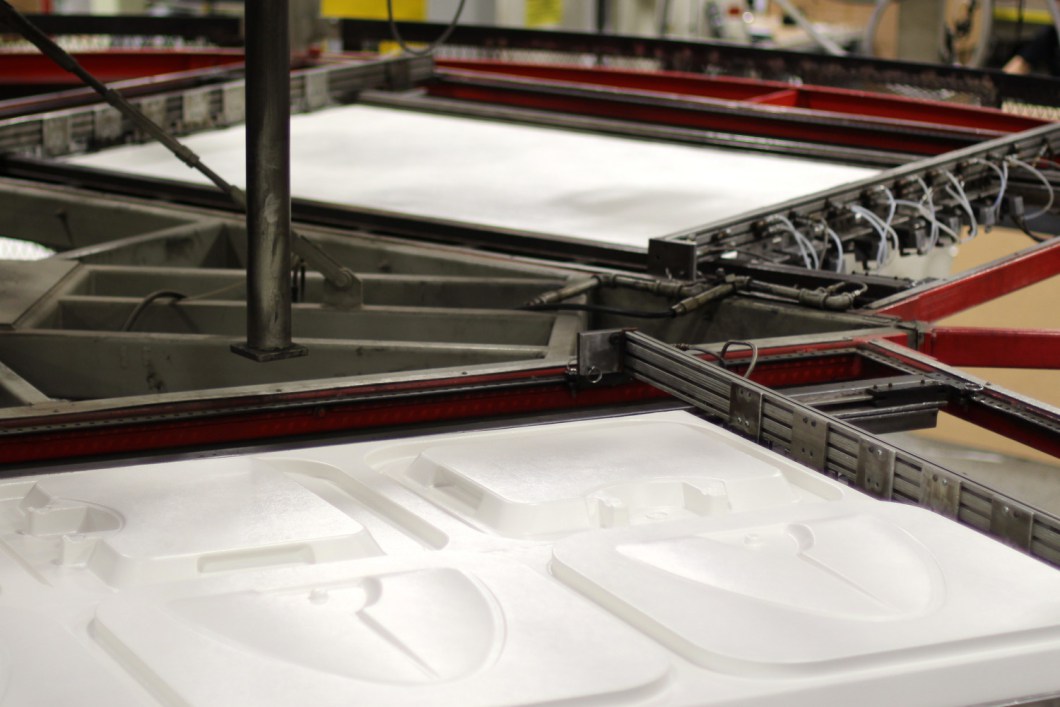
Positive pressure forming uses compressed air to push a heated plastic sheet more firmly against a mold. It can reproduce finer textures, sharper edges, and intricate details more effectively in suitable applications.
The main differences are:
Neither process is universally better. Manufacturers should compare the finished product requirements with the capabilities and total costs of each method.
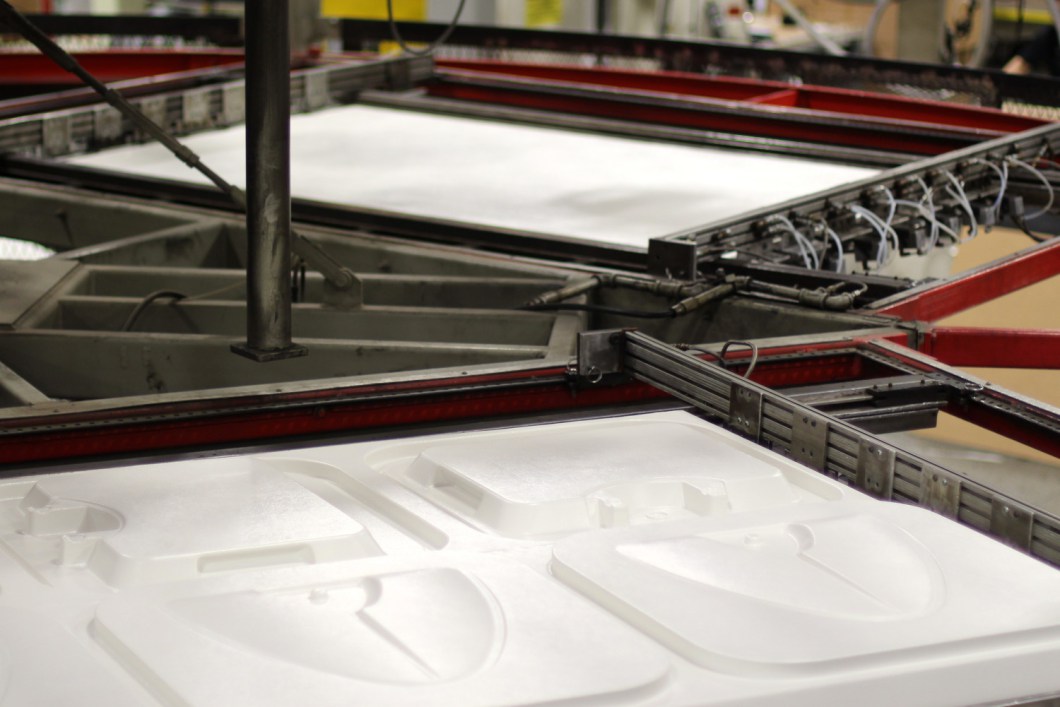
Negative pressure forming is a thermoforming process that uses vacuum to remove air from the space between a heated thermoplastic sheet and a mold. Atmospheric pressure then pushes the softened material against the mold surface.
Vacuum forming is a common example. The process generally involves clamping a plastic sheet, heating it to a suitable forming temperature, positioning it over or against the mold, applying vacuum, cooling the material, and removing the finished part.
This method is widely used for packaging trays, equipment covers, protective liners, display components, and large plastic panels.
Positive pressure forming uses compressed air to push a heated plastic sheet against a mold. The additional forming force can improve the reproduction of surface textures, defined edges, and smaller molded features.
Many industrial pressure-forming systems also use vacuum to remove air from between the plastic and the mold. Combining positive air pressure with vacuum helps the material make closer contact with the tool.
Pressure forming is often considered for equipment enclosures, automotive interior components, consumer-product housings, and other parts that require more detailed surfaces.
No. Positive and negative pressure describe the pressure conditions used during the forming process. They are not the same as positive and negative molds.
A positive mold generally has a projecting shape, while a negative mold contains a cavity. Either mold configuration may be used with suitable thermoforming methods.
Vacuum forming is often selected when manufacturers need to produce plastic parts with relatively simple geometry, large surface areas, or moderate surface-detail requirements.
A thermoplastic sheet is placed in the forming machine and secured by a clamping frame. The clamping system prevents unwanted movement while the material is heated and shaped.
The machine heats the sheet until it reaches a suitable forming-temperature range. The material must become flexible enough to stretch over the mold without melting or degrading.
Heating conditions depend on the thermoplastic material, sheet thickness, product geometry, and machine configuration. Uneven heating can lead to inconsistent wall thickness, wrinkles, or incomplete forming.
The heated plastic sheet is positioned over or against the mold. Depending on the product design, the mold may have a projecting form or a recessed cavity.
Mold geometry influences how the material stretches and how accurately it reproduces the intended shape.
The vacuum system removes air from between the sheet and the mold. Atmospheric pressure pushes the softened material against the mold surface.
Vacuum ports and vents allow trapped air to escape. Their placement is particularly important around corners, recesses, and deeper features.
The plastic cools until it can retain the required shape. The formed part is then removed and trimmed to its final dimensions.
Depending on the product, additional operations such as drilling, cutting, surface finishing, or assembly may be required.
Vacuum forming is a practical option when the required geometry and surface quality can be achieved without the additional forming force provided by positive pressure.
Positive pressure forming follows a similar sequence but introduces compressed air to apply additional force to the heated sheet.
The machine secures the plastic sheet and heats it to the appropriate forming temperature. The heating profile must suit the material, thickness, product shape, and intended cycle time.
The heated sheet and mold are brought into the required forming position. The equipment must provide suitable sealing and withstand the pressure generated during forming.
Compressed air pushes the softened sheet against the mold surface. This additional force can help reproduce sharper transitions, fine textures, and defined edges that may be more difficult to achieve using vacuum alone.
Vacuum ports or mold vents allow air between the sheet and the tool to escape. Without effective venting, trapped air may prevent complete contact with detailed areas of the mold.
The material is held against the mold while it cools. The finished part is then removed and trimmed.
The final quality depends on the forming pressure, material temperature, mold design, venting, cooling, and sheet behavior. Higher pressure by itself does not guarantee a better product.
| Comparison factor | Negative pressure forming | Positive pressure forming |
|---|---|---|
| Forming force | Vacuum creates a pressure differential | Compressed air provides additional forming force, often combined with vacuum |
| Surface detail | Suitable for many simple shapes and moderate details | Often better for fine textures, defined edges, and intricate surface features |
| Dimensional control | Depends on geometry, material, tooling, and process control | Additional forming force may improve detail reproduction and dimensional control |
| Tooling costs | Often lower for simpler applications | May be higher due to pressure-rated tooling and additional design requirements |
| Equipment | Requires heating, clamping, vacuum, and cooling systems | Requires pressure-capable equipment, compressed air, suitable sealing, and often vacuum |
| Typical products | Trays, liners, covers, panels, and packaging | Detailed housings, textured panels, and cosmetic components |
| Material distribution | Influenced by sheet stretching and mold geometry | Also influenced by stretching; pressure does not eliminate local thinning |
| Lead times | May be shorter with simple tooling | May require additional tooling engineering and process development |
| Cost effectiveness | Often attractive for simpler products | Can justify additional investment when improved detail is needed |
These are general tendencies rather than fixed rules. Actual results depend on the product design, thermoplastic material, mold, equipment, and production requirements.
The terms vacuum forming vs. pressure can sound as if they describe entirely separate manufacturing categories. In practice, both are thermoforming processes, and some machines use vacuum and positive pressure during the same forming cycle.
Vacuum forming works by reducing the pressure between the heated sheet and the mold. Atmospheric pressure on the opposite side pushes the material toward the lower-pressure area.
In a conventional vacuum-forming system, the maximum pressure difference is limited by the available atmospheric pressure. Actual forming force may be lower because of leakage, trapped air, or limitations in the vacuum system.
Positive pressure forming introduces compressed air above the heated sheet. This can create a greater pressure difference across the material than vacuum forming alone.
The additional force helps the sheet contact mold features more closely. This can improve the reproduction of textures, lettering, corners, and defined edges.
The required air pressure depends on the machine design, material, sheet thickness, mold geometry, and product requirements. There is no universal pressure setting suitable for every application.
Combining positive pressure and vacuum helps address two parts of the forming process: pushing the sheet against the mold and removing air trapped between the surfaces.
Positive pressure supplies additional forming force, while vacuum and venting help the material make closer contact with the mold. This combination is useful when a product requires a higher level of surface detail.
The required level of detail is often one of the main reasons manufacturers consider pressure forming instead of basic vacuum forming.
Products such as protective covers, interior liners, large panels, and simple trays may not need fine molded-in features. If the main requirements are overall shape, functional fit, and acceptable wall thickness, vacuum forming may be sufficient.
Choosing pressure forming for a product that does not benefit from its additional forming force may increase costs without providing a meaningful improvement.
Pressure forming is often more suitable when a part needs a textured surface, raised or recessed lettering, defined corners, or a more refined appearance.
The additional forming force helps reproduce mold features more clearly. However, mold finish, vent placement, sheet temperature, and material stretching still affect the final result.
Intricate details can be produced with some pressure-forming designs, but the process has limitations. Deep narrow recesses, complex undercuts, internal ribs, and features on multiple surfaces may require additional tooling strategies or a different manufacturing process.
For parts that need extensive three-dimensional features, injection molding may be more suitable. Pressure forming can reproduce substantial surface detail, but it does not provide the same design freedom for every feature.
When a part is visible to customers or must fit closely with another component, evaluate the surface that contacts the mold, the opposite surface, and the dimensions that affect assembly.
The mold's geometry and finish influence appearance. Material stretching can also affect dimensions, so a design review and sample inspection are preferable to assuming that higher pressure alone will solve every quality issue.
The choice between vacuum forming and pressure forming depends partly on the thermoplastic material and the performance required from the finished part.
Common thermoforming materials include ABS, HIPS, PETG, polycarbonate, acrylic, and other sheet-grade thermoplastics. Each material has its own forming-temperature range, stretching characteristics, surface behavior, and mechanical properties.
When manufacturers heat a plastic sheet, the material must become sufficiently flexible to form without losing the properties needed in the finished product.
Too little heat can result in incomplete forming, poor mold contact, or excessive stress. Too much heat can cause sagging, surface defects, material degradation, or inconsistent wall thickness.
A suitable heating process should account for:
A forming machine with independent heating zones can help operators adjust temperature distribution for different product designs. The correct settings should be established through material-specific trials rather than using the same temperature profile for every job.
Impact resistance depends primarily on the material grade, sheet thickness, forming conditions, wall-thickness distribution, operating temperature, and product geometry.
Neither positive nor negative pressure automatically guarantees better impact resistance. A pressure-formed part may reproduce the mold more accurately, but local thinning in a deep corner can still reduce its ability to withstand impact.
For products exposed to drops, vibration, repeated handling, or mechanical loads, evaluate the finished part rather than the flat sheet alone. Testing should focus on areas likely to experience stress, including corners, mounting points, edges, and transitions between thick and thin sections.
If impact resistance is a major requirement, review material selection and mold design together with the forming method.
Tooling costs are an important consideration when choosing between vacuum forming and pressure forming. Both methods use molds to shape heated thermoplastic sheets, but their tooling requirements may differ.
Vacuum-forming molds can be relatively simple for products that do not require extensive surface detail or demanding dimensional control. Depending on the application, manufacturers may use machined aluminum, cast aluminum, composite materials, or other suitable tooling materials.
A simpler mold may reduce initial investment and make design revisions easier. This can be useful during product development, when dimensions or surface features may change before production begins.
Pressure-forming tooling must withstand the intended pressure and provide suitable sealing, venting, and mold-surface detail. These requirements can increase tooling complexity and cost.
The additional investment may be justified when the product needs sharp features, visible textures, detailed lettering, or improved dimensional consistency. The decision should be based on whether these features provide enough value to offset the higher tooling cost.
Lead times depend on mold design, tooling material, supplier capacity, machining requirements, testing, and design approval. Pressure forming may require additional engineering and more robust tooling, although the actual difference varies by project.
When requesting quotations, ask suppliers to separate the estimated timelines for:
This makes it easier to compare suppliers and identify potential delays before committing to a production schedule.
Positive pressure forming generally requires more equipment capability and may involve higher tooling costs than basic vacuum forming. However, a higher initial cost does not necessarily mean a higher total manufacturing cost.
The best option depends on the product requirements and the costs associated with meeting them.
| Cost consideration | Vacuum forming | Pressure forming |
|---|---|---|
| Initial tooling investment | Often lower for simpler products | May be higher for pressure-rated, detailed molds |
| Machine investment | May be lower for basic configurations | May be higher due to pressure equipment and clamping requirements |
| Product appearance | Suitable when moderate detail is acceptable | May reduce the need for secondary cosmetic work on detailed parts |
| Scrap and rework | Depends on material distribution and process control | Improved mold contact may help with some detail-related defects |
| Production efficiency | Can be cost effective for suitable products and volumes | Can justify additional investment for demanding surface requirements |
| Overall cost per part | Often attractive for simpler shapes | Depends on whether improved detail and quality offset additional costs |
A meaningful comparison should include tooling, material consumption, labor, machine time, trimming, finishing, inspection, scrap, and maintenance.
For example, a large plastic enclosure with a relatively simple shape may be more economical to produce using vacuum forming. A smaller enclosure with textured surfaces, defined edges, and visible branding may justify pressure forming if the improved finish reduces rework or additional finishing operations.
Cost effectiveness should be measured by the total cost of producing acceptable parts, not by tooling price alone.
The two methods serve overlapping markets, but certain product requirements make one process more suitable than the other.
Vacuum forming is often considered for:
Pressure forming may be more suitable for:
These examples are starting points rather than fixed rules. The actual product design, material, mold, and production targets determine which process is appropriate.
Pressure forming is sometimes compared with injection molding because it can reproduce detailed textures and surface features. However, the processes differ in how they shape plastic and the types of geometry they can produce.
In thermoforming, the starting material is a plastic sheet that is heated and stretched over or into a mold. In injection molding, molten plastic is injected into a closed mold cavity, allowing the material to form more complex three-dimensional features.
| Factor | Vacuum forming | Pressure forming | Injection molding |
|---|---|---|---|
| Starting material | Plastic sheet | Plastic sheet | Usually plastic pellets or granules |
| Forming method | Vacuum draws the sheet against the mold | Positive air pressure, often combined with vacuum | Molten plastic is injected into a closed mold |
| Surface detail | Suitable for many simple shapes | Often better reproduction of textures and defined features than basic vacuum forming | Can produce detailed features on multiple surfaces |
| Wall geometry | Material stretches, causing thickness variation | Material also stretches; pressure alone does not eliminate thinning | Can produce more complex wall sections, subject to design constraints |
| Tooling investment | Often relatively low | Often higher than basic vacuum forming | Often substantially higher for complex production tooling |
| Large parts | Often suitable | Often suitable | Depends on machine capacity, mold size, and cost |
| Production economics | Often attractive for suitable lower- to medium-volume applications | Attractive when detail is needed without injection-molding tooling investment | Often competitive for high volumes and complex repeatable parts |
Pressure forming may provide a useful middle ground when vacuum forming cannot achieve the desired detail but injection-molding tooling is not economically justified. It cannot replace injection molding for every complex part, particularly when the design requires extensive ribs, bosses, internal structures, or complex features on both sides.
A practical selection process starts with the finished product, not the machine's advertised features.
Document the product's dimensions, sheet thickness, surface finish, color, texture, impact resistance, dimensional tolerances, and assembly requirements.
Identify which features must reproduce the mold accurately and which can tolerate normal variation.
Examine draw depth, corner radii, recesses, undercuts, and material paths. Deep or narrow areas can cause local thinning, so consider plug assistance or other forming techniques where necessary.
If the part requires intricate details on multiple surfaces, include injection molding or other manufacturing processes in the evaluation.
Choose vacuum forming when its achievable detail and dimensions meet the product requirements. Consider pressure forming when improved surface reproduction or more defined features are needed.
Do not specify pressure forming simply because it offers greater forming force. If the product does not benefit from that force, the additional equipment and tooling investment may not provide a meaningful return.
Request quotations that clearly state tooling design, material, expected service life, modification costs, and sample approval procedures.
Compare the expected timeline from design approval to accepted production parts rather than looking only at the quoted mold-manufacturing period.
Ask the supplier to demonstrate the forming process using the intended thermoplastic material and representative tooling. Check surface detail, dimensions, wall thickness, appearance, and any required performance tests.
This trial can reveal problems that are difficult to predict from drawings alone.
Compare the total cost per acceptable part, including tooling, material, machine operation, labor, trimming, finishing, quality inspection, and scrap.
For products expected to remain in production for several years, include forecast volume and potential tooling maintenance in the comparison.
Both vacuum forming and pressure forming depend on controlled heating, suitable mold design, reliable air handling, and adequate cooling. Problems can occur when one of these factors is not properly matched to the product.
| Problem | Possible causes | Potential corrective actions |
|---|---|---|
| Incomplete surface detail | Insufficient forming force, poor venting, or unsuitable temperature | Review heating settings, mold vents, vacuum performance, and pressure settings |
| Uneven wall thickness | Excessive stretching, deep draws, or uneven heating | Adjust material distribution, heating zones, mold geometry, or plug assistance |
| Wrinkles or folds | Incorrect sheet temperature, sag, or material movement | Review sheet support, heating uniformity, clamping, and forming sequence |
| Surface marks | Dirty or damaged tooling, material contamination, or handling | Inspect mold finish, clean surfaces, and review material handling |
| Dimensional variation | Inconsistent heating, cooling, clamping, or material behavior | Improve process repeatability and verify the mold and inspection method |
| Excessive cycle time | Slow heating or cooling, unsuitable settings, or downstream bottlenecks | Evaluate heater capacity, cooling, handling, and line integration |
Increasing air pressure is not a universal solution. If a sheet is too cold, the mold is poorly vented, or the material is stretching excessively, higher pressure may fail to resolve the underlying problem.
A systematic approach is to change one process variable at a time and document its effect on product quality.
Negative pressure forming, commonly called vacuum forming, removes air between a heated plastic sheet and the mold so atmospheric pressure pushes the material into contact with the tool. Positive pressure forming uses compressed air to push the heated sheet against the mold, often with vacuum assistance to remove trapped air.
Pressure forming is generally better when a product requires fine textures, defined edges, lettering, or intricate surface details. Vacuum forming may be more cost effective for simpler shapes that do not require those features. The better process depends on part design, material, tooling budget, and quality requirements.
Vacuum forming can reproduce many useful contours and surface features, but its forming force is limited by the available pressure differential. Pressure forming adds compressed air, helping the heated sheet contact the mold more closely. This can improve detail reproduction, although the results depend on mold design, venting, temperature, and material behavior.
Not in every application. Pressure forming can reproduce detailed surfaces and is often considered for large shells, enclosures, and other sheet-based products where injection-molding tooling would be expensive. Injection molding remains more suitable for many parts requiring complex internal geometry, ribs, bosses, and features on multiple surfaces.
Not automatically. Impact resistance depends on the thermoplastic grade, part geometry, wall thickness, forming conditions, and operating environment. Pressure forming can improve surface detail, but the finished part still needs appropriate material selection and impact testing where required.
Heating determines whether the material can stretch and conform to the mold. Uneven heating can cause wrinkles, inconsistent thickness, or incomplete detail. Excessive heat may lead to sagging or material degradation. The temperature profile should be matched to the sheet grade, thickness, mold, and cycle requirements.
They are often higher than for basic vacuum forming because the mold and machine must accommodate positive air pressure, reliable sealing, and the required detail. The difference depends on the part, mold material, complexity, and production volume. Pressure forming may still be more cost effective than injection molding for some large or lower-volume parts.
Vacuum forming may have shorter lead times when the product uses a simple mold and requires little process development. Pressure forming can involve more detailed tooling and pressure-system requirements, but actual lead times depend on supplier capacity, design complexity, and testing. Request a schedule covering tooling, samples, approval, and production startup.
Vacuum forming can reproduce many contours and selected details, but the achievable level of detail depends on the pressure differential, mold surface, venting, sheet temperature, and geometry. For sharper corners, defined textures, or small molded-in features, pressure forming may be a better choice.
Depending on the machine and application, pressure forming can process thermoplastics such as ABS, HIPS, PETG, polycarbonate, and other suitable sheet materials. The correct material depends on forming-temperature requirements, impact resistance, appearance, chemical exposure, and the product's operating environment.
No. Additional forming force can improve mold contact and may help some applications achieve their required shape efficiently. However, total cycle time also depends on heating, cooling, part geometry, material thickness, and handling. Actual performance should be confirmed through production trials.
Compare the total manufacturing cost for acceptable parts, including tooling, material, machine time, labor, trimming, finishing, scrap, and maintenance. Then evaluate whether the additional detail offered by pressure forming creates enough value to justify its investment. A production trial using the intended material and mold provides a stronger basis for the decision than machine specifications alone.
Positive and negative pressure forming are related thermoforming processes that differ mainly in how they apply forming force to a heated plastic sheet. Vacuum forming uses a pressure differential created by removing air from between the sheet and the mold. Positive pressure forming adds compressed air, often alongside vacuum, to improve contact with the mold surface.
Vacuum forming is often a practical option for large, relatively simple shapes where tooling costs and straightforward production matter. Pressure forming is worth considering when the product requires more defined edges, textures, lettering, or intricate details.
The final decision should account for material behavior, impact resistance, mold design, production volume, lead times, and total cost per acceptable part. By testing the actual material and product design, manufacturers can select a forming process that meets the required quality standards without paying for capabilities the product does not need.