Quote now
EN

Choosing the right thermoforming machine requires more than comparing equipment prices or production speeds. Manufacturers need to consider the type of plastic sheet being processed, product dimensions, forming method, production volume, mold design, automation requirements, and long-term operating costs. A machine that works well for food packaging may not be suitable for producing large industrial housings or thick plastic components.
This guide explains how to evaluate a thermoforming machine based on your production needs, material requirements, product specifications, and future business plans. It is designed to help manufacturers, packaging companies, purchasing managers, and production engineers make informed equipment decisions.
To choose a thermoforming machine, start by defining your product dimensions, required output, plastic sheet thickness, thermoplastic material, and acceptable product quality. Then compare forming methods, heating systems, mold compatibility, automation levels, energy consumption, and maintenance requirements.
For high-volume food packaging, an automated machine with stable sheet feeding, fast heating, accurate forming, and integrated cutting may be appropriate. For large plastic covers or industrial components, a machine with a larger forming area and greater flexibility in mold design may be a better fit. The best choice is the machine that consistently produces acceptable parts at the required output and total operating cost.
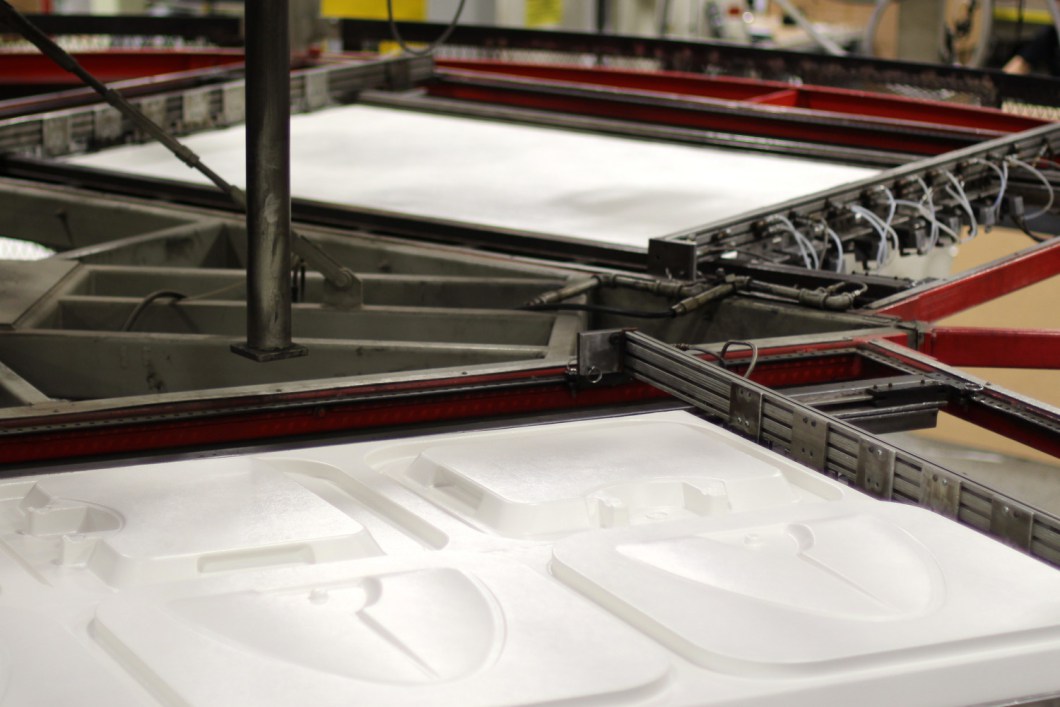
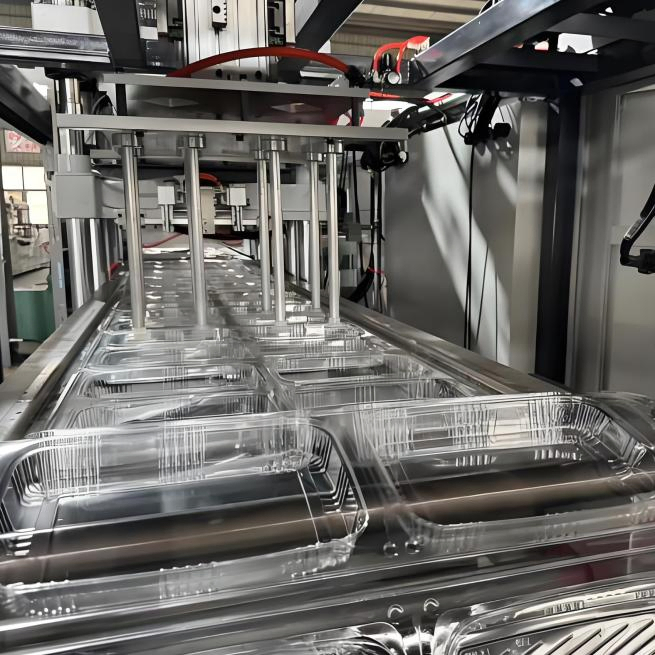
A thermoforming machine is industrial equipment that heats a thermoplastic sheet until it becomes soft enough to form over or into a mold. The machine uses vacuum, air pressure, mechanical assistance, or a combination of these methods to shape the heated material. After cooling, the formed part is removed from the mold and may undergo trimming or other finishing operations.
Thermoforming machines are widely used to manufacture food trays, disposable containers, protective packaging, medical packaging, automotive interior components, equipment covers, and other plastic products.
The equipment configuration depends on the sheet material, product geometry, forming method, required output, and level of automation. Some machines are designed for relatively simple products and short production runs, while others are built for continuous, high-volume manufacturing.
Before comparing machine models, establish what you intend to manufacture. Equipment selection becomes much easier when product specifications and production targets are clearly defined.
The size of the finished product determines the required forming area, mold dimensions, and machine layout. Manufacturers should consider the product's length, width, depth, flange dimensions, and spacing between cavities.
For multi-cavity production, the machine must accommodate the complete mold layout, including the space required for mold structure, cooling channels, clamping, and trimming.
A machine with a large forming area is not automatically the best option. Oversized equipment may increase investment costs and energy consumption when producing relatively small components. Conversely, a machine with insufficient forming space may restrict product design or limit the number of parts produced in each cycle.
Product geometry affects material distribution during forming. Shallow trays and simple covers are generally easier to form than deep containers, products with narrow recesses, or parts with complex surface details.
For deep-draw products, evaluate whether the machine supports the necessary pre-stretching, plug assistance, vacuum control, or pressure-forming functions. Ask the equipment supplier to test the actual product design rather than relying exclusively on the machine's maximum forming depth.
Estimate both current demand and expected demand over the next several years.
The required production rate should be calculated using acceptable finished parts rather than theoretical machine cycles alone. Material loading, heating, cooling, trimming, mold changes, and rejected products all affect actual output.
The plastic sheet is one of the main factors determining the machine's heating system, forming capability, and operating parameters. Different materials respond differently to heat, stretching, cooling, and pressure.
Common thermoplastic materials used in thermoforming include PET, PP, PS, PVC, ABS, HIPS, and certain engineering plastics.
| Thermoplastic material | Common applications | Machine selection considerations |
|---|---|---|
| PET | Food containers, clear packaging, protective trays | Stable heating, transparency requirements, accurate forming |
| PP | Food containers, reusable packaging, industrial components | Material-specific heating settings and suitable forming conditions |
| PS | Disposable trays, lids, lightweight packaging | Efficient heating and consistent sheet handling |
| HIPS | Appliance liners, packaging trays, consumer product housings | Reliable temperature control and material distribution |
| PVC | Blister packaging, selected industrial products | Compatibility with the specified material formulation and appropriate process controls |
| ABS | Equipment covers, automotive parts, durable housings | Heating capacity, forming accuracy, and cooling performance |
The table provides general guidance. Actual processing conditions depend on sheet grade, thickness, additives, color, recycled content, and product geometry.
Machine specifications should state the supported sheet thickness range. However, a stated range does not guarantee that the equipment will perform equally well at every thickness.
Thin sheets may require accurate temperature control and stable sheet feeding to avoid wrinkles, deformation, or uneven forming. Thicker sheets generally need more heating energy and longer heating or cooling periods.
If your production includes several sheet thicknesses, ask the supplier to confirm the changeover procedure, heating capacity, clamping capability, and achievable cycle time for each material specification.
The machine must accommodate the sheet width and feeding format used in your factory. Roll-fed equipment is common in continuous packaging production, while sheet-fed systems may be suitable for larger components or applications using pre-cut sheets.
Check the maximum sheet width, feeding accuracy, clamping arrangement, material tension control, and compatibility with your upstream sheet supply system.
For manufacturers processing multiple materials, also confirm how quickly the machine can be adjusted when changing sheet thickness, color, or material type.
Different thermoforming methods serve different product requirements. Understanding the available processes helps narrow the equipment options.
Vacuum forming uses negative pressure to draw a heated plastic sheet against a mold. It is often used for trays, packaging inserts, equipment covers, and relatively large plastic components.
Advantages include a comparatively straightforward process, flexible mold design, and suitability for a broad range of product sizes. The final surface detail and material distribution depend on mold geometry, sheet properties, heating conditions, and vacuum performance.
When choosing a vacuum-forming machine, examine the vacuum system capacity, mold sealing arrangement, forming area, and cooling system.
Pressure forming uses compressed air in addition to vacuum or other forming assistance to press the heated sheet against the mold. This can improve surface definition and help reproduce more detailed features than basic vacuum forming in suitable applications.
It may be appropriate for products requiring textured surfaces, defined edges, or a more refined appearance. The equipment may need additional pressure controls, sealing components, and a suitable mold design.
Plug assistance uses a mechanical plug to stretch or distribute the heated sheet before or during forming. This technique can improve wall-thickness distribution in certain deep-draw products, including containers and trays.
If your products have significant depth or demanding wall-thickness requirements, ask the supplier whether plug assistance is available and whether it can be integrated into the machine's control system.
The correct process depends on the part's geometry, material, surface requirements, and production targets. A machine should be selected according to the process needed to manufacture the product, rather than choosing a process solely because it is available on a particular model.
The heating system affects cycle time, material consistency, energy use, and product quality. Its performance deserves close attention when comparing thermoforming equipment.
Thermoforming machines may use ceramic infrared heaters, quartz heaters, or other heating configurations. The most suitable arrangement depends on the plastic sheet, production speed, material thickness, and required temperature distribution.
When evaluating the heating system, consider:
Uniform heating helps reduce problems such as uneven wall thickness, incomplete forming, sagging, and surface defects. The supplier should be able to demonstrate heating performance with your actual sheet material.
A suitable control system should allow operators to set and monitor heating parameters consistently. Multi-zone temperature control can help compensate for differences between the center and edges of a sheet or between different product areas.
Ask whether temperature settings can be stored as product recipes. This feature can shorten changeovers and reduce reliance on individual operators' experience.
The practical objective is repeatable forming conditions, not simply reaching a high heating temperature.
Machine manufacturers often publish cycle rates or maximum output figures. These figures are useful for initial comparisons, but they should not be treated as guaranteed production results.
Actual output depends on several factors:
For example, a machine producing multiple small food containers per cycle may achieve a much higher part count than a machine producing large industrial covers, even if both operate at a similar cycle rate.
A useful estimate is:
Acceptable hourly output = parts per cycle × cycles per hour × production yield
Production yield is the proportion of manufactured parts that meet the required specifications. For example, if a machine produces 12 parts per cycle, completes 8 cycles per minute, and achieves a 95% yield, the estimated acceptable output is:
12 × 8 × 60 × 0.95 = 5,472 acceptable parts per hour.
This is an illustrative calculation, not a performance claim for any specific machine. In actual production, cycle rate and yield must be verified through trials.
When comparing suppliers, request a production test using the intended mold, material, sheet thickness, and product specifications. Ask for the demonstrated cycle rate, acceptable output, reject rate, and conditions under which those figures were achieved.
The mold determines the shape of the finished product and influences forming quality, material usage, cooling performance, and production speed.
Before purchasing a thermoforming machine, confirm that its mold mounting system and working dimensions match your tooling requirements.
Review the maximum and minimum mold dimensions, mold height, clamping arrangement, and available space for connections and cooling channels.
If you already own molds, ask the supplier to check compatibility with the proposed machine. Differences in mounting dimensions, forming height, or utility connections may require tooling modifications.
Manufacturers producing several product types should consider how quickly the machine can change from one mold to another.
Features such as accessible mold mounting points, quick-change systems, stored machine recipes, and convenient utility connections can reduce downtime. However, the actual benefit depends on mold weight, operator access, and the complexity of each product.
Mold investment varies with product size, geometry, surface finish, cavity count, material, and expected production volume.
For lower-volume production, a simpler mold may be sufficient for some products. High-volume applications may justify more durable tooling designed for repeated operation and consistent output.
Discuss mold maintenance, repair options, expected service life, and the availability of replacement components before finalizing the equipment purchase.
Automation can reduce manual handling, improve repeatability, and support higher production volumes. The appropriate level depends on product complexity, labor availability, and operating requirements.
A thermoforming production line may include sheet feeding, heating, forming, cooling, trimming, stacking, conveying, and inspection.
Semi-automatic equipment may suit manufacturers with varied products, moderate production requirements, or a need for more operator involvement. It can offer flexibility without the investment required for a fully integrated line.
However, manual handling can increase labor requirements and introduce variation in loading, trimming, and stacking.
Fully automatic thermoforming equipment coordinates several production stages with limited manual intervention. It is commonly considered for high-volume food packaging and other repetitive applications.
Potential benefits include consistent cycle timing, reduced manual handling, and easier coordination between process stages. Actual performance depends on the quality of integration and the suitability of the machine for the product.
Cutting and stacking options deserve particular attention when selecting equipment for food packaging or disposable containers.
Determine whether cutting occurs in-line or in a separate operation, whether the machine supports the required cutting method, and whether finished parts can be stacked in the required orientation and quantity.
A fast forming unit may not deliver the expected line output if trimming, stacking, or downstream packaging becomes a bottleneck.
A modern control system may provide recipe storage, alarm records, production counters, and operating parameter monitoring.
These functions help operators reproduce settings, identify production interruptions, and track output. For factories with several machines, consider whether the control system can integrate with existing production monitoring or factory management systems.
Food packaging is a major application of thermoforming technology. Typical products include meat trays, fruit containers, bakery packaging, ready-meal trays, lids, and other formed packaging components.
A thermoforming machine for food packaging must be selected according to the packaging format, intended food contact, required output, material properties, and downstream packaging process.
Not every thermoplastic material or sheet grade is suitable for every food-contact application. Confirm that the chosen material complies with the applicable food-contact regulations in the intended market.
The machine supplier should clarify which materials the equipment is designed to process, while the packaging manufacturer remains responsible for verifying the suitability and compliance of the finished packaging system.
Consider the accessibility of machine surfaces, material-contact areas, guarding, and components that may need regular cleaning. The level of hygiene-related design required depends on the packaging process and the factory's operating procedures.
If the packaging line includes additional operations such as filling, sealing, or modified-atmosphere packaging, check whether the thermoforming machine can integrate with the downstream equipment.
For food packaging, variations in dimensions, rim shape, wall thickness, or stacking quality may affect filling, sealing, transport, and retail presentation.
Evaluate the machine's ability to maintain repeatable forming conditions across long production runs. Product trials should include dimensional checks, stacking tests, and any relevant sealing or packaging-line compatibility tests.
Many packaging operations generate trim scrap after forming and cutting. Consider how scrap is collected, removed, and handled.
If recycled material is intended for reuse, verify the requirements for the specific sheet structure and end application. Food-contact rules and multilayer packaging construction may restrict how scrap can be reused.
The purchase price is only one part of the cost of owning a thermoforming machine. Electricity, compressed air, cooling, labor, molds, maintenance, and material waste all contribute to the total cost per acceptable part.
A machine with a lower purchase price may cost more to operate if it consumes more energy, produces more rejected parts, or requires frequent manual intervention.
When comparing machines, examine the following factors:
| Cost factor | What to evaluate |
|---|---|
| Energy consumption | Electricity used by heaters, drives, pumps, and auxiliary systems |
| Compressed air | Pressure, flow requirements, and operating frequency |
| Cooling | Cooling water or chiller capacity and associated energy use |
| Material waste | Trim scrap, startup waste, and rejected parts |
| Labor | Operators required for loading, trimming, inspection, and packing |
| Maintenance | Service intervals, spare parts, and repair requirements |
| Tooling | Mold manufacturing, replacement, and refurbishment costs |
| Downtime | Production losses caused by faults, setup, and changeovers |
For a more accurate comparison, request utility consumption data under a stated production condition rather than relying on installed motor power alone.
A simple operating-cost calculation is:
Cost per acceptable part = total production cost / number of acceptable parts
The calculation should use the same accounting period and include the costs relevant to your operation. This makes it easier to compare machines with different purchase prices, output rates, and automation levels.
A machine's long-term value depends on whether it can operate consistently and whether support is available when problems occur.
Before making a purchase, review the manufacturer's experience with comparable products and production requirements.
Ask for details about the frame, forming station, heating assembly, drive system, vacuum equipment, pneumatic components, and control system.
The quality of these components affects stability, serviceability, and the machine's ability to maintain repeatable production conditions.
Operators and maintenance personnel should be able to access routine service points safely and conveniently. Check how heaters, filters, pumps, sensors, and other frequently serviced components can be inspected or replaced.
Ask for a recommended preventive maintenance schedule and a list of common replacement parts.
Confirm which spare parts are stocked locally or can be shipped from the manufacturer's facility. Clarify typical delivery times for commonly replaced components and specialized parts.
For manufacturers operating multiple shifts, long spare-part lead times can create substantial production disruption.
Installation support should cover machine setup, mold installation, heating parameters, process adjustment, safety procedures, and routine maintenance.
Training should also explain how to recognize common forming defects and how to make adjustments without creating unnecessary material waste.
Review warranty coverage, exclusions, response arrangements, remote troubleshooting options, and the availability of on-site technical support.
A clear service agreement helps establish expectations before the equipment enters production.
The machine must fit the factory's physical layout and operating conditions as well as its production targets.
Check the equipment footprint, access for mold changes, loading and unloading areas, electrical supply, compressed-air connections, cooling requirements, ventilation, and material storage.
Safety features should include appropriate guarding, emergency stops, interlocks where required, and protection around hot surfaces and moving components. Verify compliance with the applicable machinery safety requirements in the destination market.
Also consider how operators will access the machine for cleaning, inspection, and maintenance. A layout that restricts access can complicate routine service and increase downtime.
For overseas installations, discuss electrical standards, documentation language, commissioning procedures, and remote support arrangements before shipment.
A production trial provides practical evidence of whether a proposed machine can meet your requirements. It is particularly valuable when the product has deep features, tight dimensional requirements, unusual materials, or high output targets.
Whenever possible, provide the supplier with representative samples or complete specifications for the intended plastic sheet and finished product.
The trial should evaluate:
Document the test material, sheet thickness, mold configuration, operating settings, and inspection method. This helps ensure that the results can be compared fairly across different suppliers.
A successful demonstration should establish not only that the machine can produce a sample part, but also that it can maintain the required quality and output under realistic production conditions.
Before requesting quotations, prepare a clear specification sheet. This allows equipment suppliers to recommend machines based on comparable information.
| Specification | Information to prepare |
|---|---|
| Finished product | Drawings, dimensions, photos, and required tolerances |
| Material | Thermoplastic grade and sheet structure |
| Sheet thickness | Minimum, typical, and maximum thickness |
| Sheet format | Roll-fed or sheet-fed; width and feeding requirements |
| Forming method | Vacuum forming, pressure forming, or plug-assisted forming |
| Production target | Required acceptable parts per hour or shift |
| Mold configuration | Existing mold dimensions or proposed cavity layout |
| Automation | Feeding, cutting, stacking, conveying, and inspection needs |
| Quality requirements | Appearance, dimensions, wall thickness, and other tests |
| Factory utilities | Power, compressed air, cooling, and installation space |
| Service expectations | Training, spare parts, warranty, and technical support |
| Budget | Machine investment and expected operating costs |
The more complete the specifications, the easier it becomes to compare equipment on production performance rather than headline price alone.
Start with the finished product, thermoplastic material, sheet thickness, forming dimensions, and required production volume. These factors determine the machine's forming area, heating capacity, process configuration, and automation requirements.
The best machine depends on the packaging format, material, output target, and required downstream operations. High-volume packaging manufacturers often consider automatic roll-fed equipment with integrated forming, cutting, and stacking. The final choice should be confirmed through production trials using the intended material and mold.
Depending on its design and operating range, a thermoforming machine can process thermoplastic materials such as PET, PP, PS, HIPS, PVC, and ABS. The supported materials and thickness ranges vary by machine model, sheet grade, and product design, so compatibility should be confirmed with the supplier.
Sheet thickness affects heating time, forming behavior, cooling requirements, and production speed. Thicker sheets may require greater heating capacity and longer cycles, while thin sheets may need precise temperature control and stable feeding. Select equipment based on the actual thickness range used in production.
Vacuum forming uses negative pressure to draw a heated plastic sheet against a mold. Pressure forming adds compressed air to help push the material against the mold surface. Pressure forming can provide more detailed surface definition in suitable applications, but the appropriate method depends on product design, material, tooling, and cost targets.
A basic estimate is:
Hourly output = parts per cycle × cycles per hour × production yield
For a reliable estimate, use the demonstrated cycle rate and yield for your actual product. Account for heating, cooling, trimming, stacking, changeovers, and downtime when calculating the output available for customer orders.
No. Automatic equipment can reduce manual handling and support high-volume production, but it generally requires a larger investment and may involve more complex integration. A semi-automatic machine may be more practical for smaller orders, frequent product changes, or applications where flexibility matters more than maximum output.
Mold compatibility affects whether the machine can accommodate the required product dimensions, mold height, mounting arrangement, and cooling connections. If you already have tooling, confirm compatibility before ordering the machine. If new tooling is required, evaluate mold cost, changeover time, maintenance, and expected production volume together.
Focus on energy use, acceptable output, material waste, labor, mold life, maintenance, and downtime. Stable heating, suitable process settings, effective scrap management, and well-planned changeovers can improve cost per acceptable part. Compare suppliers using consistent production conditions rather than purchase price alone.
Provide the product drawing or sample, plastic sheet material, thickness range, sheet width, required production capacity, forming method, mold dimensions, quality standards, and automation requirements. Also describe available factory utilities and installation constraints. This information helps the supplier recommend a suitable configuration and prepare a more meaningful quotation.
Many machines can produce multiple products by changing molds and adjusting process settings. The range of compatible products depends on the forming area, mold mounting system, heating configuration, material range, and automation design. Confirm the changeover procedure and test representative products before assuming that a single machine can handle the full product range.
Request a production trial using your intended plastic sheet, mold, and product specifications. Review the demonstrated cycle time, acceptable output, product quality, material waste, utility consumption, and changeover process. You can also request references from customers operating similar equipment and review the manufacturer's installation and after-sales support arrangements.
Choosing the right thermoforming machine starts with understanding the product and working backward to the equipment requirements. Product dimensions, plastic sheet thickness, thermoplastic material, forming method, production volume, and quality standards determine which machine configuration is suitable.
Manufacturers should also consider automation, mold compatibility, energy consumption, maintenance, and technical support. For food packaging applications, material suitability, production consistency, cutting accuracy, and downstream integration deserve additional attention.
Rather than selecting a machine based on price or advertised speed alone, compare suppliers using the same product specifications and production conditions. A well-matched thermoforming machine should deliver the required output, maintain acceptable product quality, and support the manufacturer's operating costs over its service life.