Quote now
EN

A thermoforming machine heating system determines how efficiently a plastic sheet reaches its forming temperature and how consistently that temperature is maintained during production. When evaluating a machine, buyers should look beyond the heater's rated power and examine heating uniformity, temperature control, energy consumption, material compatibility, cycle time, and maintenance requirements.
The right heating system helps manufacturers produce parts with consistent wall thickness, accurate dimensions, and reliable surface quality. It can also reduce material waste, shorten production cycles, and improve operating costs over the machine's service life.
For manufacturers comparing thermoforming machines, the goal is to identify a heating system that matches the plastic sheet material, sheet thickness, mold design, production volume, and required product quality.
Evaluate a thermoforming machine heating system by checking its heating uniformity, temperature-control accuracy, heating speed, energy efficiency, compatibility with different plastic sheet materials, and ability to maintain stable performance during continuous production. Ask the manufacturer for heating-zone specifications, temperature-control methods, sample-forming results, energy-consumption data, and details about heater replacement and maintenance.
A suitable system should heat the plastic sheet evenly to its forming window without overheating the surface or leaving colder areas that cause incomplete forming, uneven thickness, or inconsistent product quality.
A thermoforming machine heating system is the group of components that raises a thermoplastic sheet to the temperature required for forming. Depending on the machine design, it may use ceramic infrared heaters, quartz infrared elements, other electric radiant heaters, or a combination of heating technologies. The system typically includes heating elements, temperature sensors, zone controllers, insulation, and mechanisms for positioning or moving the heaters.
Its purpose is to make the plastic sheet sufficiently soft and formable while maintaining a temperature distribution suited to the material and product geometry. The exact requirements depend on the polymer, sheet thickness, forming method, mold configuration, and production conditions.
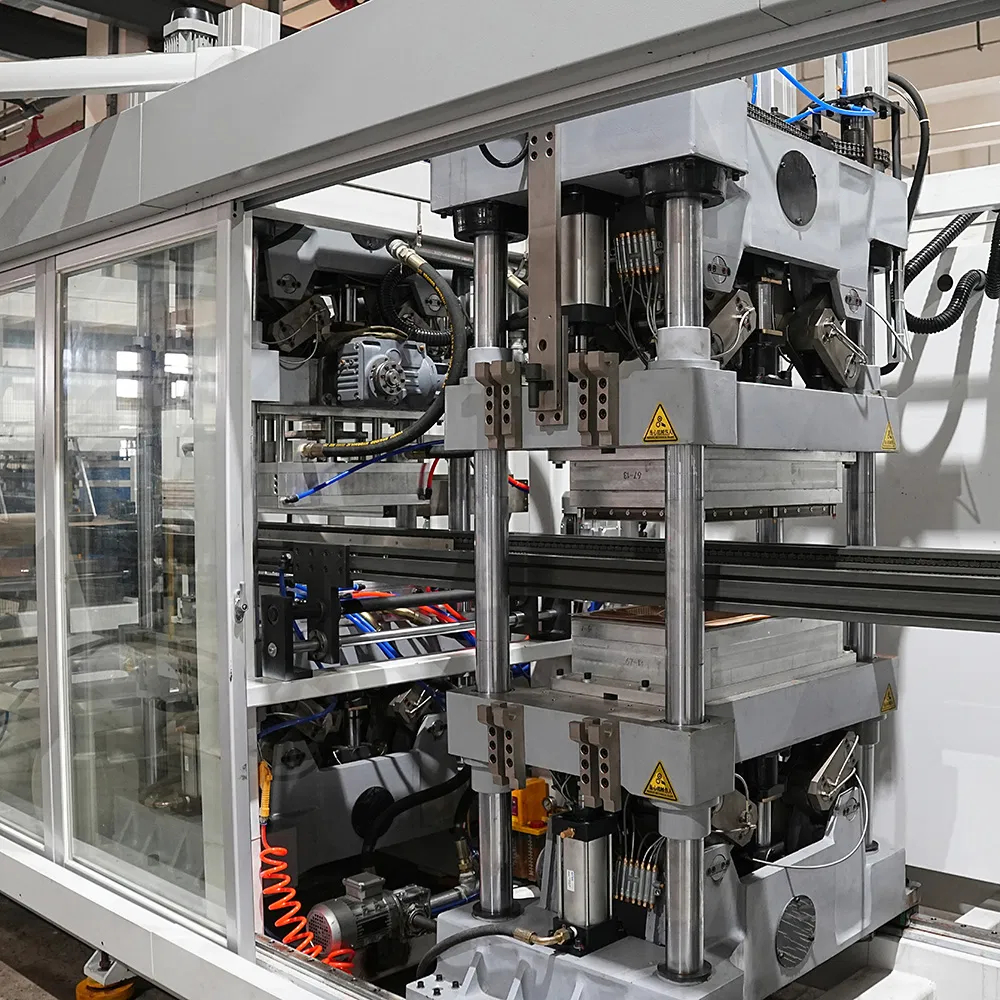
In the thermoforming process, a plastic sheet is heated until it can be shaped over or into a mold using vacuum, pressure, mechanical assistance, or a combination of these methods. The sheet must be hot enough to form correctly but not so hot that it degrades, sags excessively, sticks, or loses the required properties.
Heating performance influences several production outcomes.
If one area of the sheet is hotter than another, different sections may stretch at different rates. This can produce uneven wall thickness, distorted corners, weak areas, or inconsistent dimensions. Stable heating helps the sheet respond more predictably during forming.
Heating can account for a substantial portion of the total thermoforming cycle. A system that transfers heat efficiently and distributes it evenly may reduce heating time without sacrificing quality. However, faster heating alone does not guarantee a shorter production cycle: forming, cooling, mold movement, trimming, and material handling also affect overall throughput.
Poor temperature distribution can increase scrap rates and require additional setup adjustments. A well-matched heating system can reduce rejected parts and avoid unnecessary energy consumption. Its cost effectiveness should be assessed over the machine's operating life rather than by the initial purchase price alone.
Different thermoplastic materials respond differently to heat. A system used for polystyrene may not perform identically with ABS, PET, PP, PVC, or polycarbonate. Buyers should verify the machine's ability to process their actual materials and thickness ranges rather than relying on general claims about compatibility.
Different heating technologies transfer energy to a plastic sheet in different ways. The best option depends on the material, sheet thickness, required heating profile, machine layout, and production requirements.
Infrared heating is widely used in industrial thermoforming because it transfers radiant energy to the plastic sheet without requiring direct contact. Heating elements can be arranged above, below, or on both sides of the sheet.
Infrared systems are available with ceramic, quartz, and other radiant heating elements. Their performance depends on the radiation characteristics of the heater and how the plastic absorbs that energy. A heater that works well for one material may heat another material less efficiently, so trials with the intended plastic sheet are valuable.
A key advantage is the ability to divide the heating area into independently controlled zones. Operators can adjust individual areas to compensate for edge heat loss, material behavior, or product geometry. This is particularly useful when forming deep containers, automotive panels, trays, and other parts with uneven stretching requirements.
Ceramic infrared heaters are often considered for production environments that need robust heating elements and stable operation. They can suit a wide range of thermoforming applications, provided the heater configuration and control settings match the material.
When comparing ceramic systems, examine the heating-zone layout, temperature response, element life, replacement cost, and energy consumption under actual production conditions. A lower-cost heater may still be a good choice if it meets the required heating uniformity and operating targets.
Quartz heating elements can offer a faster response than some conventional heater designs. This may be useful when production involves frequent temperature adjustments or material changes. However, the actual response and energy efficiency depend on the element design, radiation spectrum, distance from the sheet, and material absorption characteristics.
Ask the machine supplier to explain why the proposed heater type suits your plastic sheet rather than relying on a general claim that one technology is always more efficient.
Convection systems heat a sheet by circulating heated air around it. They can be useful for materials that need gradual, more uniform heating through their thickness. For some thicker acrylic sheets, for example, the transfer of heat from the surface to the core takes longer than the initial surface heating, so increasing radiant heat alone may overheat the surface before the core reaches the required temperature.
Convection systems may require more time to reach a target temperature, depending on the equipment and material. Their suitability should be judged by the resulting sheet temperature profile, heating time, and part quality rather than by heater type alone.
Uniform heating is one of the most useful indicators of a thermoforming machine's performance. A sheet can reach the average target temperature while still containing hot and cold areas that affect forming.
Cold areas may resist stretching and fail to reproduce mold details. Overheated areas may sag too much, become excessively thin, show surface defects, or degrade. Temperature differences can also affect the consistency of dimensions between parts.
A multi-zone heating system allows the operator to adjust energy output across different parts of the sheet. For example, edge zones may need a different setting from central zones because of heat loss and the geometry of the heater arrangement.
The number of zones matters, but more zones do not automatically mean better performance. The control system must provide useful adjustment, the sensors must supply meaningful feedback, and the heating layout must match the size and shape of the sheet.
Ask the supplier to demonstrate how zones can be adjusted and stored for different products. For machines that handle several sheet sizes or materials, the ability to save and retrieve process settings can make changeovers more repeatable.
Heating from both sides can help reduce the difference between surface and core temperatures, especially when processing thicker material. The required balance between upper and lower heating depends on the polymer, sheet thickness, surface characteristics, and heater spacing.
During a machine trial, examine whether the upper and lower heaters can be adjusted independently. Confirm that the sheet reaches its forming condition without excessive sagging, surface damage, or inconsistent heating through its thickness.
Do not rely only on the temperature displayed for the heating oven. That reading may describe the heater or surrounding air rather than the actual plastic sheet temperature.
Infrared pyrometers can measure sheet surface temperature without contact, while thermal imaging cameras can reveal temperature differences across a wider area. Measurement results depend on factors such as surface emissivity, measurement position, and the time between heating and forming. Infrared surface measurements also do not directly establish the sheet's core temperature.
For a meaningful evaluation, measure multiple positions across the sheet and compare the results with the material supplier's recommended forming range. Where sheet thickness makes core temperature important, use an appropriate validation method rather than assuming that surface temperature tells the whole story.
A heating system should not only reach a set temperature; it should maintain a repeatable process as production continues.
Review how the machine controls heater output. The controller should make it practical to set the required heating conditions, adjust individual zones, and repeat established recipes.
Ask the supplier how the system responds when the line starts, when the machine pauses, or when production speed changes. Also check whether operators can identify abnormal temperatures and recover the correct settings after a material change.
Thermocouples are commonly used to measure heater or oven temperature. Infrared sensors can measure the plastic sheet surface without contact. These devices serve different purposes, so a machine's sensor configuration should be matched to the variables that need to be controlled.
For example, heater temperature alone may not reveal whether a glossy, dark, or differently formulated plastic sheet is absorbing energy as expected. Sensor placement and calibration should be reviewed alongside the control method.
More advanced systems may use measured sheet temperature to adjust heater output automatically. Alarms can alert operators to abnormal temperatures or sensor problems before defective products accumulate.
When evaluating these features, ask whether they provide closed-loop control based on the sheet itself or merely display readings for the operator. Confirm what happens if a sensor fails, a heater stops working, or a temperature moves outside the configured range.
A heating system should be selected around the materials that the machine will actually process. Different polymers absorb radiant energy differently and have different forming-temperature windows.
| Plastic sheet material | What to evaluate in the heating system |
|---|---|
| PET and PETG | Temperature consistency, surface quality, sag control, and the material grade's forming window |
| HIPS and polystyrene | Heating speed, zone balance, and repeatable forming conditions |
| ABS | Heating uniformity, surface appearance, and control of local thinning |
| PP | Material-specific heating behavior, sheet support, and a stable forming window |
| PVC | Compatibility with the specific grade and careful control of processing conditions |
| Acrylic (PMMA) | Surface-to-core temperature differences, especially with thicker sheets |
| Polycarbonate | Heating uniformity, required forming temperature, and material supplier guidance |
This table is a starting point, not a universal set of processing instructions. Forming temperatures and heating times vary by grade, formulation, sheet thickness, and machine design. Always verify the process window using the material supplier's technical data and production trials. Acrylic guidance, for instance, distinguishes between thin sheets that can be heated efficiently by radiant energy and thicker sheets that may benefit from convection heating.
Sheet thickness changes the time required for heat to travel from the surface into the material. A thin plastic sheet may heat quickly, while a thicker sheet can develop a hot surface and a cooler core if energy is applied too aggressively.
For this reason, a machine intended for a broad thickness range should offer enough heating flexibility to accommodate different thermal response times. Check the supplier's demonstrated processing range and ask for sample results at the thinnest and thickest specifications you expect to run.
Color, additives, coatings, and surface finish can influence how a sheet absorbs and emits infrared radiation. A recipe developed for one material or finish may not transfer directly to another.
If your factory frequently changes suppliers, colors, or grades, ask whether the machine can store separate heating recipes and whether the supplier can help establish settings for new materials.
A short heating time can increase production capacity, but it should not be treated as the only measure of machine performance.
Total cycle time may include sheet indexing, heating, transfer, forming, cooling, mold movement, and unloading. If the heating station becomes faster but cooling or material handling remains the bottleneck, the increase in output may be limited.
Evaluate heating speed using the actual plastic sheet and intended product. A useful comparison records the time needed to reach the required forming condition, the temperature distribution at that point, the scrap rate, and the finished-part quality.
Increasing heater power or setting temperature higher can shorten the time required to soften the surface, but it may also cause excessive sagging, uneven thickness, discoloration, or other defects. The target is the shortest repeatable heating time that achieves the correct temperature profile—not the highest possible heater output.
A short demonstration with one sheet may not show how a machine performs during a full shift. Ask for a sustained production trial using the intended sheet material, thickness, mold, and production speed.
Record whether the system maintains consistent heating after startup and through normal production. Where multiple products are involved, include changeovers so you can evaluate how easily the heating recipes are adjusted and restored.
Heating can account for a substantial share of the energy used in thermoforming, so heater selection and control can affect operating costs. Energy use varies with the machine design, material, sheet thickness, production schedule, insulation, and process settings.
A machine with a higher installed heating capacity is not necessarily more expensive to operate, and a lower-power system is not automatically more efficient. The meaningful comparison is the energy used to produce an acceptable finished part at the required output.
Ask the manufacturer for measured consumption data under defined conditions. Ideally, compare kilowatt-hours per production hour and energy per accepted part, while recording output rate and scrap.
Insulation helps reduce heat loss from the heating chamber. Heater positioning, reflective surfaces, airflow, and the control of idle periods can also affect energy demand.
Ask how the machine handles warm-up, temporary production stops, and restart. A well-designed control strategy should balance energy savings with the time required to return to stable production.
The purchase price is only one part of the cost. Consider electricity consumption, replacement elements, sensor maintenance, downtime, rejected parts, and the labor needed to establish and maintain process settings.
A heating system with a higher initial cost may offer better long-term value if it consistently reduces energy per part, waste, and maintenance. Those benefits should be supported by test data or a clear comparison rather than assumed from the heater specification alone.
Heating elements operate under repeated thermal cycles, so their condition can affect temperature consistency and production uptime. A system that is easy to inspect and maintain can reduce interruptions and simplify routine servicing.
Ask about the expected service life of the heating elements under the proposed operating conditions. Actual life depends on heater type, operating temperature, switching frequency, contamination, and maintenance practices.
Check whether replacement elements are readily available and whether individual heaters can be replaced without dismantling a large section of the heating station. Also confirm whether the machine can identify a failed element or abnormal zone output.
Review the accessibility of electrical cabinets, wiring connections, controllers, and safety devices. The manufacturer should provide maintenance instructions and clear procedures for isolating electrical power before servicing the heating station.
For machines operating multiple shifts, ask about recommended inspection intervals, spare-parts availability, and technical support response times.
Temperature sensors and controllers should be checked at appropriate intervals. Incorrect readings can cause operators to compensate with unsuitable heater settings, resulting in unstable forming conditions.
Maintenance procedures should cover sensor calibration, heater inspection, cleaning where required, electrical connections, insulation, and verification of temperature distribution. After replacing a heating element or sensor, confirm that the machine can return to its established process conditions.
A well-designed heating system should allow operators to manage temperatures and make adjustments without unnecessary complexity.
Check whether the machine provides suitable guarding, overtemperature protection, electrical protection, emergency-stop functions, and clear operating instructions. The design should also account for the high temperatures of the heaters and the plastic sheet during production and maintenance.
The control interface should make it easy to identify each heating zone, adjust output, save recipes, and recognize abnormal operating conditions. Clear displays and consistent naming can reduce setup errors when operators handle multiple products.
Ask the manufacturer to explain the available safety functions and provide the relevant documentation. Safety features should be verified against the machine's intended application and the standards applicable at the installation site.
Technical specifications are useful, but a forming trial reveals how the heating system performs with your material and product.
Begin by defining the intended production conditions: plastic sheet material, thickness, sheet dimensions, mold geometry, target output, and acceptable product tolerances. These details help the supplier select a relevant machine configuration and avoid a demonstration based on conditions that do not represent your application.
During the trial, observe how evenly the sheet heats, how long it takes to reach the forming condition, and whether the sheet sags or develops surface defects. Measure temperatures at multiple locations and compare the results with the material's recommended forming range. Then inspect the formed parts for dimensional consistency, wall-thickness distribution, surface appearance, and complete mold reproduction.
Repeat the trial over a sustained production period. This helps reveal whether the heating system maintains stable conditions after startup and whether the same settings produce consistent results across successive cycles.
Where energy cost is a major concern, record energy consumption and accepted output during the same trial. Comparing energy per accepted part gives a more useful basis for evaluating operating cost than comparing heater power alone.
Finally, request the results in a documented format. A useful machine evaluation should identify the tested material, sheet thickness, heating settings, measured temperatures, cycle time, output rate, and observed product quality. This provides a reference for future commissioning and process optimization.
Before selecting a machine, discuss the heating system in the context of your production requirements rather than focusing only on the model name or installed power.
Ask which heater technology is recommended for your plastic sheet materials and why. The supplier should be able to explain how the heater design relates to material absorption, sheet thickness, heating speed, and the required temperature profile.
Discuss the number and arrangement of heating zones, whether upper and lower heaters are independently controlled, and how temperature is measured. Clarify whether the machine uses surface-temperature feedback, heater-temperature monitoring, or a combination of methods.
Request evidence of processing capability at the sheet thicknesses you intend to use. If the machine will process multiple materials, ask how settings are stored, how changeovers are managed, and whether the supplier can help develop new heating recipes.
It is also useful to establish expected energy consumption, replacement-element costs, maintenance intervals, spare-parts availability, and technical support arrangements. These details help you compare machines based on long-term production performance rather than purchase price alone.
One common mistake is choosing a machine based on total heater power. Installed power indicates electrical capacity, but it does not establish how evenly or efficiently energy reaches the sheet.
Another is judging performance by oven temperature alone. The temperature of the heating chamber and the temperature of the plastic sheet are different measurements. The sheet must reach a suitable forming condition across its surface and, where relevant, through its thickness.
Buyers can also overlook the effect of material changes. A heating recipe that works for one polymer grade, color, or thickness may need adjustment when production requirements change.
A further mistake is comparing heating time without considering part quality. A machine that heats quickly but produces excessive thinning or inconsistent dimensions may have a higher total production cost because of scrap and rework.
Finally, do not assume that a larger number of heating zones guarantees better results. Zone design, sensor accuracy, controller performance, and practical adjustability all influence how effectively the system controls the temperature profile.
Heating uniformity is one of the most important factors because temperature differences across a plastic sheet can affect stretching, wall thickness, surface quality, and dimensional accuracy. It should be evaluated alongside temperature-control accuracy, heating time, material compatibility, and energy consumption.
There is no single best system for every application. Infrared heating is widely used for sheet thermoforming, while convection heating can be suitable for materials and thicknesses that need more gradual heating through the material. The right choice depends on polymer type, sheet thickness, heater characteristics, production speed, and the required temperature profile.
Ceramic and quartz heaters differ in their radiation characteristics, response behavior, construction, and suitability for particular materials and production conditions. Neither is universally superior. Compare their performance using the actual plastic sheet, required heating time, temperature uniformity, energy consumption, and replacement costs.
Thicker sheets generally require more time for heat to reach the core. If the surface heats too quickly, it may overheat before the inside reaches the desired forming condition. Heater type, heating from one or both sides, material properties, and sheet dimensions also affect the time required.
Uniform heating helps the sheet stretch more predictably during forming. Uneven temperatures can cause incomplete mold reproduction, inconsistent wall thickness, excessive sagging, surface defects, or dimensional variation between parts.
Measure the sheet temperature at multiple positions using a suitable infrared pyrometer or thermal imaging camera. Confirm the measurement method is appropriate for the material's surface characteristics, and compare the readings with the recommended forming range. For thicker sheets, surface readings alone may not confirm that the core has reached the required temperature.
No. Higher heater power can increase the rate of energy delivery, but the result depends on heat transfer, material absorption, sheet thickness, and control settings. Excessive heating can damage the sheet or reduce part quality. Overall cycle time also includes forming, cooling, transfer, and handling.
The required number depends on the sheet dimensions, product geometry, material range, and need for temperature profiling. More zones can provide greater adjustment flexibility, but their value depends on the controller, sensor arrangement, and how effectively operators can tune the settings for each product.
Energy use can be reduced by selecting heaters suited to the material, improving insulation and temperature control, minimizing unnecessary idle heating, and avoiding excessive temperature settings. Monitoring energy consumption per accepted part helps determine whether these measures improve actual production efficiency.
Automatic sheet-temperature monitoring can improve repeatability by giving operators or the control system information about the material's actual surface temperature. Its value depends on sensor suitability, calibration, placement, and whether readings are used for automatic feedback or simply displayed. Verify the feature during a production trial.
There is no universal replacement interval. Service life depends on the heater design, operating conditions, switching frequency, and maintenance practices. Follow the machine manufacturer's maintenance guidance and replace elements when their condition or performance no longer meets the required operating standards.
Provide the plastic sheet material and grade, sheet thickness range, sheet dimensions, product drawings or dimensions, mold requirements, target output, and expected production schedule. Also describe any requirements for temperature monitoring, automatic recipe storage, energy efficiency, or frequent material changes. This information helps the manufacturer recommend a suitable heating configuration and prepare a more meaningful quotation.
Test both systems with the same material, sheet thickness, mold, and target product specifications. Compare the time required to achieve the forming condition, temperature distribution, accepted output, finished-part quality, scrap rate, and energy consumption. Include maintenance requirements and heater replacement costs when assessing long-term value.
Many thermoforming machines can process multiple thermoplastics, but the achievable material range depends on the machine configuration and the individual material's processing requirements. Different materials may require different heating recipes, temperatures, dwell times, or heater arrangements. Confirm compatibility with the supplier and validate each material through testing.
Heating temperature may refer to the heater or oven setting, whereas forming temperature refers to the temperature condition the plastic sheet must reach to form properly. These values are not necessarily the same. The sheet's actual temperature and its distribution are more useful for judging whether it is ready for forming than the oven setting alone.
Evaluating a thermoforming machine heating system requires more than comparing heater types, power ratings, or advertised cycle times. The most useful indicators are heating uniformity, temperature-control performance, compatibility with the intended plastic sheet, repeatability, energy use, maintenance requirements, and finished-part quality.
The best heating system is the one that consistently brings your actual material to its required forming condition while meeting production targets and controlling operating costs. A documented trial using your own material, sheet thickness, and mold is one of the most reliable ways to compare machine configurations before making a purchase.