Quote now
EN

Thermoforming machine cycle time is determined by the time required to heat a thermoplastic sheet to its forming temperature, shape it over or into a mold, cool it sufficiently, and release the finished part. The main factors are material type, sheet thickness, heating efficiency, mold temperature, cooling capacity, part geometry, forming method, and machine automation.
Thicker plastic sheets generally require more heating and cooling time than thinner sheets. Materials with different thermal conductivity and forming temperature requirements also behave differently during processing. Pressure forming, vacuum forming, and twin sheet forming may have different cycle-time requirements depending on part design and equipment configuration.
To reduce cycle time without sacrificing part quality, manufacturers should optimize temperature control, improve heat transfer, balance heating and cooling, minimize handling delays, and validate process settings with actual production data. The goal is not simply to make each cycle faster, but to produce conforming parts consistently at the required production volume.
Cycle time is one of the main factors affecting the output, operating cost, and delivery performance of a thermoforming production line. For manufacturers producing plastic packaging, automotive components, equipment housings, trays, and other formed plastic products, even a small reduction in cycle time can increase output over a full production shift.
However, thermoforming machine cycle time is not determined by machine speed alone. The properties of the thermoplastic materials, the design of the part and mold, the heating system, cooling conditions, and the sequence of machine operations all influence how long a complete cycle takes.
A machine may heat a sheet quickly but require additional cooling time to prevent deformation. Another machine may form a part rapidly but lose production time because of manual loading, part removal, or mold changes. These differences explain why two thermoforming machines processing seemingly similar plastic sheets can achieve different production rates.
Understanding the factors that determine cycle time helps manufacturers select appropriate equipment, establish stable processing conditions, estimate production capacity, and identify opportunities to improve efficiency.
Thermoforming machine cycle time is the elapsed time required to complete one defined forming cycle, usually measured from the start of one cycle to the start of the next. A typical cycle includes heating the thermoplastic sheet, positioning it for forming, applying vacuum or pressure, cooling the formed part, and releasing it from the mold.
Depending on the machine design, some operations may overlap. For example, a continuous or roll-fed system may prepare the next section of plastic sheet while another part of the machine performs a different operation. Automated trimming and stacking may also run in parallel with forming.
Manufacturers should define the beginning and end of a cycle consistently when comparing machines or evaluating process improvements. They should also distinguish the forming cycle from total production time, which may include material preparation, mold changeovers, inspections, downtime, and downstream processing.
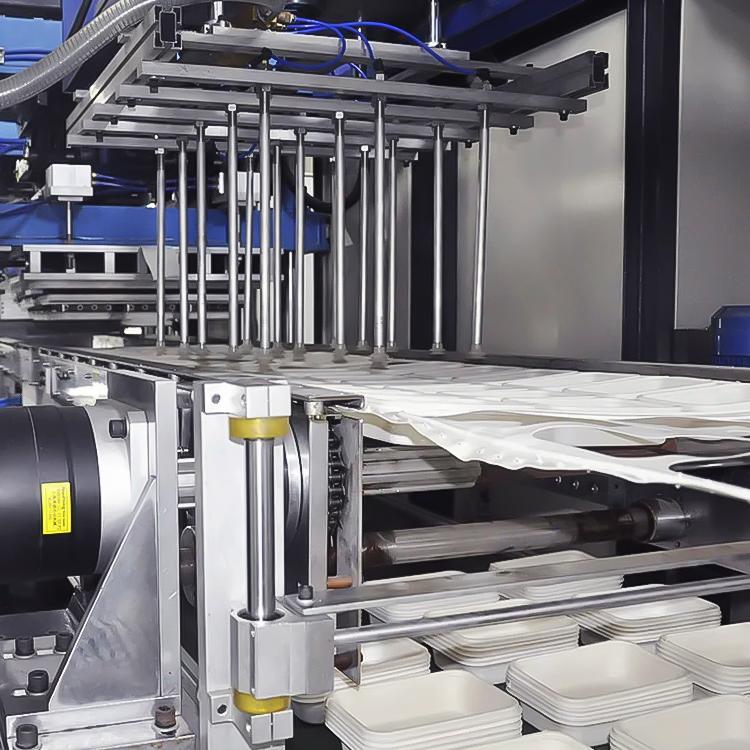
For a single-station process in which each cycle produces a defined number of parts, cycle time can be measured directly using a stopwatch, machine controller, or production monitoring system.
The theoretical hourly output can be estimated using this formula:
Theoretical output per hour = 3,600 seconds / Cycle time in seconds × Parts per cycle
For example, if a thermoforming machine completes one cycle every 30 seconds and produces four parts per cycle:
Theoretical output = 3,600 / 30 × 4 = 480 parts per hour.
This is a theoretical figure. Actual output will usually be lower because of equipment stoppages, quality rejects, material changes, and other production interruptions.
For machines with overlapping operations, cycle time should be measured from the overall machine sequence rather than calculated by simply adding every individual operation time. Otherwise, the estimate may overstate the time required for each cycle.
The type of thermoplastic sheet affects how quickly the material heats, how it responds to forming pressure, and how long it must remain in contact with the mold before it can be released.
Different thermoplastic materials have different forming temperature ranges, heat capacities, thermal conductivity, and cooling behavior. These properties influence the heating and cooling stages of the thermoforming process.
For example, ABS, HIPS, PETG, polycarbonate, polypropylene, and HDPE do not necessarily require the same heating profile or cooling time. Semi-crystalline materials such as polypropylene and HDPE may require particular attention to cooling and dimensional stability because their crystallization behavior affects how they solidify.
Thermal conductivity describes how readily a material transfers heat. In thermoforming, heat transfer within the sheet and between the formed plastic and the mold affects temperature distribution and the time required to reach a suitable forming or release condition.
However, thermal conductivity alone does not determine cycle time. Sheet thickness, heat capacity, forming temperature, mold contact, and cooling conditions must also be considered.
| Material or property | Potential effect on cycle time |
|---|---|
| ABS | Heating and cooling requirements depend on grade, thickness, and part geometry |
| PETG | Requires a suitable temperature profile to achieve forming consistency and surface quality |
| Polycarbonate | Its processing temperature and thickness can increase heating and cooling demands |
| Polypropylene (PP) | Cooling and dimensional stability require attention because of its semi-crystalline structure |
| HDPE | Cooling behavior and shrinkage can affect release timing and dimensional consistency |
| Thermal conductivity | Influences how heat moves through the sheet and mold-contact region |
These are general processing considerations, not a fixed ranking of cycle speeds. Actual results depend on the specific material grade, machine configuration, and product design. Technical guidance from Plastic Components and SIMONA discusses the relationship between polymer properties, tooling, and processing time.
Manufacturers should establish material-specific processing windows and verify them through production trials rather than using one set of temperature settings for every plastic sheet.
Sheet thickness is one of the most direct factors affecting thermoforming machine cycle time. A thicker thermoplastic sheet generally requires more energy and more time for heat to reach the required temperature throughout its cross-section.
The surface of a sheet may reach the target temperature before its core is sufficiently heated. If the sheet is formed too early, the resulting part may show uneven material distribution, poor detail reproduction, excessive thinning, or other defects.
If the sheet is heated longer than necessary, production slows and energy consumption increases. Excessive heating can also cause sagging, discoloration, surface damage, or material degradation, depending on the polymer.
Thin gauge thermoforming is commonly used for products such as packaging trays, disposable food containers, and lightweight covers. Thin plastic sheets generally heat more quickly than thicker sheets, although their cycle times also depend on forming area, production speed, material feeding, and trimming arrangements.
Thicker sheets are often used for industrial enclosures, automotive interior components, equipment housings, and large plastic covers. These products may require longer heating and cooling periods because more material must be brought to the appropriate temperature and stabilized before demolding.
To improve cycle time, manufacturers should consider:
Reducing sheet thickness simply to speed up production is not always appropriate. The finished product must still meet requirements for strength, impact resistance, rigidity, and service life.
The heating stage can account for a substantial proportion of thermoforming cycle time, particularly when processing thick sheets or materials that require high forming temperatures.
Thermoforming machines commonly use radiant heating systems, including ceramic, quartz, halogen, or other infrared heater configurations. The heating method, installed power, heater arrangement, and control system affect how quickly and evenly a thermoplastic sheet reaches its forming temperature.
The objective is not merely to heat the surface as quickly as possible. The sheet must reach a suitable temperature distribution for the intended forming operation.
Uneven heating can produce different levels of material stretch across the mold. Some regions may become too thin, while other areas may fail to reproduce fine details or reach the intended geometry.
Manufacturers can improve heating performance by:
Temperature control should be based on the material manufacturer's recommendations and verified forming trials. A preset heating time is useful for repeatability, but it should not replace an understanding of actual sheet temperature.
For applications involving large sheets or complex shapes, zone-based heating can help compensate for differences in surface area, draw depth, and material distribution. This can reduce the need for unnecessarily long heating cycles while protecting part quality.
The mold determines the final shape of the formed component and influences how quickly heat leaves the plastic after forming.
Mold material, wall thickness, cooling-channel layout, surface finish, venting, and contact between the plastic and mold all affect the forming and cooling stages.
Aluminum molds are frequently used in production thermoforming because aluminum conducts heat relatively well and can support effective mold temperature management. Other tooling materials may be appropriate for prototypes, short production runs, or specific applications.
A mold with effective cooling channels can remove heat more consistently than a poorly cooled mold. If cooling is uneven, some regions of the part may become rigid while other regions remain too soft for safe release.
Mold geometry also affects how easily the part separates from the tool. Deep draws, tight corners, narrow features, and insufficient draft may increase the risk of sticking or deformation during demolding.
Manufacturers should review:
A mold should be designed for the intended production volume and cycle-time target. A tooling arrangement suitable for prototype production may not provide the same cooling performance or durability as a mold designed for continuous production.
Cooling time is often a major constraint on thermoforming production. After the plastic sheet is formed, it must become sufficiently stable to maintain its shape during release and subsequent handling.
The cooling stage is influenced by the material, sheet thickness, mold temperature, cooling-channel design, contact area, and temperature difference between the formed plastic and the mold.
Many production molds use circulating water to control mold temperature. The effectiveness of this system depends on more than the temperature of the incoming water.
Important factors include water flow rate, cooling-channel geometry, channel cleanliness, heat-exchange performance, and the temperature difference between the mold and cooling medium.
If water temperature is too high for the application, heat may be removed too slowly. If the cooling conditions are poorly balanced, the part may develop uneven shrinkage, warping, or dimensional variation.
Manufacturers should therefore monitor both the supply and return water temperatures, check flow consistency, and maintain cooling circuits according to the equipment manufacturer's recommendations.
Hot water is not inherently unsuitable for every thermoforming application. Some processes require controlled mold temperatures rather than the lowest possible temperature. The appropriate water temperature depends on the polymer, mold design, desired surface finish, and dimensional requirements.
Reducing water temperature without considering the full process may not improve results. Excessively cold or uneven mold surfaces can introduce other quality problems, depending on the material and application.
A practical cooling optimization program can include:
The goal is to release parts as soon as they are sufficiently stable, not to remove them before they can maintain their intended dimensions. Guidance from Focus on Energy's plastics-industry best-practice material also identifies cooling efficiency and temperature management as ways to reduce cycle time and energy use.
The thermoforming process selected for a product affects the required forming time, equipment sequence, tooling arrangement, and cooling requirements.
Vacuum forming uses negative pressure to draw a heated thermoplastic sheet against a mold. It is widely used for packaging, trays, covers, and many industrial plastic components.
Cycle time depends on how quickly the sheet reaches its forming temperature, how effectively air is evacuated from the mold, how well the sheet conforms to the tool, and how long the part must cool before release.
Properly designed vacuum channels and a suitable vacuum system can help reduce forming delays and improve detail reproduction.
Pressure forming applies positive air pressure to push the heated sheet against the mold, often producing more detailed surface features than conventional vacuum forming.
The additional pressure can improve mold contact, but overall cycle time still depends on heating, pressure application, cooling, and demolding. The machine must also maintain suitable sealing and pressure conditions throughout the forming stage.
Pressure forming may be selected when surface detail or appearance requirements justify the process, rather than simply to achieve the shortest possible cycle.
Twin sheet forming heats and forms two thermoplastic sheets, then joins them to create a hollow or double-wall component. Typical applications include industrial housings, ducts, tanks, and other large structural plastic parts.
Compared with single-sheet forming, twin sheet forming requires coordination of two sheets, heating profiles, mold movements, alignment, and the joining operation. These additional steps can affect the overall cycle.
Cycle time can be improved by synchronizing sheet heating, preparing both sheets consistently, optimizing mold movement, and reducing unnecessary delays during alignment and joining.
The appropriate forming method should be selected according to part geometry, structural requirements, surface quality, and production volume. A process that takes longer per cycle may still be cost effective if it produces more suitable parts or eliminates separate assembly operations.
Part design has a direct effect on how a thermoplastic sheet stretches during forming and how much cooling is required before demolding.
Deep-draw components, sharp corners, narrow recesses, and complex contours can create uneven material distribution. These features may require careful heating profiles, plug assistance, modified mold geometry, or additional cooling control.
For example, a large, relatively shallow tray may be easier to form and release than a deep enclosure with narrow corners, even if both parts use the same plastic sheet thickness.
Manufacturers should evaluate the following design characteristics:
Designing parts with suitable radii and draft can simplify forming and release. Where product requirements permit, reducing unnecessary geometric complexity may also improve cycle consistency.
However, reducing cycle time must not come at the expense of part quality. A component that releases quickly but has thin corners, distorted surfaces, or inconsistent dimensions may create additional inspection and rework time.
Thermoforming machines differ in heating capacity, forming area, mold movement, cooling systems, feeding arrangements, and automation level. These differences influence the cycle time a machine can achieve with a specific product.
A machine's advertised cycle rate should therefore be treated as a reference under specified operating conditions, not as a guaranteed rate for every application.
Automatic sheet feeding, controlled mold movement, automatic part ejection, and integrated trimming or stacking can reduce delays between operations. Sensors and programmable controllers can also help maintain repeatable heating, forming, and cooling settings.
Semi-automatic machines may be suitable for lower production volumes, frequent product changes, or applications requiring more operator involvement. Fully automatic lines may be more suitable for repetitive, higher-volume production where material feeding and downstream handling can be synchronized.
When comparing thermoforming machines, manufacturers should assess:
| Equipment factor | Effect on cycle time |
|---|---|
| Heater capacity and layout | Influences heating speed and temperature uniformity |
| Forming station design | Affects mold movement, forming time, and repeatability |
| Cooling system | Determines how efficiently parts reach release conditions |
| Sheet feeding system | Influences material loading and indexing delays |
| Mold changeover arrangement | Affects time lost between production runs |
| Automation level | Reduces or coordinates manual handling operations |
| Control system | Helps maintain consistent process settings |
The best machine configuration is one that meets the required output while maintaining stable part quality and reasonable operating costs.
Production volume affects how manufacturers should balance cycle time, equipment investment, tooling costs, and labor requirements.
For high-volume production, small reductions in cycle time can create substantial output gains over thousands of cycles. Manufacturers may benefit from automatic feeding, multi-cavity tooling, integrated trimming, and optimized material handling.
For low-volume production or frequent product changes, setup time and flexibility may matter more than achieving the shortest possible cycle for a single part.
A useful comparison should consider the complete manufacturing cost, not only the time spent forming the part.
For example, a faster machine may require a higher initial investment, more specialized tooling, or additional maintenance. A slower machine with lower setup costs may be more cost effective for short production runs.
Thermoforming and injection molding have different processing methods and equipment requirements. Thermoforming shapes heated plastic sheets, whereas injection molding forces molten plastic into a mold cavity.
Injection molded parts can be produced with short individual molding cycles in suitable high-volume applications, particularly when multi-cavity tooling is used. Thermoforming can be attractive for large parts, relatively low tooling investment, and applications where sheet-based processing suits the product design.
The two processes should not be compared by cycle time alone. A fair comparison includes tooling investment, material use, part geometry, finishing requirements, production volume, and the cost of producing an acceptable finished component.
The right choice depends on the product and its expected lifetime demand.
Improving cycle time requires a controlled approach. Reducing heating or cooling time indiscriminately can cause defects that offset any productivity gains.
A practical optimization process begins by measuring each major stage and identifying the operation that limits output.
Record actual cycle times across multiple production runs. Document the material grade, sheet thickness, mold, heating settings, cooling conditions, and number of parts produced per cycle.
Determine whether heating, cooling, forming, demolding, or material handling is limiting production. For automated equipment, also check whether operations can overlap or whether the entire line is being held up by one station.
Test a controlled adjustment, such as a heater-zone setting, cooling-water flow, mold temperature, or handling sequence. Changing several factors simultaneously can make it difficult to determine which adjustment produced the result.
Check dimensions, surface appearance, wall-thickness distribution, warping, and other relevant acceptance criteria. A shorter cycle should only be retained if the finished parts meet specification.
Repeat the trial across multiple cycles and, where appropriate, different material batches or shifts. Record cycle time, acceptable output, scrap rate, and downtime.
Document approved process parameters and train operators to use them consistently. Continue monitoring production to identify drift or new bottlenecks.
This approach helps manufacturers improve cycle time through evidence-based adjustments rather than relying on machine speed alone.
Thermoforming machine cycle time depends on thermoplastic material properties, sheet thickness, heating efficiency, forming method, mold design, cooling capacity, part geometry, machine configuration, and handling requirements. The longest or most restrictive stage often determines the effective production rate.
Heating and cooling are often the longest stages, particularly for thick plastic sheets and large components. However, the limiting stage varies by material, machine design, tooling, and production setup. Actual process measurements are needed to identify the main constraint.
Thicker sheets generally require more time for heat to penetrate the material and for the formed part to cool sufficiently for release. Thin gauge thermoforming often allows shorter heating and cooling periods, but the actual cycle also depends on the material, forming area, and equipment configuration.
Thermal conductivity describes how readily heat travels through a material. In thermoforming, it influences heat transfer within the plastic sheet and between the formed part and the mold. Its effect on cycle time must be considered alongside heat capacity, sheet thickness, forming temperature, and cooling conditions.
There is no single ideal water temperature for every thermoforming application. The appropriate setting depends on the polymer, mold design, part geometry, required surface finish, and dimensional tolerances. Manufacturers should follow the mold and material specifications and verify the result through production trials.
Not necessarily. Pressure forming uses positive air pressure to improve contact between the heated sheet and mold, while vacuum forming uses negative pressure. Their relative cycle times depend on the equipment, material, part geometry, heating requirements, and cooling process.
Twin sheet forming heats and forms two plastic sheets and joins them to produce a hollow or double-wall component. Coordinating both sheets, mold movements, alignment, and joining can add processing steps. Synchronized heating and efficient tooling can help reduce delays.
Manufacturers can optimize heater zones, improve mold cooling, maintain suitable water flow, refine mold design, automate material handling, and reduce unnecessary setup delays. Any change should be validated against finished-part quality and actual production output.
Cycle time measures the duration of a defined production cycle or operation. Lead time measures the elapsed time between specified starting and ending points, such as order receipt and delivery. Lead time may include material procurement, scheduling, production queues, processing, inspection, and shipping.
No. A faster machine may have higher purchase costs, more complex tooling, or greater operating requirements. Manufacturers should compare acceptable output, tooling investment, labor, energy use, maintenance, scrap, and expected production volume before deciding which equipment offers the best overall value.
For a machine that produces a fixed number of parts per cycle, use:
Theoretical output per hour = 3,600 / Cycle time in seconds × Parts per cycle
For example, a 30-second cycle producing four parts gives a theoretical output of 480 parts per hour. Actual output will depend on downtime, rejects, changeovers, and other production losses.
High production volumes may justify greater automation, multi-cavity molds, and integrated downstream operations. Lower-volume production or frequent product changes may favor flexible equipment and simpler tooling. Machine selection should reflect expected demand and total manufacturing cost rather than cycle time alone.
Thermoforming machine cycle time is shaped by the interaction of material properties, sheet thickness, heating performance, mold design, cooling capacity, forming method, part geometry, and machine automation.
For many applications, improving heat transfer and temperature control offers meaningful opportunities to shorten the production cycle. However, heating and cooling must be optimized together, and the formed part must reach the required quality and dimensional stability before release.
Manufacturers should begin by measuring actual cycle times, identifying the process bottleneck, and testing targeted improvements. By combining suitable equipment, effective cooling, well-designed molds, and consistent process control, they can increase production output while maintaining part quality.
Ultimately, the best cycle time is not simply the shortest achievable time. It is the time that allows the machine to produce acceptable parts reliably, at the required production volume and at a cost that makes the manufacturing process competitive.