Quote now
EN

Medical devices require housings and protective covers that fit accurately, withstand repeated use, and meet the requirements of their intended clinical or laboratory environments. From diagnostic equipment enclosures and monitoring device shells to instrument covers and equipment guards, plastic components must balance dimensional accuracy, durability, cleanability, and manufacturing cost.
Thermoforming machines offer a manufacturing option for producing medical device components from heated thermoplastic sheets. The process can create large, lightweight covers, shaped enclosures, recessed panels, and protective shells with contours suited to specific equipment designs. Depending on the application, manufacturers can use thin-gauge or heavy-gauge thermoforming, followed by trimming, drilling, machining, and assembly.
Choosing the right thermoforming equipment requires more than comparing machine specifications. Material compatibility, medical-grade requirements, dimensional tolerances, mold design, surface finish, production volume, and downstream assembly all influence the final result. Manufacturers must also determine whether thermoforming or an alternative method, such as injection molding, better matches the component geometry and production targets.
This guide explains how thermoforming machines are used for medical device housings and protective covers, how to select suitable materials and equipment, and which design and manufacturing considerations affect product quality and cost effectiveness.
Yes. Thermoforming machines can produce medical device housings, protective covers, equipment enclosures, instrument panels, and other plastic components from compatible thermoplastic sheets. The process heats a sheet, forms it over or into a mold using vacuum, pressure, or mechanical assistance, cools the material, and trims the part to its final dimensions.
Thermoforming is particularly suitable for selected large or contoured components where sheet-based forming, relatively lightweight construction, and design flexibility offer manufacturing advantages. However, the suitability of the process depends on the required tolerances, wall thickness, material properties, surface finish, regulatory requirements, and production volume.
Medical device manufacturers should evaluate the complete manufacturing process, including material traceability, cleaning compatibility, dimensional inspection, secondary operations, and assembly. For smaller components with intricate integrated features or tight dimensional requirements, injection molding or precision machining may be more appropriate.
Thermoforming is a plastic manufacturing process in which a thermoplastic sheet is heated until it becomes formable and then shaped using a mold. Vacuum pressure, compressed air, mechanical plug assistance, or a combination of forming methods can help the sheet reproduce the mold geometry. The formed material is cooled and removed before excess material is trimmed.
In medical equipment manufacturing, thermoforming can produce protective covers, outer enclosures, instrument housings, access panels, equipment shells, and selected internal or external component structures. Depending on the design, a finished housing may require openings, mounting points, ventilation slots, inserts, gaskets, or other features added through secondary operations.
The term medical grade does not refer to one universal plastic formulation. A material's suitability depends on its composition, intended application, contact conditions, cleaning agents, sterilization exposure, temperature range, and relevant regulatory or customer requirements. A thermoformed component is not automatically suitable for patient contact or a sterile environment simply because it is made from plastic.
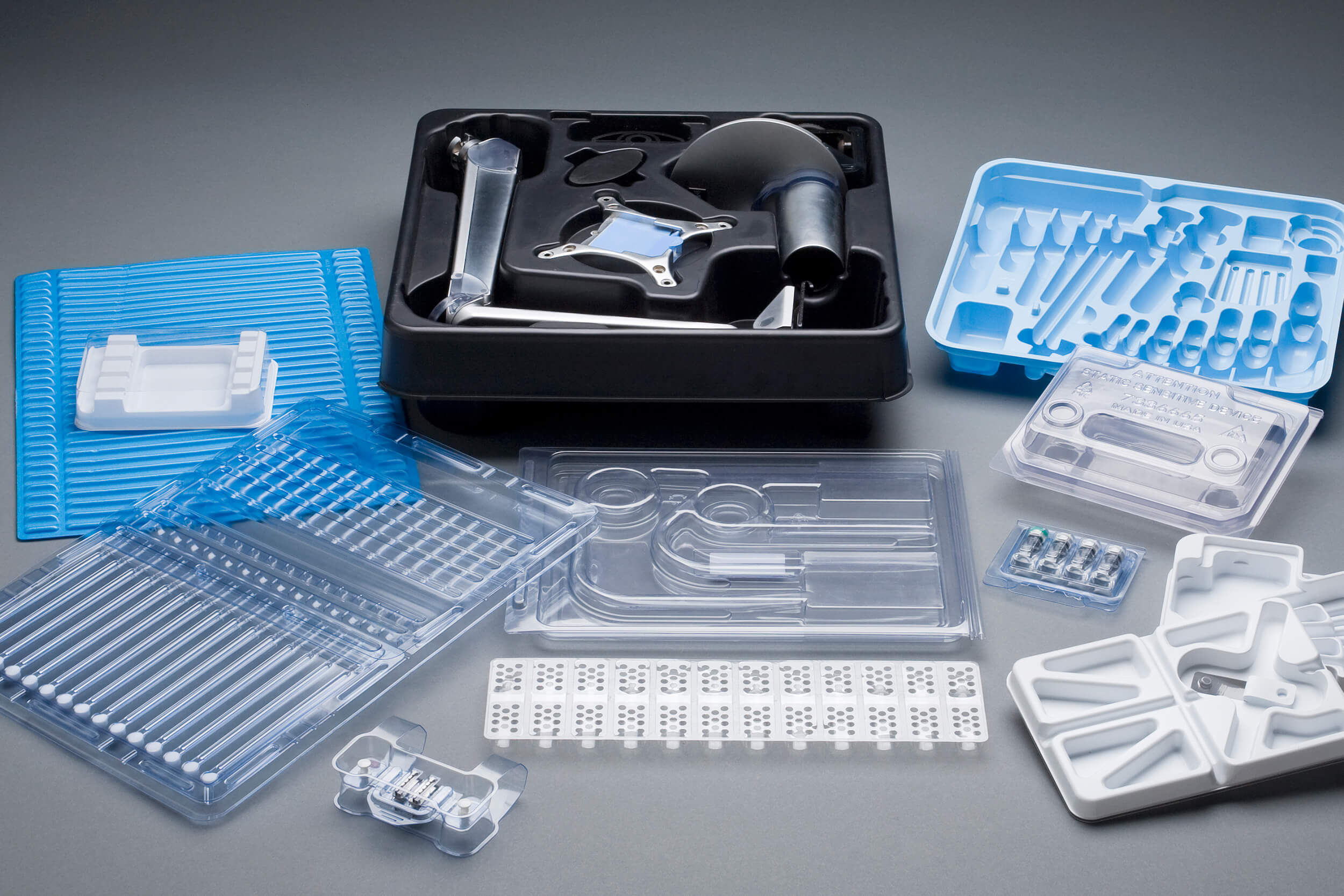
Medical equipment manufacturers often need large or irregularly shaped plastic components that protect internal electronics, mechanical assemblies, and sensitive instruments. Thermoforming can offer a practical way to create these components when the geometry is compatible with sheet forming.
Thermoformed plastic housings can reduce component weight compared with selected metal constructions. Lower weight can make equipment easier to move, install, transport, or reposition within a laboratory or clinical environment.
The final weight depends on the material, sheet thickness, part geometry, reinforcements, and attached hardware. Design engineering teams must ensure that weight reduction does not compromise rigidity, impact resistance, mounting strength, or the protection required for the equipment inside.
Medical equipment comes in many configurations, including benchtop analyzers, diagnostic systems, patient monitoring devices, imaging accessories, laboratory instruments, and mobile equipment carts.
Thermoforming can accommodate broad curved surfaces, recessed panels, sloped walls, and other contours. For suitable designs, changes to the mold may be more practical than redesigning a complex injection mold, although the actual cost and lead time depend on the tooling construction and extent of the change.
Thermoforming also supports prototype development and lower-volume production programs where manufacturers need to validate the appearance, fit, and ergonomics of an enclosure before committing to larger production runs.
Cost effectiveness depends on the relationship between tooling investment, material consumption, production time, labor, and finishing operations.
Thermoforming may offer an economic advantage for large covers and enclosures that do not require intricate integrated features. The process begins with plastic sheet, and the equipment can be configured for different levels of automation according to the production target.
However, trimming waste, secondary machining, assembly, and inspection must be included in the cost calculation. Injection molding may provide a lower unit cost for certain high-volume parts, especially when the design integrates clips, ribs, bosses, and other features directly into the molded component.
Medical equipment manufacturers may offer multiple product configurations with different dimensions, colors, interfaces, and access requirements. Thermoforming can support customized outer shells and protective panels when the parts fit the capabilities of the machine and mold.
The design should account for mounting points, access panels, cable openings, ventilation, and the clearance needed for internal components. If a housing needs complex internal geometry, manufacturers may combine thermoformed covers with injection-molded brackets or machined components.
The process is best suited to components whose shape can be produced from a heated sheet without excessive stretching or inaccessible undercuts.
| Medical equipment application | Potential thermoformed component | Main design consideration |
|---|---|---|
| Diagnostic equipment | Outer covers and enclosure panels | Dimensional fit, access, and protection |
| Laboratory analyzers | Shaped housings and instrument covers | Chemical compatibility and cleanability |
| Patient monitoring equipment | Protective shells and selected panels | Weight, impact resistance, and assembly |
| Medical carts and mobile systems | Large covers and formed panels | Rigidity, abrasion, and mounting strength |
| Imaging equipment accessories | Covers and nonstructural enclosures | Fit, surface finish, and equipment clearance |
| Sterilization or processing equipment | Selected protective covers | Temperature and chemical exposure |
| Medical instrument systems | External shells and access panels | Tolerances, interfaces, and service access |
| Healthcare equipment cabinets | Large formed doors, covers, and panels | Stiffness, appearance, and dimensional stability |
These are potential applications, not a claim that every component in each category should be thermoformed. Parts that carry structural loads, maintain precise mechanical alignment, contact patients, or require specialized sterile barriers may need additional design controls or a different manufacturing method.
Material selection affects formability, stiffness, impact performance, chemical resistance, cleaning compatibility, and long-term dimensional stability. The correct material should be chosen according to the device's intended use rather than appearance alone.
ABS is used in various equipment housings because selected grades offer a combination of rigidity, impact performance, and surface quality. ABS sheets can be thermoformed into suitable covers and enclosure shells.
Manufacturers should check the specific grade's chemical resistance, operating temperature limits, impact performance, and compatibility with disinfectants or cleaning agents. Not all ABS grades perform equally in demanding chemical or thermal environments.
Polycarbonate is often considered when impact resistance and toughness are important. Selected grades can be used for protective covers and housings where the forming process and application requirements are compatible.
Design teams should evaluate chemical compatibility carefully because some cleaning agents, solvents, or environmental conditions can cause stress cracking or other forms of degradation in susceptible grades. Optical clarity, where required, also depends on the material, tooling surface, and processing conditions.
HIPS can be considered for certain equipment covers and enclosure components where its mechanical properties, surface finish, and cost meet the application requirements.
Its suitability depends on the required impact performance, temperature exposure, chemical environment, and service life. It should not be selected for applications that exceed its validated performance limits.
Polypropylene offers low density and resistance to many chemicals. Selected PP sheet grades may be suitable for housings, covers, trays, and other components exposed to compatible cleaning products or laboratory chemicals.
The design should account for stiffness, shrinkage, thermal behavior, and dimensional stability. Material grade and processing conditions influence the final properties.
Depending on the required performance, manufacturers may evaluate other thermoplastics or specialized formulations for demanding thermal, chemical, or mechanical conditions. Their suitability for thermoforming depends on sheet availability, the forming temperature range, the machine's heating capabilities, and the material supplier's processing guidance.
For medical applications, the material's technical data should be supported by documentation relevant to the intended use. A generic resin name alone does not establish medical suitability, biocompatibility, sterilization compatibility, or regulatory compliance.
| Material | Potential advantages | Points to verify |
|---|---|---|
| ABS | Rigidity, impact performance, surface finish | Cleaning chemicals, temperature limits, and grade suitability |
| PC | Toughness and impact resistance | Chemical compatibility, stress cracking, and forming conditions |
| HIPS | Cost-effective option for selected covers | Impact requirements, temperature exposure, and durability |
| PP | Low density and resistance to many chemicals | Stiffness, shrinkage, dimensional stability, and grade |
| Specialized engineering thermoplastics | Potentially higher performance for specific environments | Sheet availability, process window, cost, and application documentation |
Material selection should involve the equipment designer, material supplier, manufacturing team, and quality or regulatory specialists where appropriate. This is especially important when a component is exposed to disinfectants, repeated cleaning, sterilization cycles, or patient-contact conditions.
The appropriate sheet thickness depends on the size of the component, its geometry, stiffness requirements, impact exposure, and mounting arrangement.
Thin-gauge thermoforming is often considered for relatively lightweight covers, panels, and shells where the finished component does not need substantial structural stiffness. It may suit high-volume production when the part geometry and automated handling system are compatible with thin sheets.
Heavy-gauge thermoforming starts with thicker plastic sheet and is commonly used for larger, more rigid covers, housings, equipment panels, and protective enclosures. It can provide a useful balance of part size, surface design, and stiffness for selected applications.
| Factor | Thin-gauge thermoforming | Heavy-gauge thermoforming |
|---|---|---|
| Starting sheet | Relatively thin sheet | Thicker sheet |
| Typical part types | Lightweight covers and panels | Larger or more rigid enclosures |
| Material handling | May support roll-fed or sheet-fed systems, depending on the machine | Often uses individual sheets and heavier handling arrangements |
| Forming considerations | Sheet stability and controlled material distribution | Heating uniformity, deeper forming demands, and cooling |
| Secondary operations | Trimming, cutting, or hole making as required | Trimming, machining, drilling, or reinforcement as required |
| Main cost factors | Cycle time, material use, and finishing | Sheet cost, heating time, tooling, handling, and finishing |
The distinction is based on starting sheet thickness and the machine configuration; there is no single thickness threshold that applies to every manufacturer. Suppliers should confirm the machine's supported material range and effective forming area.
A repeatable manufacturing process requires coordinated control of sheet material, heating, forming, cooling, trimming, and inspection.
The process begins with the component's three-dimensional model, engineering drawing, and performance requirements.
Design engineering should define the envelope dimensions, mounting points, opening locations, surface finish, wall thickness expectations, and interfaces with other components. The team should also consider cleaning access, ventilation, internal clearances, cable routing, and the need to remove covers during service.
If the part is used in a regulated medical device, its intended use and risk-related requirements should be established early. These requirements may influence material selection, documentation, traceability, and inspection plans.
The mold determines the shape and surface reproduction of the formed component. Tooling design must account for draft angles, corner radii, draw depth, sheet stretching, shrinkage, and part release.
Depending on the required finish and production volume, molds may use different materials and construction methods. Vacuum ports, venting, cooling arrangements, and mold mounting must be compatible with the selected machine and forming process.
A prototype mold or trial tool can help reveal problems before production tooling is finalized. This may include excessive stretching, difficult part release, surface defects, or interference with downstream trimming.
Before forming, the thermoplastic sheet should be checked for thickness variation, surface contamination, defects, and correct material identification.
Storage and handling should follow the material supplier's instructions. Where the material has specific moisture-control or environmental requirements, those conditions should be incorporated into the manufacturing procedure.
Consistent incoming sheet quality helps reduce variation during heating and forming.
The sheet is heated until it reaches the forming window recommended for the selected material. Heating may use infrared elements, ceramic heaters, or other systems designed for the machine and sheet type.
Uniform heating helps the sheet stretch consistently as it conforms to the mold. Underheating can cause incomplete forming, poor detail reproduction, or excessive resistance to stretching. Overheating can lead to sagging, thinning, surface defects, or material degradation.
Heating settings should be established through trials that consider sheet thickness, color, material grade, heater configuration, and part geometry.
Once the sheet is sufficiently heated, it is shaped against or into the mold.
Vacuum forming uses reduced pressure to draw the sheet onto the mold surface. Pressure forming applies compressed air to help reproduce the intended shape. Mechanical plug assistance may help distribute material in deeper or more demanding geometries.
The appropriate method depends on surface detail, draw depth, tolerances, material behavior, and production requirements. Not every medical housing needs pressure forming; the process should be selected according to the actual component specification.
The formed part must cool enough to retain its intended shape after removal from the mold.
Insufficient or uneven cooling may cause warping, dimensional changes, or distortion around openings and mounting features. Excessively long cooling can increase cycle time and reduce production capacity.
The cooling strategy should balance dimensional stability with cycle efficiency. For components requiring tight assembly tolerances, measurements should be made after the part has stabilized under defined inspection conditions.
The formed sheet usually contains excess material that must be removed. Trimming establishes the final outline and creates openings, mounting interfaces, and connection edges.
Depending on the part, secondary operations may include drilling, CNC machining, countersinking, adding inserts, bonding, fastening, or installing seals. The trimming method may be manual, fixture-based, or automated.
High-precision interfaces often require dedicated fixtures or CNC-controlled finishing to maintain repeatable dimensions. The finishing method should be chosen according to the tolerance requirements and production volume.
The finished component should be inspected against the approved drawing and quality plan. Checks may include overall dimensions, hole locations, wall thickness, surface finish, color consistency, warpage, and fit with mating parts.
Where required, additional tests may assess impact resistance, chemical compatibility, cleanability, or other performance characteristics. Documentation may include material certificates, batch traceability, inspection records, and process information, depending on the device and customer requirements.
A defined inspection process helps identify variation and supports corrective action when defects occur.
The right machine should match the component design, material, production target, and required quality level. Machine specifications should be assessed against representative parts rather than evaluated in isolation.
The usable forming area must accommodate the sheet dimensions, mold footprint, clamping requirements, and part layout. Large medical equipment covers may require a larger forming area than compact instrument housings.
Buyers should also verify maximum forming depth, mold clearance, loading access, and part removal space. The nominal machine size does not always equal the practical usable area for a specific mold.
The heating system should provide consistent and controllable temperature distribution across the sheet. Independently adjustable heating zones can help match the heating profile to the part geometry.
Control features should support repeatable setup and process monitoring. Manufacturers should also ask how heating settings are stored, how process changes are documented, and what maintenance is required for the heating system.
The required forming method determines whether the machine needs vacuum forming, pressure forming, plug assistance, or a combination of these capabilities.
Equipment specifications should be reviewed alongside mold design and material requirements. A machine with higher pressure or vacuum capacity is not automatically the best option if the part does not need those capabilities.
Thermoforming alone may not provide every required final dimension. If the housing contains precision mounting holes, connector openings, or interfaces with internal assemblies, trimming and machining capabilities should be considered as part of the manufacturing system.
CNC trimming, dedicated fixtures, and inspection equipment can help improve repeatability where required. The actual achievable tolerance must be confirmed through process trials and measurement rather than assumed from the machine type.
Automation options may include sheet loading, mold movement, unloading, trimming, stacking, and inspection transfer. These systems can reduce repetitive handling and support consistent production when matched to the product.
Actual throughput depends on heating, forming, cooling, trimming, inspection, and changeover time. Buyers should request a cycle-time estimate based on the real part and production sequence.
Machine uptime depends on maintenance, operator training, spare parts, and access to technical assistance. These factors should be included in the purchase evaluation.
Before placing an order, manufacturers should provide the supplier with part drawings, material specifications, expected output, dimensional requirements, and finishing needs. Sample production or a forming trial can help verify the proposed configuration.
Thermoforming and injection molding are both used to manufacture plastic components, but they differ in material input, tooling, geometry, and production economics.
Thermoforming starts with plastic sheet and is well suited to many large, contoured covers and shells. Injection molding uses molten resin injected into a closed mold, allowing the production of many complex shapes and integrated features.
| Comparison factor | Thermoforming | Injection molding |
|---|---|---|
| Starting material | Thermoplastic sheet | Plastic resin, typically pellets |
| Typical components | Large covers, shells, panels, and enclosures | Smaller housings, clips, brackets, and complex parts |
| Tooling considerations | Depends on mold material, part size, and forming method | Often requires more complex injection tooling |
| Geometry | Suited to sheet-based shapes and contours | Can support complex integrated features within process limits |
| Wall thickness | Varies with sheet stretching | Controlled through part design and injection processing |
| Secondary operations | Trimming is often needed | Gates or runners may need removal; finishing depends on design |
| Production volume | Suitable for selected low-, medium-, or high-volume applications | Often attractive for large-volume production of repeatable complex parts |
| Cost considerations | Tooling, material utilization, trimming, labor, and cycle time | Tooling investment, cycle time, resin use, and production volume |
Thermoforming may be attractive for a large protective cover that has broad curved surfaces and relatively few integrated features. Injection molding may be preferable for a compact housing requiring integrated snap fits, ribs, bosses, and complex internal structures.
The best choice depends on the complete design and manufacturing process. A reliable cost comparison includes tooling, machine investment, material waste, labor, secondary machining, assembly, inspection, and expected production volume.
Medical equipment housings may be exposed to disinfectants, detergents, laboratory reagents, oils, or other substances during normal use. The selected material must tolerate the chemicals and environmental conditions specified for the application.
Chemical resistance is formulation-specific. Two grades within the same polymer family can respond differently to the same cleaning agent. Stress, temperature, exposure duration, and repeated cleaning can also affect performance.
Manufacturers should obtain compatibility information from the material supplier and validate the finished component under representative conditions. Testing should reflect the actual cleaning procedure, chemical concentration, exposure time, temperature, and expected service life.
Medical-grade requirements also depend on the intended use. An external equipment cover does not necessarily have the same requirements as a component that contacts patients, bodily fluids, medicines, or sterile pathways.
Where applicable, material documentation, traceability, biocompatibility evaluation, sterilization compatibility, and regulatory controls should be addressed through the device manufacturer's quality and regulatory processes. A material label alone does not establish compliance with every medical device requirement.
Cost effectiveness should be evaluated across the full manufacturing process, from sheet purchasing to finished-part inspection.
Part layout and sheet dimensions influence material waste. Nesting multiple parts on a sheet may improve utilization, provided the layout leaves adequate clamping areas and does not compromise forming quality.
Manufacturers should also account for trim scrap, rejected parts, and material handling losses when calculating the true material cost per accepted component.
Early collaboration between design engineering and manufacturing teams can reduce unnecessary complexity. Suitable draft angles, practical corner radii, accessible trimming lines, and well-planned joining interfaces can make forming and finishing easier.
A small design adjustment may reduce excessive stretching, simplify the mold, or eliminate a difficult machining operation. Such changes should be evaluated against the component's functional and regulatory requirements.
Consistent heating, validated forming parameters, suitable mold venting, and controlled cooling can reduce defects. Measuring recurring defects by type helps identify whether the main cause lies in incoming material, forming, trimming, or assembly.
A documented process also helps ensure that successful settings are reproduced after mold changes, maintenance, or material batch changes.
Automation can improve repeatability and reduce handling, but it requires investment and maintenance. Its economic value depends on the production volume, labor requirements, changeover frequency, and cycle-time savings.
For smaller production programs, a semi-automatic machine with well-designed fixtures may provide a better financial fit than a fully automated line. The decision should be based on actual production forecasts and total operating costs.
Uneven wall thickness often results from nonuniform heating, excessive local stretching, or unsuitable mold geometry. Manufacturers can review heater settings, material distribution, draw depth, and the use of plug assistance where appropriate.
Thickness mapping helps identify weak areas and determine whether a process adjustment or design change is needed.
Warping may occur when cooling is uneven, the part is removed before sufficient stabilization, or residual stress causes the shape to change.
Reviewing cooling time, mold temperature, part support, and material behavior can help reduce distortion. Dimensional inspection should use consistent conditioning and measurement procedures.
Surface marks may result from contamination, mold defects, trapped air, or unsuitable forming conditions. Incomplete forming can occur when the sheet is not sufficiently heated or when the mold geometry prevents the material from reaching the required surface.
Maintaining clean tooling, checking material quality, reviewing mold venting, and adjusting the heating profile may improve the result.
Fit problems can result from dimensional variation, trimming errors, shrinkage, or insufficient allowance for assembly interfaces.
Manufacturers should measure critical dimensions, inspect fixtures, and verify the complete assembly. Where tight tolerances are required, CNC trimming and dedicated inspection fixtures may improve repeatability.
Thermoforming can produce selected medical equipment covers, outer housings, instrument panels, protective shells, access panels, and large formed enclosures. Suitability depends on geometry, material, dimensional requirements, and the component's intended use.
Yes, when the selected thermoplastic sheet is appropriate for the application and the forming process preserves the required properties. Medical suitability must be established through material documentation and application-specific evaluation, not simply from the use of a medical-grade label.
Potential materials include selected grades of ABS, polycarbonate, HIPS, polypropylene, and specialized engineering thermoplastics. The best option depends on impact resistance, stiffness, temperature exposure, chemical resistance, cleanability, and cost.
Thermoforming shapes a heated plastic sheet and usually requires trimming. Injection molding injects molten plastic into a closed mold and can produce complex integrated features. Thermoforming may suit large covers and shells, while injection molding may be more suitable for small, intricate, high-volume parts.
Thermoforming can produce components with controlled dimensions, but achievable tolerances depend on material behavior, geometry, mold design, cooling, and finishing. Precision mounting holes and interfaces may require CNC trimming, dedicated fixtures, and dimensional inspection.
Heavy-gauge thermoforming uses thicker thermoplastic sheets to manufacture larger or more rigid components, such as equipment enclosures, protective covers, and formed panels. The suitable sheet thickness depends on part size, stiffness, forming depth, and the intended application.
They should select a suitable material grade, obtain compatibility information from the supplier, and validate the finished component against the actual cleaning agents and exposure conditions. Testing should account for chemical concentration, temperature, exposure duration, and repeated cleaning.
Potentially, but suitability depends on the material, sterilization method, temperature, cycle count, and component function. Compatibility must be demonstrated for the actual sterilization conditions. Not all thermoformed plastics can withstand repeated sterilization.
Machine cost depends on forming area, sheet thickness range, heating system, vacuum or pressure capability, automation, control system, trimming requirements, and production capacity. Tooling, installation, training, maintenance, and downstream finishing should also be considered when calculating total investment.
It may reduce tooling investment for selected designs, support efficient production of large covers, and allow relatively straightforward changes to suitable molds. Actual savings depend on material utilization, cycle time, labor, scrap, trimming, assembly, and production volume.
Common checks include dimensional measurement, wall thickness inspection, surface quality, warpage, mounting-hole position, fit, and assembly verification. Depending on the intended use, chemical compatibility, impact resistance, cleanability, or other application-specific tests may also be required.
They should compare usable forming area, material compatibility, heating uniformity, forming capability, automation, trimming options, service support, and relevant application experience. Providing sample drawings and material specifications enables suppliers to assess the application more accurately. A forming trial can help verify the proposed machine configuration.
Thermoforming machines can manufacture a broad range of medical device housings and protective covers when the component geometry, material, and quality requirements are compatible with sheet-based forming. The process can support lightweight enclosures, large formed panels, customized equipment covers, and selected protective shells for medical and laboratory equipment.
Successful design and manufacturing depend on selecting a suitable thermoplastic, developing an appropriate mold, controlling heating and cooling, planning accurate trimming, and verifying the finished component against its specifications. Medical-grade requirements, chemical resistance, cleanability, traceability, and regulatory considerations should be addressed according to the component's intended use.
When comparing thermoforming with injection molding, manufacturers should consider part complexity, tooling investment, production volume, material utilization, finishing requirements, and total manufacturing cost. A machine evaluation based on representative part drawings, material specifications, and measurable quality targets provides a more reliable basis for equipment selection than machine specifications alone.