Quote now
EN

Thermoforming is a plastic manufacturing process used to produce lightweight, durable, and application-specific plastic parts from heated thermoplastic sheets. It is widely used in packaging, automotive manufacturing, medical equipment, electronics, consumer products, and industrial components. By heating a plastic sheet until it becomes formable and then shaping it over or into a mold, manufacturers can produce components in a wide range of sizes, shapes, and thicknesses.
For manufacturers evaluating different plastic forming methods, thermoforming offers a practical combination of design flexibility, relatively low tooling costs, and efficient production. Depending on the product design and required surface detail, manufacturers can choose vacuum forming, pressure forming, or other thermoforming techniques to meet their production requirements.
Understanding the thermoforming process, available plastic materials, material selection criteria, and industrial applications helps engineers and purchasing teams determine whether this technology is suitable for a particular product.
Thermoforming is a manufacturing process in which a thermoplastic sheet is heated to a suitable forming temperature, shaped against a mold using vacuum, air pressure, or mechanical force, and then cooled before being trimmed into a finished part. Common materials include ABS, PET, HIPS, polycarbonate, polypropylene, and polyvinyl chloride (PVC). Thermoforming is commonly used for packaging trays, automotive interior panels, medical device housings, equipment covers, and other plastic components. It is often cost-effective for prototypes, customized products, and low-to-medium production volumes, although the best process depends on material requirements, part geometry, production volume, and tooling design.
Thermoforming converts a flat thermoplastic sheet into a three-dimensional product using heat and forming force. The sheet is heated until it softens, positioned over or into a mold, and shaped to follow the mold's contours. After cooling, the component is removed and trimmed to its final dimensions.
Unlike injection molding, which forces molten plastic into a closed mold, thermoforming starts with an existing thermoplastic sheet. This affects equipment requirements, mold design, material distribution, production speed, and manufacturing costs.
The process produces simple and complex plastic parts, including shallow trays, large equipment panels, protective covers, packaging inserts, and customized enclosures. Depending on the application, manufacturers may use single-sheet forming, twin-sheet forming, or specialized techniques to achieve the required structural and dimensional characteristics.
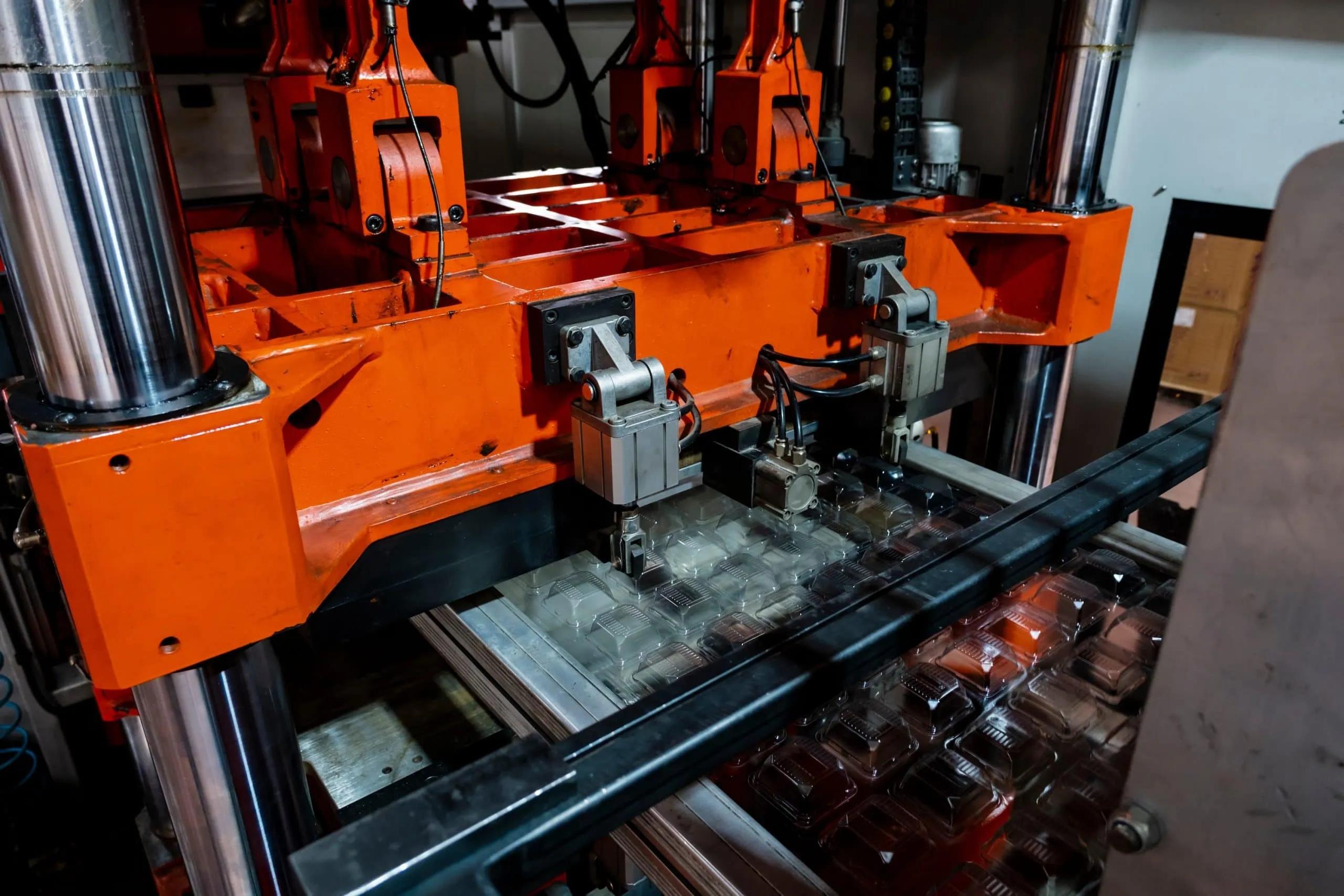
The thermoforming process consists of several stages. Although machine configurations differ, most production lines follow a similar sequence from sheet preparation to final inspection.
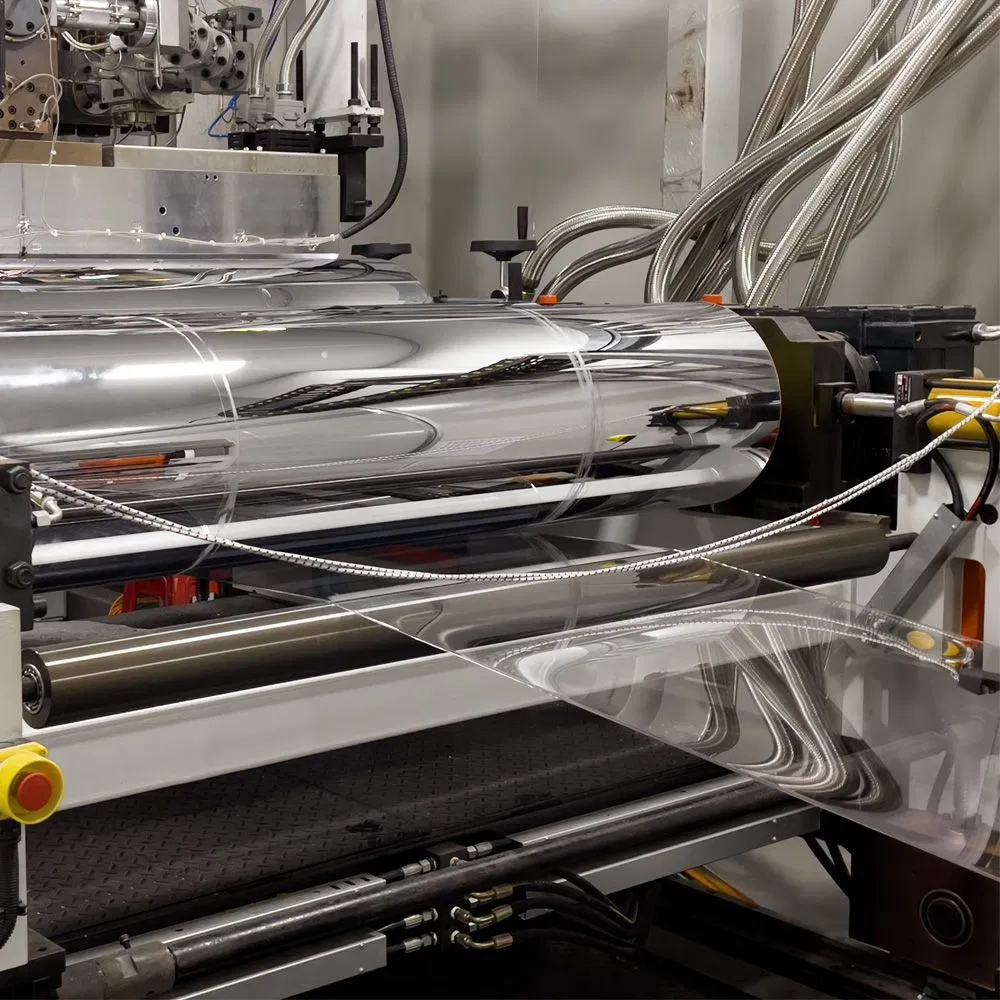
Production begins with a thermoplastic sheet or roll-fed material. The selected sheet must have suitable thickness, dimensions, and material properties for the intended application.
Sheet-fed thermoforming machines are often used for large or thick sheets, while roll-fed systems are common in high-volume packaging production. Before forming, operators may check the sheet for surface defects, thickness variations, contamination, or other issues that could affect the finished part.
The sheet passes into a heating station, where electric or other controlled heating systems raise the material to its forming temperature. Heating must be sufficiently uniform to allow the sheet to stretch across the mold without excessive thinning, tearing, or surface defects.
The correct temperature depends on the plastic material, sheet thickness, heating method, and production speed. Excessive heat can cause sagging, discoloration, degradation, or uneven material distribution, while insufficient heat can result in incomplete forming.
The glass transition temperature, commonly written as glass transition temperature Tg, helps explain the thermal behavior of amorphous plastics. Above Tg, these materials become progressively more flexible as temperature rises. However, Tg is not a universal forming temperature. Semi-crystalline materials such as polypropylene and polyethylene also have melting behavior that must be considered when establishing a suitable processing window.
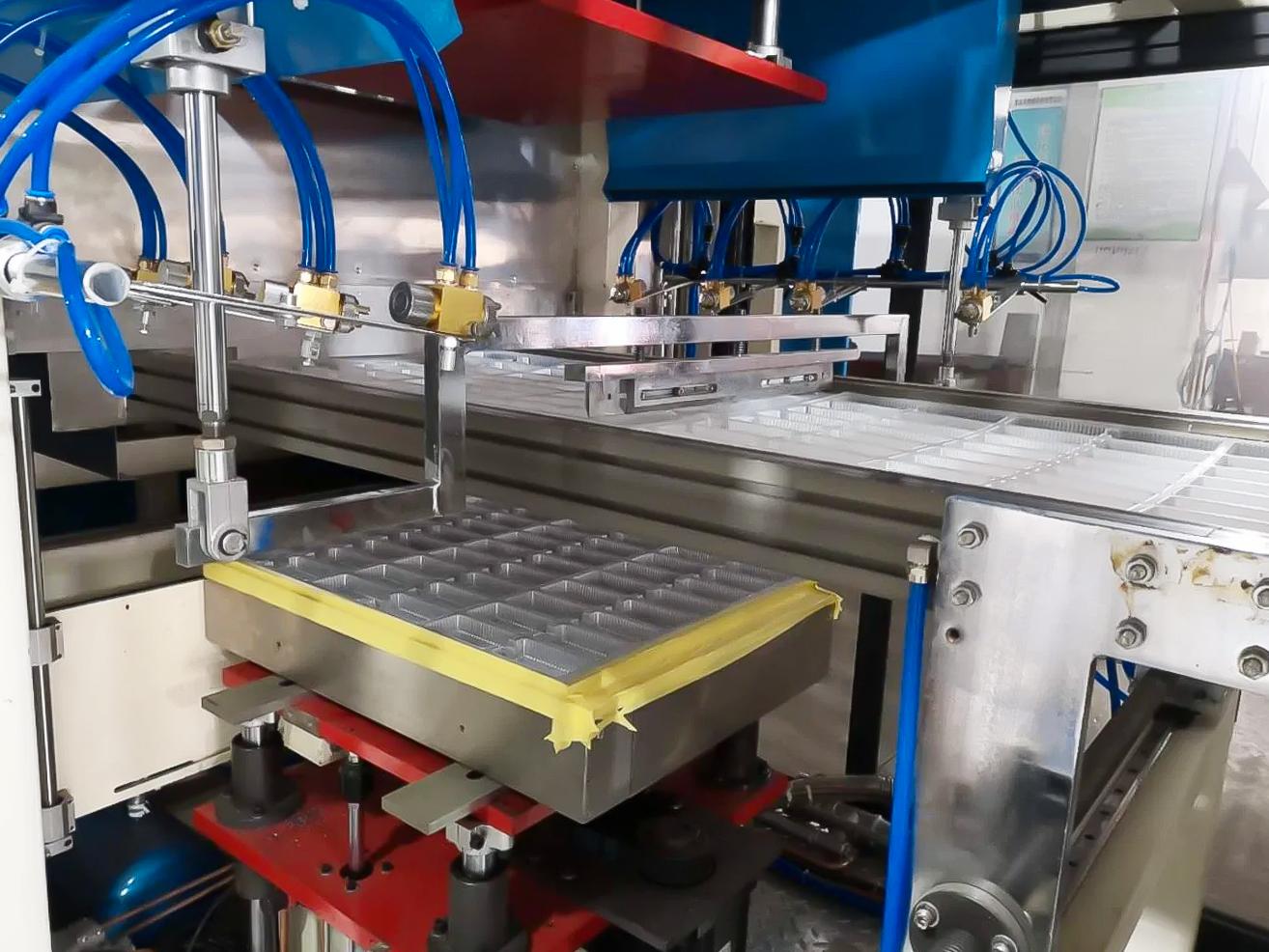
Once the sheet reaches the required temperature, it is transferred or indexed into the forming station. The sheet is positioned against a mold, and vacuum, compressed air, mechanical assistance, or a combination of these methods shapes it into the desired geometry.
The forming method determines how closely the plastic reproduces the mold surface, how much detail can be achieved, and how material thickness is distributed across the part.
After forming, the plastic must cool sufficiently to retain its shape. Cooling can occur through contact with the mold, forced air, or integrated cooling systems.
Temperature control and cooling time affect dimensional stability, surface quality, cycle time, and the risk of warping. Complex parts may require carefully designed cooling arrangements to maintain consistent results throughout production.
Once the formed sheet has cooled, excess material is removed through trimming, routing, die cutting, CNC machining, or other finishing methods.
Depending on the product, secondary operations may include drilling, punching, bonding, assembly, printing, surface treatment, or quality inspection. These operations convert the formed sheet into a finished part that meets the dimensional and functional requirements of the application.
The final inspection process checks dimensions, wall thickness, appearance, surface defects, and other product-specific requirements. For technical components, manufacturers may also evaluate impact resistance, stiffness, chemical compatibility, temperature performance, or other mechanical properties.
Consistent control of heating, forming pressure, cooling, and trimming helps reduce scrap and improve repeatability across production batches.
Different thermoforming methods address different requirements for product geometry, surface detail, material distribution, and production efficiency.
Vacuum forming uses negative pressure to draw a heated plastic sheet against a mold. As air is evacuated from between the sheet and the mold, atmospheric pressure pushes the softened material into the mold's contours.
This method is widely used for packaging inserts, protective covers, equipment housings, display components, and large plastic panels. Its relatively straightforward tooling and process setup make it an attractive option for many applications where moderate detail is sufficient.
Vacuum forming is particularly useful for large parts and designs that do not require the highest level of surface definition. However, the amount of detail that can be reproduced depends on mold design, material temperature, vacuum performance, and part geometry.
Pressure forming combines vacuum with positive air pressure to push the heated plastic sheet more firmly against the mold. This additional force can reproduce finer surface details, sharper features, and more defined textures than conventional vacuum forming.
Pressure forming is often selected for visible plastic parts that need a more refined appearance, such as appliance housings, automotive interior components, instrument panels, and medical equipment enclosures.
Although pressure forming can achieve higher levels of detail, it may require more sophisticated equipment, mold construction, and process control. Its suitability depends on the balance between cosmetic requirements, part complexity, and manufacturing budget.
Twin-sheet thermoforming forms two heated plastic sheets separately and then joins them while the material remains hot enough for bonding. The resulting hollow component can provide greater structural depth and stiffness than a comparable single-sheet part.
Applications include industrial tanks, air ducts, equipment panels, protective structures, and selected large hollow components. The method requires careful control of sheet alignment, heating, forming, and joining conditions.
Mechanical forming uses a plug or other mechanical device to help distribute the heated sheet into the mold. Plug assistance is often combined with vacuum or pressure forming to improve material distribution in deep-draw parts.
This approach can help reduce excessive thinning in selected areas and improve consistency where the product geometry requires significant stretching.
Material selection determines much of a thermoformed component's performance, including impact resistance, stiffness, transparency, chemical resistance, temperature tolerance, and cost.
The range of materials available for thermoforming allows manufacturers to match plastic properties to different industrial environments. However, not every material is suitable for every design or forming machine.
ABS is commonly used for durable plastic housings, automotive interior components, equipment covers, and consumer product enclosures. It offers a useful balance of toughness, rigidity, surface finish, and processability.
ABS is often considered when a part needs good impact resistance and an attractive exterior surface. Its specific performance depends on grade, additives, sheet thickness, and service conditions.
Polyethylene terephthalate (PET) and glycol-modified PET (PETG) are used in packaging, transparent covers, display components, and selected medical or consumer applications.
PET grades can offer useful stiffness and barrier properties, depending on formulation and application. PETG is frequently chosen where transparency, impact performance, and ease of fabrication are desirable.
For food-contact or medical applications, the material grade and finished product must meet the relevant regulatory and performance requirements. The suitability of a material should not be assumed from its generic name alone.
HIPS is widely used for packaging trays, refrigerator liners, appliance interiors, disposable containers, and other cost-sensitive products.
It is generally easy to process and can provide an economical solution for applications with moderate mechanical requirements. Its temperature resistance and chemical performance must be assessed against the intended service environment.
Polycarbonate is known for its impact resistance and transparency. Thermoformed PC sheets can be used for protective covers, machine guards, equipment windows, and specialized industrial components.
The material can be appropriate when a product requires a combination of visibility and toughness. Manufacturers must also consider forming temperature, drying requirements, residual stress, chemical compatibility, and the conditions under which the finished part will operate.
Polypropylene offers low density, chemical resistance, and useful fatigue resistance in suitable grades. It is used for containers, trays, automotive components, and industrial products.
Because polypropylene is semi-crystalline, its heating, cooling, and shrinkage behavior differs from that of amorphous plastics. Process settings and mold design must account for these characteristics to achieve consistent dimensions.
Polyvinyl chloride, commonly known as PVC, is available in rigid and flexible formulations. Rigid PVC may be used for selected enclosures, panels, packaging, and industrial components, while flexible formulations serve different product requirements.
PVC formulation strongly affects flexibility, thermal behavior, chemical resistance, and processing characteristics. Heating conditions must be controlled carefully to avoid material degradation. Manufacturers should also evaluate additives, workplace ventilation, and applicable environmental and regulatory requirements.
Polyethylene is used in selected trays, containers, protective liners, and industrial components. It offers low density and good resistance to many chemicals.
Different PE grades have different stiffness, forming behavior, and temperature performance. Shrinkage and dimensional control should be considered during product development.
Depending on the equipment and application, thermoforming may also use specialty thermoplastics such as ABS/PC blends, acrylic (PMMA), and selected high-temperature engineering polymers.
These materials can address requirements such as optical clarity, weatherability, chemical resistance, or elevated service temperatures. Their processing windows and forming requirements vary, so manufacturers should confirm compatibility with the selected machine and tooling.
Material selection should begin with the conditions the finished part must withstand rather than price alone. Engineers need to consider the product's mechanical loads, operating temperature, chemical exposure, appearance, and expected service life.
Impact resistance matters for protective covers, transport packaging, automotive parts, and industrial housings. A material that performs well in a laboratory test may behave differently when formed into a thin-walled component.
Part geometry, wall thickness, temperature, and stress concentration all affect the performance of the finished product. Material testing should reflect the intended operating conditions wherever possible.
The glass transition temperature Tg helps engineers understand when an amorphous plastic transitions from a relatively rigid glassy state to a more mobile, flexible state.
However, Tg alone does not determine whether a plastic is suitable for thermoforming or for a particular service environment. The forming temperature, heat resistance, creep behavior, and dimensional stability under load must also be evaluated.
For semi-crystalline plastics, melting temperature and crystallization behavior are additional considerations.
Industrial components may come into contact with cleaning agents, oils, solvents, disinfectants, or other chemicals. The selected plastic must be compatible with the actual substances, their concentrations, exposure duration, and operating temperature.
Chemical compatibility charts are useful for preliminary screening, but testing under representative conditions may be necessary for demanding applications.
Transparent parts may require PETG, PC, acrylic, or other optical-grade materials, depending on the application. Exterior housings and visible panels may prioritize color consistency, texture, gloss, or paintability.
The forming process itself can affect appearance. Uneven heating, excessive stretching, surface contact, and residual stress may produce defects even when the starting sheet meets specification.
The cost of a thermoformed product includes more than the price per kilogram of plastic. Sheet utilization, scrap rate, cycle time, trimming, finishing, transportation, and quality control all contribute to the final manufacturing cost.
Material availability and consistency are also important, especially for products that require repeat orders over several years. A suitable alternative material may reduce cost, but it should be validated before replacing an established specification.
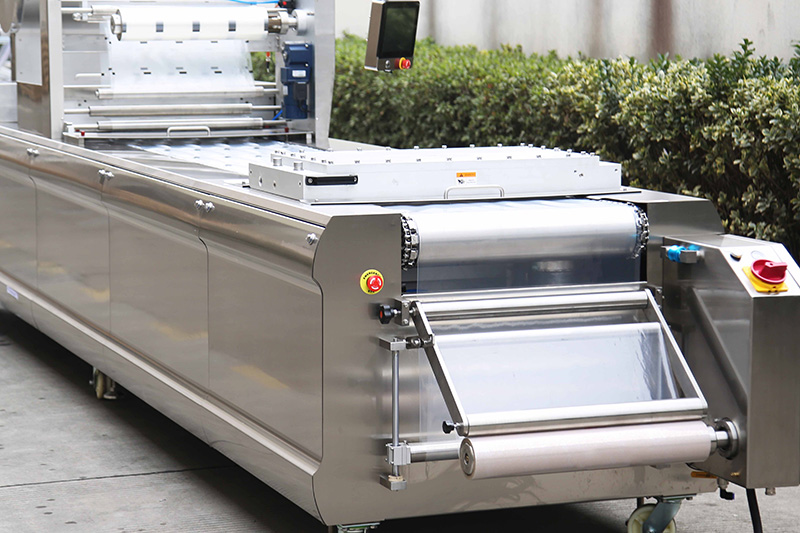
Thermoforming machines control sheet heating, forming, cooling, material handling, and, in many cases, trimming or automated transfer. Equipment selection depends on product size, sheet thickness, forming method, production volume, and the level of automation required.
The heating system raises the sheet to the required forming temperature. Infrared heaters and other controlled heating technologies are commonly used, with heating zones adjusted to account for material behavior and part geometry.
Uniform temperature distribution is particularly important for deep-draw components and products with large surface areas.
The clamping system holds the sheet securely during heating and forming. In roll-fed equipment, feeding and indexing systems move the material through successive stations.
Reliable sheet handling improves positioning accuracy and reduces production interruptions.
Vacuum pumps remove air from the space between the heated sheet and the mold. Pressure-forming systems also use compressed air to apply positive pressure where required.
System capacity, response time, sealing, and mold venting affect forming quality. The appropriate configuration depends on the size and complexity of the part.
Tooling costs are an important consideration when comparing thermoforming with other plastic manufacturing processes. Thermoforming molds can be less expensive than complex injection molds for many applications, especially large parts and lower-volume production.
However, mold costs vary with size, material, surface finish, cooling requirements, tolerances, and expected production life. Some parts also need secondary trimming tools, fixtures, or assembly equipment.
Draft angles, radii, vent locations, draw depth, and material distribution should be considered during mold design. Poor tooling design can lead to thinning, webbing, incomplete forming, and dimensional variation.
Cooling systems help the formed plastic retain its intended geometry. Automated handling, trimming, stacking, and inspection can reduce labor requirements and improve consistency.
For high-volume applications, manufacturers should evaluate the complete production cycle rather than focusing only on the forming station. The balance between cycle time, scrap rate, labor, and equipment utilization determines actual production efficiency.
Thermoforming and injection molding are both widely used plastic manufacturing processes, but they suit different product and production requirements.
| Comparison factor | Thermoforming | Injection molding |
|---|---|---|
| Starting material | Thermoplastic sheet or roll | Plastic pellets or granules, typically melted before injection |
| Typical tooling | Often simpler and less expensive for suitable parts | Can require complex, precision-engineered molds |
| Part size | Well suited to large panels, covers, and trays | Suitable for a broad range of sizes, subject to machine and mold capacity |
| Geometry | Best suited to shapes that can be formed and released from the mold | Can produce complex three-dimensional geometries and detailed features |
| Wall thickness | Varies with stretching during forming | Controlled by mold geometry, flow, and process conditions |
| Production volume | Often attractive for prototypes and low-to-medium volumes; high-volume applications are also common | Often attractive for medium-to-high volumes and repeat production |
| Material utilization | Excess sheet may require trimming and recycling | Runner and gate waste depend on mold design and process |
| Secondary operations | Trimming is often required | Often limited, although finishing and assembly may still be needed |
| Typical products | Trays, large covers, panels, housings, and liners | Connectors, detailed housings, caps, and complex molded components |
Thermoforming can be cost-effective when a product has a relatively large surface area, a simple or moderately complex shape, and production requirements that do not justify a more expensive injection mold.
Injection molding may be preferable when the design contains complex internal features, fine details, integrated mounting features, or geometries that are difficult to produce from a flat sheet.
The right choice depends on the finished part, material, annual volume, tolerance requirements, and total manufacturing cost. Neither method is universally less expensive.
Thermoforming is used across many industries because it can produce both large structural components and lightweight packaging products.
Packaging is one of the most established applications of thermoforming. Products include food trays, lids, blister packs, clamshell containers, protective inserts, and retail packaging.
Roll-fed thermoforming machines can support high production rates when the product design, sheet material, and downstream trimming operations are optimized. Food-contact applications require appropriate material grades and compliance with applicable food-contact regulations.
Automotive manufacturers use thermoformed plastics for interior panels, luggage-area liners, door components, protective covers, and selected exterior or underbody parts.
The technology is particularly useful for relatively large components where weight, surface appearance, and design flexibility matter. Material selection must account for temperature variation, UV exposure, chemical contact, impact requirements, and the vehicle's applicable performance standards.
Thermoforming is used for medical device housings, equipment covers, packaging trays, instrument organizers, and protective enclosures.
The process can support custom geometries and transparent components, depending on the selected material. For sterile barrier packaging, patient-contact parts, or regulated medical products, material suitability, biocompatibility where applicable, cleanliness, traceability, and validated manufacturing conditions must be assessed against the relevant requirements.
Not every thermoformed medical product is sterile or intended for direct patient contact. These distinctions should be established during product design and regulatory planning.
Thermoformed plastics can be used for equipment enclosures, protective covers, display housings, insulation-related components, and packaging for electronic products.
Design considerations may include dimensional stability, electrical properties, flame performance, heat exposure, electromagnetic compatibility requirements, and resistance to cleaning agents. The selected material and finished assembly must meet the product's actual specifications.
Industrial applications include machine guards, control-panel covers, equipment housings, protective liners, ducting, and large access panels.
Thermoforming can be a practical option for parts that need a large formed surface without the expense of highly complex tooling. Depending on the application, the design may require reinforced mounting points, additional supports, inserts, or secondary assembly operations.
Thermoformed plastic components are used in selected agricultural equipment covers, construction panels, protective housings, storage products, and equipment liners.
Outdoor applications require attention to UV resistance, temperature changes, impact performance, moisture exposure, and long-term dimensional stability. The choice of material and any weather-resistant additives should reflect the intended service conditions.
Thermoforming can be cost-effective when the process, material, mold design, and production volume align with the product requirements. Its economic advantages often come from relatively accessible tooling, the ability to form large parts, and the use of established thermoplastic sheet materials.
Several factors determine whether a project will deliver the expected savings.
Tooling investment: Simpler molds can reduce initial development costs compared with more complex tooling processes. However, detailed surface finishes, tight tolerances, or specialized cooling requirements can increase tooling expenses.
Production volume: Low-to-medium volumes may benefit from lower initial tooling investment. High-volume production can also be economical when cycle time, material utilization, and automation are optimized.
Material utilization: Sheet nesting, part layout, draw depth, and trim design affect the amount of material used in each component. Scrap handling and recycling options should be included in cost calculations.
Labor and automation: Automated sheet handling, forming, trimming, and stacking can reduce manual work. The investment is justified when the expected production volume and labor savings support it.
Secondary processing: Trimming, drilling, finishing, assembly, and inspection can add substantial cost. These operations should be included when comparing thermoforming with alternative manufacturing processes.
Quality and scrap rate: Inconsistent heating, poor mold design, or inadequate process control can increase rejects and rework. Stable production conditions improve the cost per acceptable finished part.
A reliable cost comparison should consider total project cost, including tooling, material, machine time, finishing, inspection, packaging, and expected production yield.
Thermoforming defects often arise from the interaction between material properties, heating conditions, mold geometry, and forming parameters.
Excessive stretching can create thin areas in deep-draw sections or around corners. Engineers can address this through improved material distribution, plug assistance, mold redesign, or adjustments to heating and forming conditions.
Webbing occurs when excess material folds or gathers in unwanted areas. It can result from unsuitable sheet temperature, part spacing, draw geometry, or material movement. Mold and part layout adjustments, along with process optimization, can help prevent the defect.
Insufficient vacuum, inadequate pressure, poor mold venting, or incorrect sheet temperature may prevent the plastic from reproducing the mold surface. Checking the vacuum or pressure system and reviewing the heating profile are common troubleshooting steps.
Uneven cooling, residual stress, material shrinkage, and inconsistent forming conditions can cause parts to distort after removal from the mold. Better cooling control, suitable mold design, and consistent process parameters can improve dimensional stability.
Surface defects may result from contamination, overheating, contact with unsuitable surfaces, or material degradation. Correct storage, clean handling, appropriate temperature settings, and regular equipment maintenance help maintain surface quality.
Selecting a manufacturing partner requires more than comparing machine prices or quoted unit costs. Buyers should evaluate whether the supplier can consistently produce the required component and support the project throughout its production life.
Relevant factors include:
Early collaboration between product designers, material suppliers, tooling engineers, and thermoforming specialists can identify manufacturability issues before production tooling is finalized.
Thermoforming continues to develop through improvements in process control, machine automation, heating systems, mold engineering, and material management.
Modern equipment can use zoned heating, programmable recipes, automated handling, and integrated inspection to improve consistency and reduce dependence on manual adjustments. Digital monitoring can help manufacturers identify process variation and investigate recurring defects.
Material development is also expanding the range of potential applications. Recycled-content sheets, recyclable packaging structures, and alternative material formulations are being evaluated for products where environmental impact and end-of-life handling matter.
These developments do not remove the need for application-specific testing. Recycled content can affect material consistency, appearance, and mechanical performance, while multi-layer structures may create additional recycling challenges. Manufacturers should evaluate sustainability claims alongside product performance, regulatory requirements, and the actual recycling infrastructure available.
The most suitable thermoforming solution combines appropriate material selection, sound tooling design, stable process parameters, and a production system matched to the finished part's requirements.
Thermoforming is a process that heats a plastic sheet until it becomes flexible, shapes it over or into a mold, and cools it to create a finished plastic component. Vacuum or air pressure is commonly used to help the sheet follow the mold's shape.
The main steps are sheet loading, heating, forming, cooling, trimming, and quality inspection. Some production lines also include automated material feeding, secondary finishing, assembly, and in-line inspection.
Common thermoforming materials include ABS, PET, PETG, HIPS, polycarbonate, polypropylene, polyethylene, PVC, and acrylic. The appropriate material depends on the required impact resistance, transparency, chemical compatibility, operating temperature, and cost.
Vacuum forming uses negative pressure to pull a heated plastic sheet against a mold. Pressure forming combines vacuum with positive air pressure to improve contact with the mold and reproduce finer surface details. Pressure forming is often chosen for parts with more demanding cosmetic requirements.
Thermoforming can have lower initial tooling costs for many large or relatively simple parts, making it attractive for prototypes and low-to-medium production volumes. Injection molding may offer a lower unit cost for complex parts manufactured in large quantities. The better option depends on tooling, material utilization, cycle time, finishing, and annual demand.
The glass transition temperature Tg is the temperature range in which an amorphous polymer changes from a relatively rigid, glassy state to a more flexible, rubbery state. It helps engineers understand plastic behavior during heating and use, but it is not necessarily the forming temperature. The appropriate processing range depends on the material grade and the forming method.
Yes. Thermoforming can produce curved panels, deep-draw components, textured housings, protective covers, and other three-dimensional shapes. Complexity is limited by material stretching, draft angles, wall-thickness requirements, mold design, and the forming method. Highly intricate internal geometries may be better suited to injection molding.
Thermoformed plastics are used in packaging, automotive manufacturing, medical equipment, electronics, industrial machinery, agriculture, construction, and consumer products. Common applications include trays, enclosures, machine guards, interior panels, protective covers, and equipment housings.
Material grade, sheet thickness, heating uniformity, forming temperature, vacuum or air pressure, mold design, cooling time, and trimming accuracy all affect quality. Stable process settings and suitable tooling help reduce defects such as wrinkles, uneven wall thickness, warping, and incomplete forming.
Thermoforming can be suitable for medical equipment housings, instrument trays, protective enclosures, and certain medical packaging applications. The selected material, production environment, cleanliness controls, and validation requirements must match the intended use and applicable regulations. Sterile packaging and patient-contact products may require additional testing and regulatory controls.
Thermoforming shapes a pre-manufactured thermoplastic sheet using heat and forming force. Injection molding melts plastic feedstock and injects it into a mold cavity. Thermoforming is often attractive for large, sheet-based components, while injection molding supports a broader range of complex geometries and integrated features.
Manufacturers can reduce costs through efficient sheet layout, suitable material selection, optimized heating and cooling, well-designed molds, automated handling, lower scrap rates, and reduced secondary processing. Evaluating total manufacturing cost rather than material price or tooling price alone provides a more realistic comparison.
Thermoforming is an adaptable plastic manufacturing process that transforms heated thermoplastic sheets into components for packaging, transportation, healthcare equipment, electronics, and industrial applications. Its main advantages include design flexibility, the ability to manufacture large parts, and relatively low tooling costs for suitable products.
Choosing the right solution requires an understanding of the thermoforming process, material properties, forming methods, equipment capabilities, and production economics. Factors such as impact resistance, glass transition temperature Tg, chemical compatibility, wall-thickness distribution, and finished-part tolerances should be evaluated early in the design process.
For manufacturers developing new plastic components, working with an experienced thermoforming equipment supplier or production partner can help establish the appropriate forming method, optimize tooling, improve process consistency, and achieve a practical balance between product quality and manufacturing cost.