Quote now
EN

Thin gauge thermoforming machines are designed to heat thin plastic sheets and shape them into lightweight, repeatable products for packaging and other high-volume manufacturing applications. By controlling sheet temperature, forming pressure, mold contact, and cooling, manufacturers can produce consistent parts while managing material use and production cycle times.
For manufacturers choosing between thin gauge thermoforming and heavy gauge thermoforming, the main differences are sheet thickness, finished-part requirements, mold design, and production volume. Thin gauge systems are commonly selected for trays, containers, lids, blister packaging, and other products that require relatively thin walls and efficient output.
Thin gauge thermoforming machines are industrial forming machines that heat thin thermoplastic sheets until they become pliable, then shape them over or into a mold using vacuum forming, pressure forming, or a combination of forming methods. After the plastic cools and retains the required shape, the formed sheet may be trimmed into individual products.
The equipment is widely used when manufacturers need lightweight plastic parts, consistent dimensions, and repeatable production across large batches. Depending on the machine configuration, operations such as sheet feeding, heating, forming, cutting, stacking, and product discharge can be integrated into one production line.
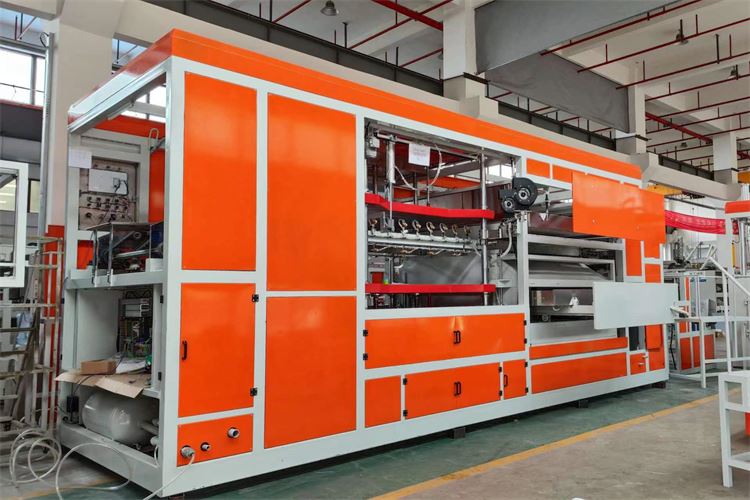
The thermoforming process turns flat plastic sheets into finished shapes through a sequence of controlled operations. The exact setup varies with the material, product design, mold structure, and required output.
The process begins with a roll or pre-cut stack of thermoplastic sheet. Roll-fed systems are common for continuous, high-volume production because they can feed material into the machine at a controlled rate. Sheet dimensions, thickness consistency, and material condition should be checked before forming.
Heating stations raise the sheet temperature until the plastic softens enough to form without tearing or losing the required material properties. Heating needs to be suitable for the selected resin and sheet thickness. Uneven heating can lead to inconsistent wall thickness, poor detail, sagging, or incomplete forming.
Once the sheet reaches the forming temperature, the machine moves it into position over or into the mold. Vacuum forming uses reduced air pressure to draw the softened sheet against the mold surface. Pressure forming uses compressed air pressure to push the plastic against the mold, helping reproduce finer surface details in suitable applications.
Some forming machines combine vacuum and pressure to meet specific product requirements. The appropriate method depends on part geometry, surface finish, material characteristics, and production targets.
The formed part must cool sufficiently to retain its shape after release from the mold. Cooling performance affects dimensional stability, cycle time, and product consistency. The required cooling period depends on the plastic material, wall thickness, mold temperature, and part design.
After forming, excess material is removed to achieve the required product dimensions. Depending on the production line, cutting may take place in-line or at a separate station. Finished products can then be stacked, counted, inspected, or transferred to downstream packaging operations.
Vacuum forming and pressure forming are both used in thin gauge thermoforming. The choice depends on how much detail the product needs and the performance expected from the finished part.
| Comparison | Vacuum Forming | Pressure Forming |
|---|---|---|
| Forming method | Vacuum draws softened plastic against the mold | Compressed air applies pressure to form plastic against the mold |
| Typical use | Products with relatively straightforward shapes | Products requiring finer detail or more defined surface features |
| Product design | Suitable for many trays, containers, covers, and packaging components | Suitable for selected parts with more detailed textures or sharper features |
| Equipment considerations | Requires an appropriate vacuum system and mold design | Requires suitable pressure equipment, sealing, and mold design |
| Selection factors | Material, shape, surface quality, and cycle requirements | Detail requirements, material response, tooling, and cycle requirements |
Pressure formed products may benefit from improved detail reproduction when the material and mold are suitable. However, pressure forming is not automatically the best choice for every product. Manufacturers should compare tooling costs, cycle time, product appearance, and production requirements before choosing a process.
Materials include several thermoplastics that soften when heated and can be shaped into a mold. The right plastic material depends on product function, transparency, stiffness, impact resistance, chemical compatibility, food-contact requirements, and end-use conditions.
| Plastic material | Common characteristics | Typical applications |
|---|---|---|
| PET and PET-based sheet | Good clarity in suitable grades and commonly used for packaging | Food trays, clear containers, lids, and retail packaging |
| PP (polypropylene) | Available in grades with useful chemical resistance and flexibility | Food containers, reusable packaging components, and selected industrial products |
| PVC (polyvinyl chloride) | Available in rigid formulations with different performance properties | Blister packs, display packaging, and selected protective packaging |
| PS (polystyrene) | Easy to process in suitable grades and widely used in packaging | Trays, disposable containers, and blister packaging |
| ABS | Offers impact resistance and stiffness in appropriate grades | Selected housings, covers, and technical components where sheet thickness and machine capability are suitable |
| PE (polyethylene) | Available in flexible and rigid grades, depending on formulation | Selected liners, trays, and industrial formed products |
Not every material is suitable for every thin gauge application. Resin grade, sheet thickness, forming temperature, shrinkage, mold geometry, and trimming method should be evaluated together. Food-contact or medical applications may also require specific material certifications and documented production controls.
Thin gauge thermoforming and heavy gauge thermoforming share the principle of heating and shaping thermoplastic sheets, but they serve different production needs.
| Factor | Thin Gauge Thermoforming | Heavy Gauge Thermoforming |
|---|---|---|
| Sheet format | Often thin sheets supplied from rolls or sheet stock | Generally thicker sheets supplied as cut sheets or other suitable formats |
| Typical products | Trays, lids, containers, blister packaging | Equipment housings, vehicle components, protective covers, and large formed parts |
| Production priorities | High output, repeatability, material use, and efficient trimming | Part size, rigidity, surface quality, and forming depth |
| Feeding system | Roll-fed systems are common in high-volume production | Sheet-loading arrangements depend on sheet size and machine design |
| Forming requirements | Fast, repeatable cycles for lightweight products | Forming capacity suited to thicker materials and larger components |
Thin gauge thermoforming is often suitable for large production runs of lightweight products. Heavy gauge thermoforming is generally selected for thicker parts that need greater rigidity or larger dimensions. The distinction is based on the actual sheet thickness and application rather than a universal thickness threshold, since industry definitions vary.
Thin gauge forming machines serve industries that need lightweight plastic products in repeatable quantities.
Thin gauge thermoforming is commonly used to manufacture food trays, bakery containers, produce packaging, lids, and other formed packaging products. Material selection and production controls must match the intended food-contact requirements.
Suitable machine configurations can produce blister packaging, component trays, and protective packaging for medical or pharmaceutical products. The required material, cleanliness, traceability, and regulatory controls depend on the application.
Blister packs, display packaging, clamshell containers, and product inserts can be formed from suitable thin plastic sheets. Clear materials may be selected where product visibility is required.
Thin gauge thermoforming can produce trays and inserts that organize or protect components during storage and transportation. Product dimensions, load requirements, and handling conditions should guide the mold and material design.
The best machine configuration depends on the product, the material, and the production target. Before selecting equipment, manufacturers should evaluate the following factors.
Confirm the product footprint, forming depth, number of cavities, trimming allowance, and required dimensional tolerances. These details affect mold size, forming area, and the amount of sheet material used per cycle.
Identify the resin grade, sheet thickness range, sheet width, and whether the material will be supplied on rolls or as pre-cut sheets. The heating system and forming station must be suitable for the selected materials.
For high volume manufacturing, evaluate the complete production cycle rather than forming speed alone. Feeding, heating, forming, cooling, trimming, stacking, and material changes all influence actual output. A line with integrated downstream operations may reduce manual handling where the product and factory layout allow it.
Vacuum forming can meet the needs of many common packaging shapes. Pressure forming may be preferred when the product requires more defined surface detail. Mold design and material behavior should be considered before finalizing the forming method.
Depending on production requirements, equipment may include automatic sheet feeding, temperature control, forming controls, cutting stations, stacking, and product transfer. Quality checks can cover dimensions, wall distribution, surface defects, trimming quality, and product consistency.
Confirm the available floor space, electrical supply, compressed-air capacity, vacuum requirements, tooling access, operator training, and maintenance arrangements. Manufacturers should also clarify installation, spare parts, troubleshooting support, and the expected lead time before ordering.
High-volume output depends on the coordination of the entire manufacturing process. Increasing machine speed without controlling heating, forming, cooling, and trimming can lead to more rejects and inconsistent products.
A practical improvement plan starts with stable sheet feeding and uniform heating. The forming station should match the mold geometry and material behavior, while cooling should allow parts to retain their shape before trimming. Tooling maintenance, routine inspection, and consistent operating parameters can reduce unplanned stops.
Material utilization also affects production cost. Mold layout, cavity spacing, web width, trimming design, and the handling of scrap should be reviewed together. Where suitable recycling arrangements exist, clean production scrap may be recovered in accordance with material specifications and applicable requirements.
Manufacturers should measure output using accepted finished parts per hour or per shift, rather than relying only on the machine's nominal cycle rate. This provides a more realistic view of performance across the full production line.
Understanding common defects helps production teams identify the process settings or tooling conditions that need adjustment.
| Problem | Possible causes | Areas to check |
|---|---|---|
| Uneven wall thickness | Uneven heating, excessive stretching, or unsuitable mold geometry | Heater settings, sheet temperature, mold design, and forming sequence |
| Incomplete mold detail | Insufficient forming force, poor venting, or unsuitable material temperature | Vacuum or pressure system, mold vents, and heating profile |
| Wrinkles or folds | Poor sheet positioning, excessive sagging, or unsuitable forming conditions | Sheet tension, heating balance, and forming timing |
| Warping after release | Inadequate cooling or uneven temperature distribution | Cooling time, mold temperature, and part geometry |
| Inconsistent dimensions | Variation in sheet properties, process settings, or trimming | Material consistency, process control, tooling, and cutting station |
Troubleshooting should be carried out systematically. Changing several settings at once makes it harder to identify the source of a defect. Record the material batch, machine settings, mold conditions, and inspection results so that successful adjustments can be repeated.
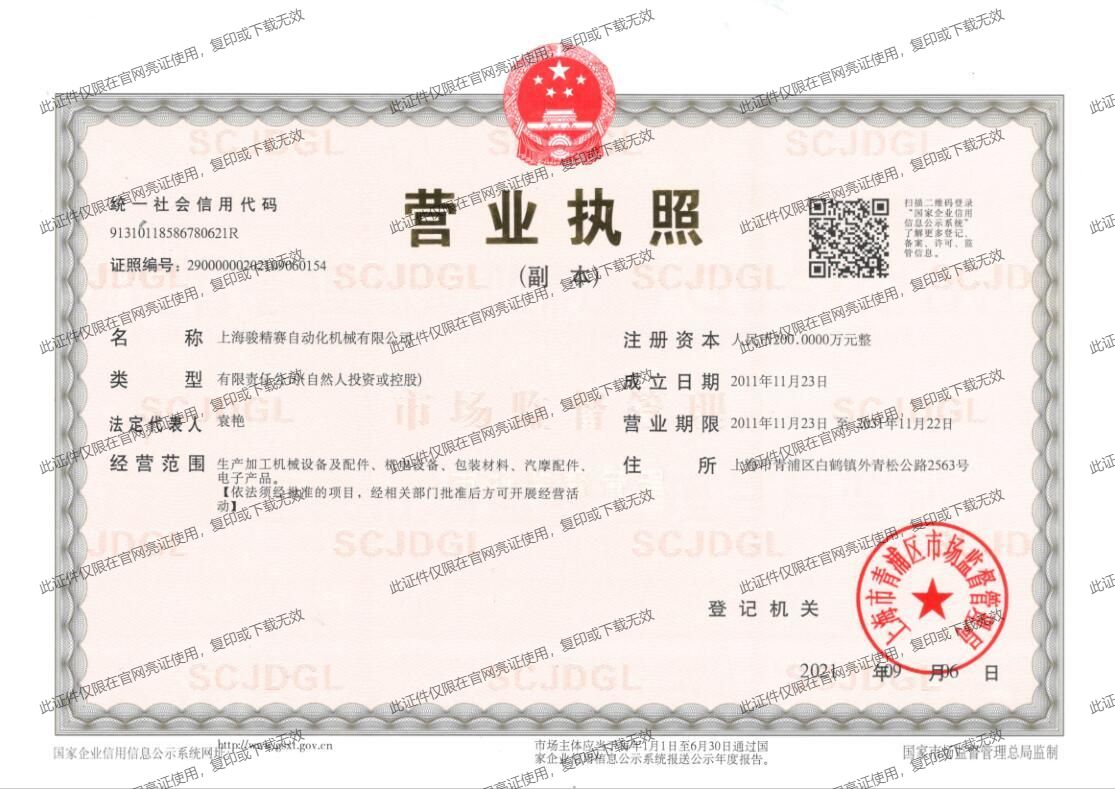
Shanghai Junjingsai Automation Machinery Co., Ltd. develops thermoforming and plastic forming equipment for different manufacturing requirements. For thin gauge applications, machine selection should start with the product drawing, sheet material, required output, mold arrangement, and downstream finishing process.
A suitable configuration may include sheet feeding, heating, vacuum or pressure forming, cooling, cutting, stacking, and material handling. The final equipment design should be confirmed against the actual product, factory conditions, and target production rate.
When requesting a machine proposal, manufacturers should prepare sample parts or drawings, material specifications, sheet thickness and width, expected output, quality requirements, and details of any existing production-line interfaces. This information helps establish whether a standard machine or a customized configuration is the better fit.
A thin gauge thermoforming machine heats thin thermoplastic sheets and shapes them over or into a mold. The process commonly uses vacuum forming, pressure forming, or a combination of methods to manufacture lightweight products such as trays, lids, containers, and blister packaging.
Thin gauge thermoforming is commonly used for lightweight packaging and products made from thin sheets, often in high-volume production. Heavy gauge thermoforming is generally used for thicker, more rigid or larger plastic parts, such as housings and protective covers. The exact distinction depends on the material and application.
Depending on the machine and application, materials may include PET, PP, PVC, PS, and selected PE or other thermoformable plastic sheets. The material grade, sheet thickness, heating requirements, and end-use conditions should be checked before production.
Vacuum forming uses reduced air pressure to draw softened plastic against a mold. Pressure forming uses compressed air to push the sheet against the mold and may reproduce finer details in suitable applications. The choice depends on product geometry, appearance requirements, tooling, and production targets.
Yes. Thin gauge thermoforming machines are widely used for high-volume production, especially when roll feeding, automatic forming, trimming, and stacking can be integrated. Actual output depends on product design, number of mold cavities, material, cycle time, and line efficiency.
Material waste can be reduced by optimizing mold layout and cavity spacing, controlling sheet temperature, using suitable forming parameters, designing efficient trimming patterns, and monitoring rejected parts. Scrap recovery may also be possible when the material is clean and the recycling process meets applicable requirements.
Start with the required product detail, surface finish, material, mold geometry, and output target. Vacuum forming may suit simpler shapes and many packaging applications, while pressure forming may be useful for parts requiring more defined surface features. Sample trials can help confirm the most suitable method.
Many machines can process different thermoplastics within their designed operating range, but changing materials may require adjustments to heating profiles, forming conditions, cooling, and trimming. Confirm the compatible resin types and sheet thickness range with the equipment manufacturer.
Provide product drawings or samples, plastic material and sheet thickness, sheet dimensions, required production volume, mold or cavity requirements, dimensional tolerances, trimming and stacking needs, factory utilities, and any automation or line-integration requirements. These details help the manufacturer recommend an appropriate configuration.
Thin gauge thermoforming machines provide an effective way to manufacture lightweight plastic packaging and formed components at scale. The right equipment depends on material properties, sheet dimensions, product geometry, forming method, automation needs, and expected production volume. Evaluating the complete manufacturing process—from sheet feeding and heating to forming, cooling, trimming, and inspection—helps manufacturers select a machine that fits their production goals.