Quote now
EN

Junjingsai manufactures vacuum forming machines for processing thermoplastic sheets into components with specific shapes, dimensions, and surface characteristics. Its product range includes automatic vacuum forming machines, heavy-gauge vacuum forming machines, oven-type forming equipment, positive and negative pressure forming systems, and customized plastic forming automation.
Whether you need a vacuum forming machine for automotive interior components, industrial housings, plastic packaging, or large-format formed parts, Junjingsai can evaluate your product design, plastic material, sheet thickness, forming area, and production targets to recommend a suitable machine configuration.
A vacuum forming machine is a type of plastic forming equipment that heats a thermoplastic sheet until it becomes pliable, positions the softened sheet over or against a mold, and uses vacuum pressure to draw the material into the required shape. After cooling, the formed component is removed and may undergo trimming or other finishing operations.
Vacuum forming machines are used to manufacture automotive parts, protective covers, appliance housings, plastic trays, luggage shells, industrial components, and other shaped plastic products. The appropriate machine depends on the material, sheet thickness, product dimensions, forming depth, mold design, and required production output.
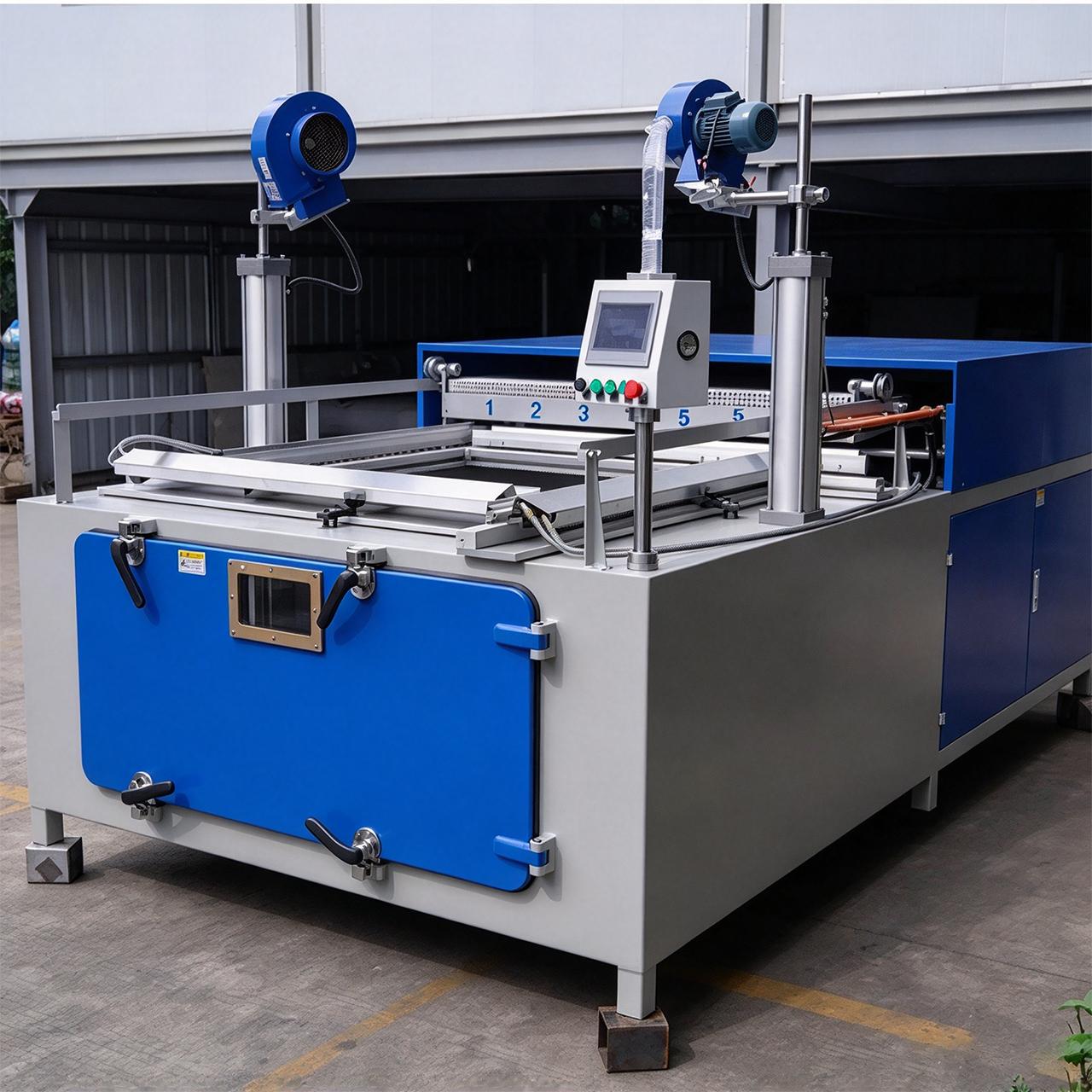
Different products require different forming methods, machine structures, and levels of automation. Junjingsai provides vacuum forming equipment for applications ranging from small plastic components to large, deep-drawn parts.
An automatic vacuum forming machine integrates selected operations to reduce manual handling and improve production consistency. Depending on the configuration, the system may include automatic sheet feeding, heating, forming, cooling, unloading, and integration with downstream cutting equipment.
Automatic equipment is suitable for manufacturers with repeatable production requirements and defined output targets. The appropriate automation level depends on product geometry, cycle time, material handling, mold configuration, and the surrounding production line.
For high-volume production, buyers should assess the complete process rather than machine speed alone. Heating time, forming time, cooling, unloading, and trimming can all affect the output of finished products.
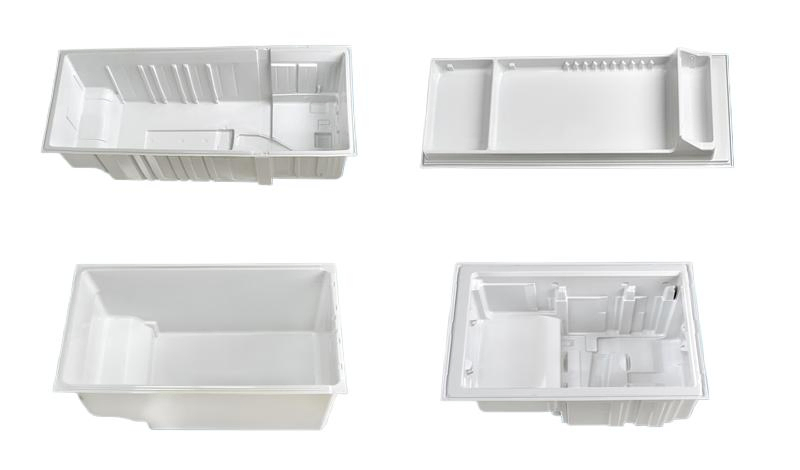
A heavy-gauge vacuum forming machine processes thicker thermoplastic sheets to produce rigid, durable, or large-format components. Typical applications include automotive interior and exterior parts, fender liners, floor mats, luggage shells, refrigerator liners, equipment housings, and industrial protective covers.
Thicker sheets generally require careful control of heating uniformity, forming temperature, mold contact, cooling, and material distribution. Machine selection should also account for the product's maximum dimensions, forming depth, mold weight, and handling requirements.
For large components, automatic loading and unloading can help reduce manual work and improve production flow. The final configuration should be selected according to the product and expected operating conditions.
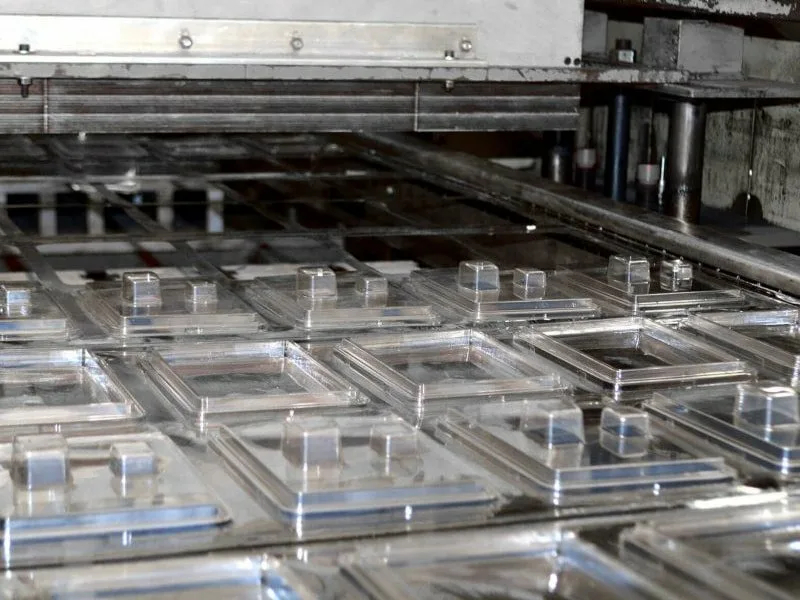
Thin-gauge vacuum forming machines are used to process relatively thin plastic sheets into lightweight products and packaging components. Depending on the material and tooling, applications can include plastic trays, blister packaging, disposable containers, and selected protective packaging products.
Sheet feeding, heating control, mold layout, forming accuracy, and trimming arrangements influence the quality and consistency of the finished parts. For packaging applications, manufacturers should also consider the number of cavities per cycle, material utilization, cutting requirements, and stacking arrangements.
An oven-type vacuum forming machine uses a heating oven to soften the plastic sheet before it is positioned for forming. This arrangement can accommodate different sheet sizes and product geometries, depending on the machine's structure and mold configuration.
Oven-type equipment is suitable for a range of industrial and custom forming applications. Semi-automatic and fully automatic options can be evaluated according to production volume, operator requirements, and material handling needs.
Single-station machines perform forming operations within one primary working station. They may suit production environments where flexibility, product variety, or a relatively simple process is preferred.
Multi-station systems separate selected operations into different stations, potentially allowing heating, forming, and other production steps to be coordinated more efficiently. Their suitability depends on the product, tooling, cycle time, and required level of automation.
When comparing these configurations, evaluate the complete production cycle, changeover requirements, mold arrangement, factory space, and maintenance access.
Servo-driven vacuum forming machines use servo technology for selected machine movements or positioning functions. Depending on the system design, servo control can support repeatable positioning, adjustable movement profiles, and coordinated automated operations.
The practical benefits depend on which functions are servo-controlled and how the machine is configured. Buyers should compare positioning requirements, control functions, maintenance needs, and expected production conditions when evaluating this option.
Some plastic forming applications require more than vacuum pressure alone. Positive-pressure forming applies compressed air to help push the softened sheet against the mold, while combined positive and negative pressure systems use both pressure methods.
These systems may be suitable for products that require more detailed surface definition or different material distribution characteristics. The choice depends on mold geometry, sheet material, forming depth, surface requirements, and dimensional tolerances.
Junjingsai offers positive and negative pressure forming equipment alongside its vacuum forming solutions, allowing machine configurations to be evaluated against different production requirements.
A vacuum forming process typically consists of several stages. The exact sequence depends on the machine configuration, material, mold, and finished product.
A thermoplastic sheet is placed into the machine's clamping or feeding system. The sheet dimensions, thickness, and positioning must be compatible with the machine and mold.
Automatic loading can be incorporated when the production process requires more consistent material handling or reduced manual intervention.
The sheet passes through a heating stage until it reaches a suitable forming temperature. Heating must be controlled according to the plastic type, sheet thickness, and material characteristics.
Uneven heating can lead to inconsistent stretching, surface defects, or variations in wall thickness. The heating arrangement should therefore be matched to the material and product geometry.
The softened sheet is brought into position over or against the mold. A vacuum system removes air between the sheet and mold surface, allowing the plastic to conform to the mold's contours.
For deep-drawn or complex products, the process may require specialized mold geometry or mechanical assistance. Plug assist can be considered when pre-stretching the material helps improve distribution in selected areas.
After forming, the plastic must cool sufficiently to retain the intended shape. Cooling conditions depend on the material, part thickness, mold design, and production cycle.
Insufficient or uneven cooling can contribute to warping, dimensional variation, or difficulties during demolding.
The formed component is removed from the mold. Excess sheet material is then trimmed when required, using a suitable cutting tool, trimming station, or separate cutting machine.
For automated production, unloading and trimming can be integrated into the wider manufacturing process. The final setup depends on the product's edge requirements, dimensional tolerances, and production volume.
A vacuum forming machine must be compatible with the plastic sheet used in production. Different polymers respond differently to heating, stretching, cooling, and mold contact.
Junjingsai's stated processing range includes ABS, PP, PET, PVC, PE, and engineering plastic sheets. Actual compatibility depends on the material grade, sheet thickness, machine design, and required forming conditions.
| Plastic material | General characteristics | Potential applications |
|---|---|---|
| ABS | Impact resistance and good surface-finish options | Automotive components, appliance housings, protective covers |
| PP | Low density and chemical resistance | Selected trays, packaging, industrial components |
| PET | Packaging versatility and transparency in suitable grades | Packaging trays, blister packaging, selected containers |
| PVC | Available in rigid and flexible formulations | Selected packaging and industrial products |
| PE | Toughness and chemical resistance, depending on grade | Industrial trays, protective components |
| Engineering plastics | Properties vary by polymer and grade | Specialized industrial and technical components |
This table provides general application guidance rather than a guarantee that every grade can be processed on every machine. Material selection should account for forming temperature, thickness, shrinkage, stiffness, surface finish, and the intended use of the finished product.
For projects involving unfamiliar materials, providing samples or technical datasheets allows the manufacturer to assess the required heating and forming configuration.
Vacuum forming is used across industries that require shaped plastic components, lightweight structures, protective housings, and packaging products.
Automotive manufacturers use vacuum forming to produce selected interior and exterior plastic components, including door panels, instrument panel parts, trunk components, floor mats, fender liners, air-duct parts, and decorative trim.
Large automotive components may require heavy-gauge processing, large molds, controlled heating, and automated material handling. Product drawings and dimensional specifications help determine the suitable forming area and machine structure.
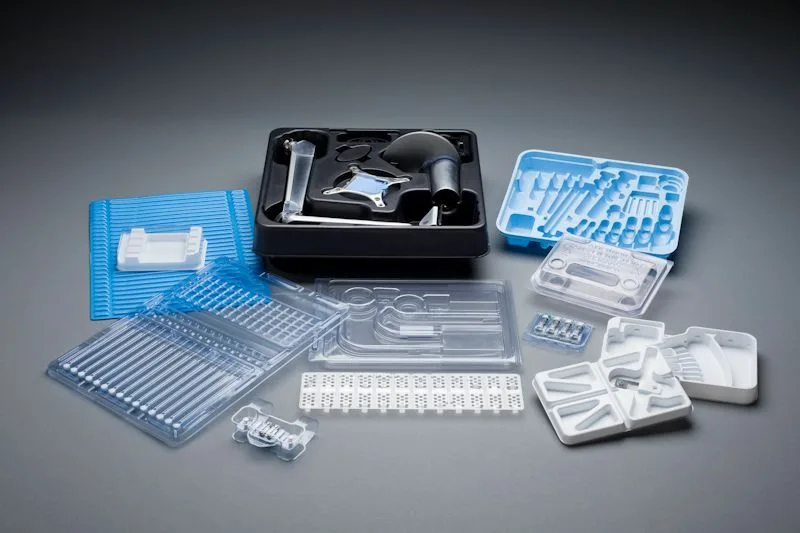
Vacuum forming equipment can manufacture trays, blister packaging, protective inserts, and other formed plastic packaging products, depending on the sheet material and tooling.
For packaging production, buyers should consider sheet thickness, cavity layout, mold design, cutting requirements, material utilization, and output per cycle. Food-contact or pharmaceutical packaging may also require additional material, cleanliness, and regulatory assessments beyond machine selection.
Selected medical equipment housings, protective covers, device holders, and packaging components can be manufactured using vacuum forming technology.
The machine configuration depends on the component's geometry, material, tolerance requirements, and intended use. For medical applications, buyers should also evaluate cleanliness, material qualification, traceability, process validation, and applicable regulatory requirements.
The ability to form a medical-related component does not, by itself, establish compliance with medical-device or sterile-packaging standards.
Vacuum forming can produce refrigerator liners, appliance housings, luggage shells, storage components, decorative parts, and other consumer products.
These applications may require customized mold structures, different sheet thicknesses, specific surface finishes, or larger forming dimensions. Machine selection should reflect the actual product design and expected production volume.
Industrial applications include equipment covers, protective shells, machine housings, formed trays, and custom plastic components.
The required machine depends on the component's size, mechanical requirements, operating environment, and material. For unusually shaped products, prototype trials can help evaluate mold design and material behavior before full-scale production.
Selecting a suitable vacuum forming machine begins with the product and its manufacturing requirements. A machine that works well for thin packaging sheets may not be appropriate for a large, thick automotive component.
Define the finished part's length, width, height, forming depth, wall-thickness requirements, and dimensional tolerances. These details help determine the mold dimensions, machine opening, and required forming area.
Deep-drawn parts may need more attention to material stretching and distribution than shallow products. The mold design and forming method should be evaluated together.
Identify the exact plastic material, grade, thickness, and sheet dimensions. If the machine must process several materials, provide the complete range so the manufacturer can assess the heating and forming requirements.
Material behavior can affect cycle time, cooling, shrinkage, and the quality of the final part. Testing the intended material is preferable when the application has demanding specifications.
The forming area determines the usable space for the mold and the arrangement of products within a cycle. It should accommodate the part dimensions, clamping requirements, sheet movement, and necessary spacing.
For multi-cavity applications, evaluate how many products can fit within the forming area while maintaining suitable spacing and material distribution. A larger forming area does not automatically mean greater production output.
Estimate the required daily or annual output and consider how many operating hours are available. The total cycle includes heating, forming, cooling, demolding, and any downstream cutting or handling operations.
When comparing machines, ask how the quoted cycle time was measured and whether it reflects the actual material, mold, and finished product.
Determine whether the process requires manual loading, automatic feeding, unloading, integrated trimming, or connection to other production equipment.
Automation can reduce manual handling and improve process repeatability, but its value depends on production volume, product consistency, staffing, and the complexity of the manufacturing process.
The mold affects product geometry, surface finish, material distribution, and demolding. Mold materials, venting, cooling, surface treatment, and maintenance requirements should be considered alongside the machine.
For demanding products, request a technical review or forming trial to assess whether the proposed configuration can achieve the required results.
Check the available factory space, power supply, compressed-air requirements where applicable, installation conditions, and operator training needs. Also confirm spare-parts availability, warranty coverage, maintenance procedures, and remote or on-site support.
These details help buyers estimate the practical requirements of operating the equipment over its service life.
Standard equipment may not meet every product's dimensions, forming depth, material requirements, or automation needs. Shanghai Junjingsai Automation Machinery Co., Ltd. offers OEM and ODM services for customers requiring customized vacuum forming machines and non-standard plastic forming equipment.
Customization can be assessed using product drawings, physical samples, material specifications, production targets, and factory conditions.
Depending on the project, the proposed solution may address:
Junjingsai's equipment portfolio includes vacuum forming machines, heavy-gauge and thin-gauge forming machines, oven-type systems, positive and negative pressure forming equipment, and customized automation solutions.
For a project-specific assessment, provide the intended product, plastic material, sheet thickness, maximum dimensions, target output, and any special surface or dimensional requirements. This information helps the engineering team evaluate a suitable configuration.
Founded in 2002, Shanghai Junjingsai Automation Machinery Co., Ltd. has more than 20 years of manufacturing experience in plastic forming machinery and automation equipment. Its product range supports applications in automotive manufacturing, packaging, medical equipment, consumer products, and industrial production.
Junjingsai operates facilities in Shanghai, Chongqing, Jiangsu, and Guangdong, with a combined production area of approximately 29,000 square meters.
Its manufacturing resources support component machining, sheet-metal fabrication, mechanical assembly, electrical installation, machine debugging, and performance testing.
The Thermoforming Machine Division has more than 150 employees, including 30 R&D engineers. The company's stated annual production capacity exceeds 500 thermoforming machines and automation systems.
Its manufacturing equipment includes CNC machining centers, laser cutting machines, sheet-metal bending equipment, assembly production lines, and machine-testing systems.
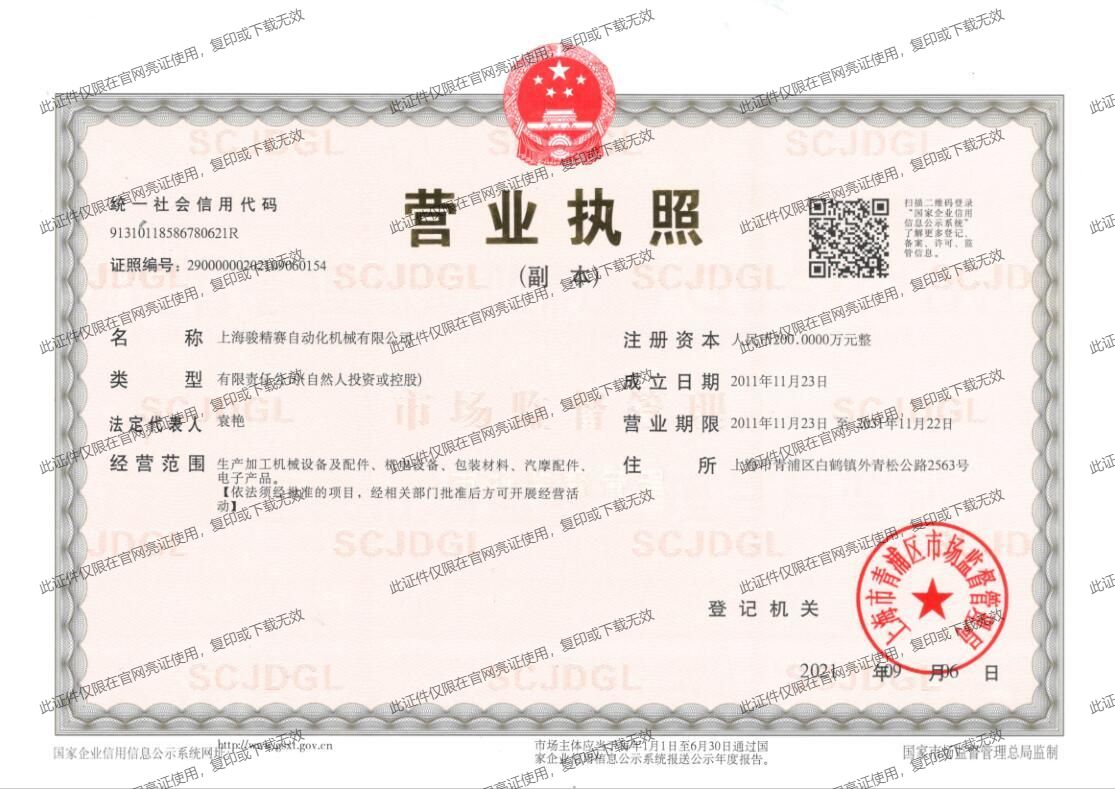
Junjingsai reports 25 patents, ISO 9001 quality management system certification, CE certification, and 3A Credit Certification.
Its stated quality-control process covers incoming materials, component processing, mechanical assembly, electrical testing, machine debugging, and final factory acceptance testing. Certificate scope and validity should be confirmed for the specific machine and intended market.
Junjingsai reports exporting equipment to more than 35 countries and regions and supplying equipment for customers including Volkswagen, BYD, Yanfeng, Faurecia, WEGO, and Chen Guang.
These customer relationships span automotive, medical equipment, packaging, and consumer product applications. Specific references and project details can be discussed where relevant to a buyer's requirements.
Junjingsai offers OEM and ODM customization for different product designs and production environments. Its stated support services include a one-year warranty, remote technical assistance, on-site installation, operator training, spare parts supply, and production support.
The company also states a standard production lead time of approximately 30 days and a minimum order quantity of one machine. Actual delivery schedules and warranty terms depend on the machine configuration, customization requirements, and order agreement.
A vacuum forming machine heats a thermoplastic sheet and uses vacuum pressure to shape it against a mold. It is used to manufacture automotive components, appliance housings, protective covers, luggage shells, plastic trays, blister packaging, and various industrial plastic products.
Thermoforming is the general process of heating and shaping thermoplastic sheets. Vacuum forming is one type of thermoforming that uses negative pressure to draw the softened sheet against a mold. Other thermoforming processes may use positive pressure, plug assist, or combined pressure systems.
Depending on the machine design and forming conditions, vacuum forming equipment can process ABS, PP, PET, PVC, PE, and selected engineering plastic sheets. Compatibility depends on the material grade, sheet thickness, heating requirements, mold design, and intended product.
Start with the product dimensions, forming depth, plastic material, sheet thickness, forming area, required output, and dimensional tolerances. Then evaluate heating performance, vacuum capacity, mold configuration, automation requirements, downstream cutting, installation conditions, and technical support.
Yes. Heavy-gauge and large-format vacuum forming machines can produce selected automotive components, equipment covers, luggage shells, appliance liners, and other large plastic parts. The suitable machine depends on the maximum product dimensions, sheet thickness, forming depth, mold size, and material-handling requirements.
A heavy-gauge vacuum forming machine is generally considered when processing thicker sheets for rigid or large components. Typical applications include automotive parts, industrial housings, protective covers, and large consumer product shells. The required sheet thickness and machine capacity should be confirmed against the actual product specification.
Yes. Junjingsai provides OEM and ODM customization for customers with specific product, material, mold, forming, or automation requirements. Customers can submit drawings, product samples, sheet specifications, target output, and factory requirements for technical evaluation.
Provide product drawings or samples, plastic type and grade, sheet thickness, maximum product dimensions, forming depth, expected production output, and automation requirements. Factory power supply, available space, and any applicable quality or regulatory requirements should also be included.
Junjingsai states a standard production lead time of approximately 30 days. The actual schedule depends on the machine model, customization scope, mold requirements, component availability, and order confirmation. Buyers should request a project-specific delivery schedule before placing an order.
Evaluate the machine's construction, heating control, vacuum performance, forming repeatability, safety features, maintainability, and compatibility with the intended material and mold. Ask for relevant technical specifications, factory acceptance test procedures, sample parts, and confirmation of the performance requirements agreed for the project.
Looking for a vacuum forming machine manufacturer for automotive parts, plastic packaging, appliance components, or customized industrial products?
Shanghai Junjingsai Automation Machinery Co., Ltd. provides vacuum forming machines, thermoforming equipment, and customized plastic forming automation for different materials, product designs, and production requirements.
Send your product drawings or samples, material specifications, sheet thickness, forming dimensions, and target production output to request a technical assessment. The Junjingsai team can help evaluate the suitable machine configuration, discuss customization options, and clarify delivery and after-sales support.
Contact the team to discuss your vacuum forming project and request a machine proposal.